
Quick answer
Okonomiyaki is not one fixed Japanese pancake recipe. The clearest starting distinction is between a mixed construction associated with Osaka and the wider Kansai area, where cabbage and additions are combined with batter, and a Hiroshima-style layered construction that commonly integrates noodles and egg in separate stages. Both names describe families of practice, not rigid formulas followed identically by every cook.
This guide compares those systems and gives 16 useful directions: four style or format choices, six ingredient-led variations, and six home adaptations. The labels matter. A regional style is not the same thing as a convenient variation invented in a home kitchen. For the complete layered sequence rather than the overview here, use the dedicated Hiroshima-style okonomiyaki method.
The two main construction systems
| Question | Osaka/Kansai-associated mixed style | Hiroshima-style layered build |
|---|---|---|
| How is cabbage used? | Folded into a modest amount of batter | Piled above a thin batter base |
| How does it hold together? | Mixed batter cooks as one cohesive round | Separate components are stacked and transferred |
| Are noodles central? | Not required for the basic mixed construction | Commonly a distinct layer |
| What does the cook manage? | Batter thickness, cabbage ratio, turn and center set | Griddle space, vegetable settling, noodles, egg and multiple turns |
| Best home equipment | Broad skillet or griddle and one wide turner | Large griddle or two pans and two broad spatulas |
The Japan National Tourism Organization and Japan’s Ministry of Agriculture, Forestry and Fisheries describe meaningful regional distinctions. Those sources support the high-level comparison, not the claim that every restaurant, festival stand, or household uses one identical ingredient list.
Okonomiyaki also belongs beside—not inside—other Japanese griddle foods. Monjayaki is much looser and is eaten differently; monjayaki has its own guide. Negiyaki emphasizes green onion and has its own identity. Sweet hotcakes, dorayaki, and soufflé pancakes are separate again, as the pancakes in Japan overview explains.
Ingredient roles before you vary anything
Batter: In a mixed style, batter should coat and connect cabbage rather than bury it in a bowl of liquid. In a layered style, the base is thin and flexible enough to support a mound. A formula designed for one system should not be moved to the other without recalibration.
Cabbage: Fine, even shreds soften predictably. Very coarse pieces resist the turn and hold the center open; extremely wet cabbage can loosen a mixed batter. Cut first, then portion, so the ratio stays repeatable.
Egg: It may appear within a mixed formula or as a separate lower layer in Hiroshima-style construction. Its role and safe cooking endpoint belong to the chosen recipe. A browned exterior is not proof that an egg-rich center has set.
Dashi or other liquid: The liquid sets flavor and hydration, but products vary in salt, allergens, and animal ingredients. Read labels rather than assuming a prepared stock fits a vegetarian, vegan, fish-free, or allergy-managed meal.
Additions: Pork, seafood, cheese, vegetables, or plant proteins alter moisture, fat, and safe-doneness needs. Thin, cooked, drained additions are easier than a large pile of raw or wet ingredients.
Sauce and garnish: These finish the dish; they should not be used to disguise raw batter or an undercooked center. Prepared sauces, mayonnaise-style toppings, flakes, and seasonings require label checks.
Sixteen okonomiyaki directions
1. Osaka/Kansai-associated mixed cabbage style
Fold shredded cabbage and chosen additions into a restrained batter, portion a thick round, and cook both sides until the center is set. This is the most approachable starting point when you have one broad skillet.
2. Hiroshima-style layered okonomiyaki
Build a thin base, cabbage mound, noodles, and egg through separate griddle stages. It needs more space and support than a mixed round. Follow the full Hiroshima guide for sequence and rescue limits.
3. Modan-yaki as a noodle variation
Modan-yaki commonly names a mixed-style okonomiyaki served with or incorporating noodles, but descriptions and assembly vary. Treat it as a named noodle direction, not as evidence that Hiroshima and Osaka constructions are interchangeable.
4. Small individual rounds
This is a home format rather than a regional claim. Make smaller mixed rounds when the pan or spatula cannot support a large one. Keep each portion’s cabbage-to-batter ratio consistent rather than thinning the final scoop.
5. Classic pork-layer direction
Arrange thin pork through the chosen recipe and cook it to the safe endpoint specified for that ingredient. Keep raw-meat utensils away from finished garnish. This is common, but it is not mandatory for the whole okonomiyaki category.
6. Shrimp and scallion
Use fully prepared, evenly sized shrimp and keep the amount modest so the round remains cohesive. Seafood safety and allergy controls apply independently of the batter’s appearance.
7. Squid with cabbage
Cut squid into manageable pieces and follow a complete recipe so it cooks without turning the center into a wet, crowded layer. “Seafood okonomiyaki” does not imply one universal combination.
8. Cabbage and green onion
Increase aromatic green onion while preserving enough cabbage for the selected formula. If green onion becomes the defining base and method, compare the separate negiyaki guide instead of renaming it casually.
9. Mushroom and leek home adaptation
Brown mushrooms first and evaporate their free moisture; soften leek separately. Fold a restrained amount into a mixed batter. Label this a home adaptation rather than a traditional regional style.
10. Corn and scallion home adaptation
Drain corn thoroughly and use it as a sweet textural accent. Too much creates rolling pieces that interrupt contact and make the turn unstable.
11. Kimchi-influenced home variation
Drain and chop kimchi before adding it, check the label for seafood or other ingredients, and reduce other salty seasoning. This is a clearly labeled variation, not a Japanese regional origin claim.
12. Cheese-finished mixed round
Use a modest amount of cheese within or on a mixed round according to the recipe. Cheese can brown before the cabbage center sets, so surface color remains an incomplete cue.
13. Tofu and mushroom home adaptation
Press or drain tofu and pre-cook mushrooms. Use small pieces so the batter can still connect cabbage. This is not automatically vegan: stock, sauce, mayonnaise-style topping, and garnish must all be checked.
14. Leftover roasted vegetable variation
Cut cooked, chilled vegetables evenly and blot wet surfaces. Use only leftovers that were cooled and stored safely. Dense roots should be tender before they enter the round because the short griddle stage is not designed to cook raw chunks through.
15. Gluten-aware adaptation using a complete formula
Do not swap wheat flour one for one and call the result equivalent. Use a tested-for-purpose complete recipe, verify every sauce and stock, and control cross-contact. The word “flourless” in one component does not certify the meal.
16. Topping-bar service
Cook one stable base formula and let diners select verified sauces, herbs, scallions, sesame, or other compatible finishes at the table. This changes service, not the underlying style, and prevents several wet toppings from disrupting the pan.
A practical mixed-style home workflow
Choose one complete mixed-style formula. Preheat a broad skillet or griddle and apply a thin, even oil film. Combine batter and cabbage only shortly before cooking; a long wait can draw water from salted vegetables and change consistency. Portion one test round and shape it without compressing it into a dense cake.
Cook until the lower structure can accept a turn. Use a broad spatula—or two for a large portion—and turn once with support under the center. Do not press hard after the turn. Complete the recipe’s second side and center-set endpoint before adding sauce.
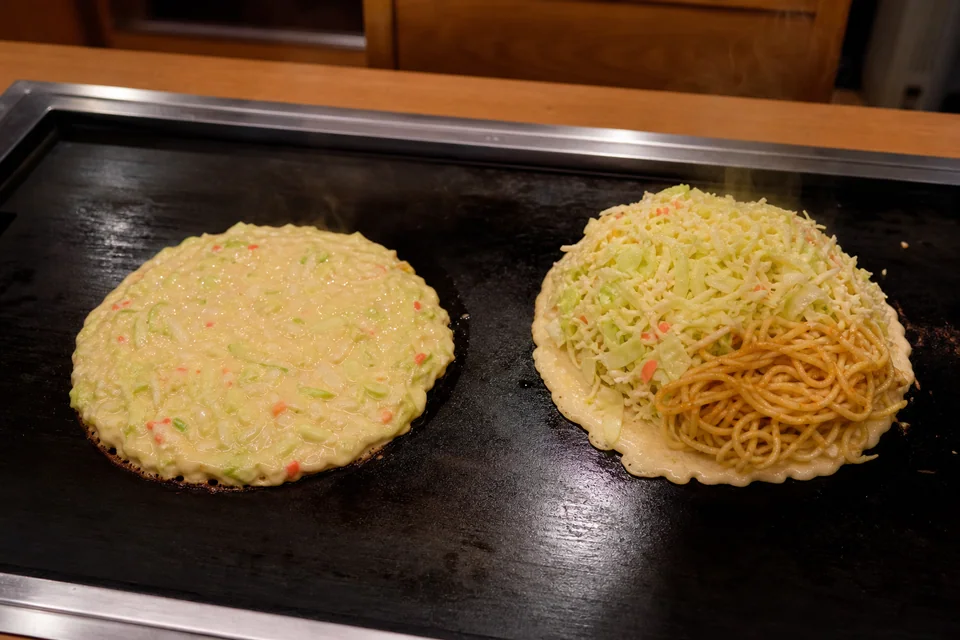
For a Hiroshima-style build, do not use this abbreviated sequence. Its cabbage pile, noodle layer, egg layer, and transfers require the recipe-specific method.
Current-batch problems and fixes
The mixed round spreads: Stop widening it. Nudge the edge inward while the batter is still soft and make the remaining portions smaller. Do not add dry flour to the already cooking round.
It breaks at the turn: Let the first side develop more structure, clear room, and support the center with a wider tool. A fully cooked broken portion can be plated; repeated flipping usually creates more fragments.
The outside is dark but the middle looks pasty: Lower the heat and allow more controlled cooking. Make the next round smaller or less crowded. Sauce must wait until the raw-flour center is resolved.
The cabbage stays rigid: Coarse shreds, an oversized mound, or excessive heat may be responsible. Moderate the surface and give the current round time; cut the next batch more evenly.
The finished dish is watery: Drain additions before they enter the batter and avoid salting shredded cabbage far in advance. Scrape away released liquid before the next portion rather than mixing it back in.
Use the Pancake Troubleshooting hub when sticking, burning, or raw-center symptoms persist beyond this dish-specific check.
Prevent the next batch from failing
Keep a style label at the top of your notes: mixed or layered. Record cabbage weight, batter quantity, add-in weight, pan diameter, portion size, and the visible release cue. For layered versions, also record noodle moisture and which transfer shifted.
Change one variable at a time. Adjust shred size for rigid cabbage, portion for a pasty center, surface heat for premature browning, or add-in moisture for looseness. Do not change flour, liquid, pan, portion, and cooking heat together and then claim one ingredient solved it.
Storage, safety, and cultural limits
Cook raw flour and egg completely under the selected recipe, and follow ingredient-specific safe-doneness rules for meat or seafood. Prevent cross-contact between raw additions and finished garnish. Cool leftovers promptly, refrigerate in a covered shallow container, and reheat until properly hot. Expect softer cabbage and noodles after storage.
This guide distinguishes documented regional constructions from explicitly named home variations. It does not rank authenticity, reproduce a named venue, or imply that 16 ideas exhaust Japanese practice. For the wider category boundaries, see different kinds of Japanese pancakes.
FAQ
Is okonomiyaki always made with cabbage?
Cabbage is central to the familiar Osaka/Kansai and Hiroshima constructions described here, but ratios, cuts, additions, and regional practices vary. Follow a complete style-specific recipe rather than treating one list as universal.
Is Hiroshima okonomiyaki just Osaka okonomiyaki with noodles?
No. The key distinction is layered construction, not merely adding noodles. The cabbage mound, noodle layer, egg, and staged transfers form a different cooking system.
Can okonomiyaki be vegetarian or vegan?
It can be adapted, but the status depends on every component: stock, batter, sauce, mayonnaise-style topping, flakes, cooking fat, and cross-contact. Do not infer suitability from the absence of visible meat.
Why does my okonomiyaki fall apart?
Possible causes include too much wet cabbage, excessive add-ins, insufficient first-side set, a narrow spatula, or a portion larger than the pan can support. Observe when it fails before changing one variable.
Do I need a special griddle?
No for a modest mixed round; a broad reliable skillet can work. A layered Hiroshima build is easier with more flat space or two pans because several components cook separately.
Related Pancake World guides
Use the Hiroshima-style method for its complete layered workflow. Compare other categories in pancakes in Japan, then explore monjayaki and negiyaki as separate dishes.
Sources and editorial references
- Japan National Tourism Organization: Okonomiyaki Guide —
https://www.japan.travel/en/guide/okonomiyaki-guide/ - Ministry of Agriculture, Forestry and Fisheries Japan: Hiroshima Okonomiyaki —
https://www.maff.go.jp/e/policies/market/k_ryouri/search_menu/2805/index.html - U.S. Food and Drug Administration: Handling Flour Safely —
https://www.fda.gov/consumers/consumer-updates/handling-flour-safely-what-you-need-know - USDA Food Safety and Inspection Service: Leftovers and Food Safety —
https://www.fsis.usda.gov/food-safety/safe-food-handling-and-preparation/food-safety-basics/leftovers-and-food-safety
For more practical food and breakfast guides, visit Pancakes World.
For the wider topic, start with Japanese Pancakes.
For a closely related guide, see Discover the Flavors of Okonomiyaki.
A useful next comparison is Easy Okonomiyaki: Japanese Savory Pancakes at Home.
For another practical angle, read Nutritional Value of Japanese Pancakes: One Recipe Case Study.
