
Quick answer: what is takoyaki?
Takoyaki is a Japanese battered food cooked as small rounds in a pan of hemispherical wells. A familiar version contains pieces of octopus—tako—with a loose savory batter and accents such as green onion, pickled ginger, and crisp tempura crumbs. The cooked rounds are commonly finished with a dark savory-sweet sauce, mayonnaise, aonori, and moving flakes of dried bonito.
Takoyaki is strongly associated with Osaka and is widely encountered at specialist shops, festivals, markets, and casual food counters. “Street food” is useful context, but not a rule that confines it to outdoor stalls. It may be cooked in view of the customer and served in a tray, yet home pans and table-top takoyaki gatherings are also part of its contemporary life.
Most importantly for Pancake World: takoyaki is not a pancake. It shares batter, a hot metal cooking surface, and visible griddle technique with subjects this platform covers, but its shaped wells, filling, staged turn, round form, and serving identity make it a distinct dish. This page is a food-culture guide adjacent to Japanese griddle culture, not an attempt to absorb takoyaki into a pancake category.
Why the special pan changes everything
A takoyaki pan has rows of half-sphere depressions. Batter fills the wells and can flow over the flat bridges between them. As the portion touching metal sets, the cook loosens and turns it, pushing uncooked batter and the overflow into the well. Repeated partial turns create a sphere around the filling.
That technique explains why a muffin tin, cake-pop machine, and flat skillet are not automatic equivalents. They may cook batter in a round shape, but depth, heat source, access for turning, and browning pattern differ. On a takoyaki pan, a pick or slender skewer can reach the edge of each piece while the next section remains fluid enough to tuck inward.
Cast iron retains heat and can develop a seasoned surface, but it is heavy and responds slowly to burner changes. Coated aluminium is lighter and releases readily, but it must be used within the maker’s heat and utensil guidance. Electric pans offer a dedicated heat source but may have hot and cool wells. Whatever the material, learn its pattern with a small batch rather than assuming every cavity cooks alike.
The ingredient architecture
Takoyaki batter is looser than American pancake batter. Flour provides the set shell and tender interior; egg contributes structure and richness; a seasoned stock supplies flavor and water. Recipes vary in stock, soy seasoning, grated yam, baking powder, and commercial mixes, so one formula should not be presented as the only authentic standard.
The central octopus piece must be small enough to fit with batter around it. Cooked octopus is a practical home choice because the brief pan stage is then about heating and batter doneness rather than hoping a large raw piece cooks safely inside. Follow the product’s preparation and storage directions. Frozen seafood should be thawed safely and drained; water clinging to it cools the well and spits in hot oil.
Green onion adds a fresh allium note. Beni shoga, a red pickled ginger, adds acid and sharpness. Tenkasu, crisp tempura fragments, adds texture and richness. These can be adjusted, but the name of the resulting dish should remain clear. Cheese, sausage, kimchi, or vegetables may be enjoyable fillings at a home gathering; they are variations, not evidence that octopus is irrelevant to the identity of classic takoyaki.
A practical home formula
For roughly 28 pieces, use:
- 150 g plain flour;
- 2 large eggs;
- 500 ml cool dashi or another recipe-appropriate unsalted stock;
- 1 teaspoon soy sauce;
- 1/4 teaspoon fine salt, adjusted to the stock;
- 140 g prepared cooked octopus, cut into 28 small pieces;
- 3 spring onions, finely sliced;
- 2 tablespoons chopped beni shoga, optional;
- 30 g tenkasu, optional;
- neutral high-heat oil for the pan.
For serving, provide takoyaki sauce, mayonnaise if desired, aonori, and bonito flakes, checking labels for allergens and fish ingredients. Sauces vary substantially in salt and sweetness. Apply them as toppings, not as a substitute for seasoning or fully cooking the batter.
Whisk the eggs with about one quarter of the stock. Add flour and salt, whisk smooth, then gradually add the remaining stock and soy sauce. The batter will look unusually fluid. Rest it for 10–15 minutes and stir again because flour settles. Transfer it to a jug with a controlled spout.
Prepare every filling and topping before heating the pan. Once several wells begin setting, there is little time to chop an octopus piece or search for a skewer.
Oil, fill, and make the first turn
Heat the pan according to its material and manufacturer. Brush oil around the bottom, sides, and top bridges, not only in the deepest point. A small drop of batter should sizzle on contact without instantly scorching.
Pour batter into every well and allow it to overflow across the bridges. Add one piece of octopus to each well, then scatter green onion, ginger, and tenkasu. Top up any visibly shallow wells. The overflow is useful material: it will be divided and tucked inward, not discarded.
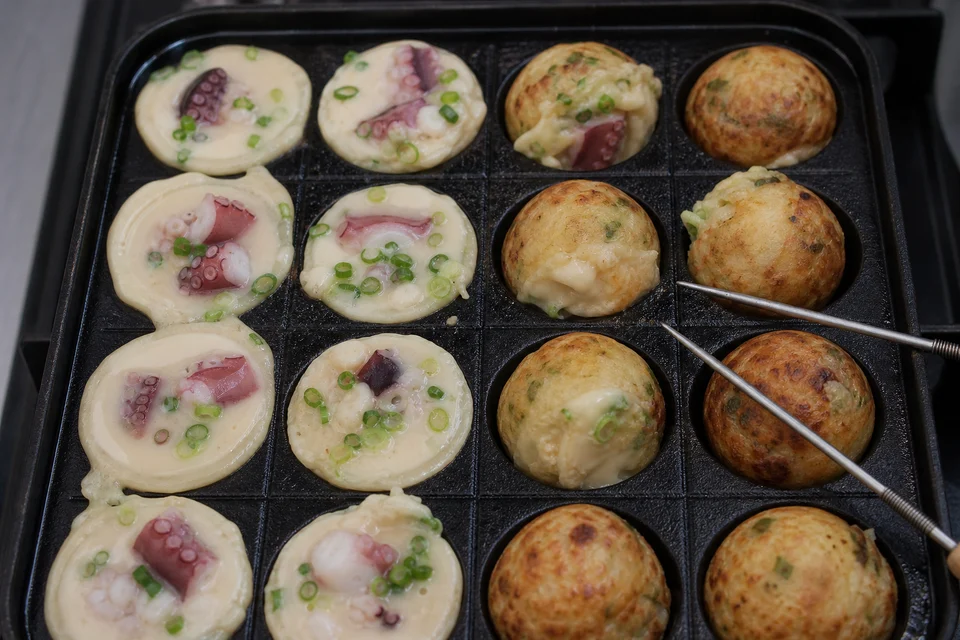
Let the base set enough that a pick can trace the rim. Draw lines through the cooked overflow to separate one well from the next. Lift an edge and rotate each piece about 90 degrees, leaving the uncooked center exposed. Push its allocated flap of overflow down into the cavity. The pieces may look like cups or rough crescents at this stage; forcing a perfect sphere immediately tends to tear the shell.
As the newly exposed batter sets, turn another quarter rotation. Continue in smaller movements, tucking loose batter inward. Rotate pieces between hot and cool wells if your pan allows and if the temperature difference is obvious. A final series of turns develops an evenly browned exterior.
What doneness looks and feels like
Finished takoyaki should hold a round form and release readily, with a browned exterior and a hot, tender interior. Tender does not mean raw. A wet flour paste or cold center is not an acceptable stylistic feature. Break open a test piece from the first batch: the shell should be continuous, the batter set around the filling, and the seafood hot under its applicable guidance.
The precise time varies with well size, batter temperature, pan mass, burner, and filling. Observable cues matter more than a universal minute count. If the shell colors too early, lower the heat before the next turn. If it stays pale and collapses, give the pan time to recover and avoid pouring refrigerator-cold batter into every well at once.
Serve carefully. Fresh takoyaki can be extremely hot inside even when the exterior seems manageable. A short rest reduces the burn risk without turning the serving cold. Sauce and mayonnaise go on after the rounds leave the pan; aonori and bonito flakes follow.
How to order and eat takoyaki thoughtfully
A menu may offer a classic sauce finish, a salt or ponzu direction, extra green onion, cheese, or other limited editions. Look for the shop’s own description rather than expecting every vendor to match one list. The number of pieces per serving, sauce quantity, and interior softness vary.
Use the provided pick or chopsticks to open or lift a piece and let steam escape. Eating a whole freshly cooked round immediately is uncomfortable and can burn the mouth. Bonito flakes moving in rising heat are normal; they are thin dried fish flakes, not something alive.
People avoiding seafood need more than an octopus-free filling. Dashi, bonito topping, shared batter, sauces, and the pan itself can carry fish, shellfish, wheat, egg, soy, and other allergens. Ask the venue and judge whether its answer meets your needs. At home, check every component and control cross-contact deliberately.
Diagnostics and current-batch fixes
Pieces will not become round
Likely causes are underfilled wells, waiting until all the batter is rigid, or failing to allocate overflow to each cavity. For takoyaki still to cook, fill to the rim and slightly beyond, begin with a partial turn, and tuck the flap inward. A ragged first batch can still be cooked through and served; shape is secondary to a set center.
Batter sticks to the pan
The pan may be insufficiently heated or oiled, the surface may be damaged, or the turn may be too early. Trace the edge gently rather than gouging it. Add a little oil around a stubborn piece and wait for a firmer shell. Follow coated-pan utensil rules; metal picks can shorten the surface’s life.
Outside is dark but inside is raw
Heat is too high, the wells are overfilled with cold ingredients, or the pieces are too large. Reduce heat and continue turning the current pieces so no side remains against the hottest metal. Break one open before serving. For the next pour, use smaller octopus pieces and let the pan stabilize at a lower setting.
Centers collapse after removal
The shell or internal batter may be under-set, or the recipe may be too thin for the well and heat combination. Return eligible current pieces to the pan and keep turning. For remaining batter, avoid adding arbitrary flour immediately; first confirm the pan recovered and the earlier batch actually received enough time.
Oil spits aggressively
Water on thawed seafood or washed garnishes is a common practical cause. Move back, lower the heat if necessary, and never add water to hot oil. Drain and blot ingredients for wells still to fill.
Toppings overwhelm the food
Heavy sauce can hide browning and make the surface soft. Serve additional sauce alongside. The takoyaki should remain identifiable rather than become a carrier for an opaque layer.
Prevent problems in the next batch
Cut exactly one small filling piece per well and dry it. Put batter in a pourable jug, toppings in separate bowls, oil and brushes within reach, and two picks on the work surface. Mark which wells run hot by noting the first batch; rotate your turning order or move pieces accordingly.
Oil the bridges as well as the cavities. Work in rows so each piece gets a similar set time. Start the first partial turn while the upper batter can still flow, then make several patient rotations. Use one opened test piece as the doneness check. Record the batter quantity your pan actually holds because cavity sizes differ.
Storage boundaries
Takoyaki is best soon after cooking, when exterior and interior contrast are strongest. For leftovers, cool and refrigerate promptly under applicable food-safety guidance. Reheating in an oven or suitable air fryer may restore more surface texture than a microwave, but it cannot make improperly stored seafood safe. Verify a hot center and discard leftovers with an uncertain history.
Frequently asked questions
Is takoyaki a pancake?
No. It is a distinct Japanese battered octopus dish made in round wells. Pancake World covers it as adjacent food and griddle culture.
Is the octopus raw when it goes into the pan?
Home recipes often use prepared cooked octopus. Follow the exact product and a validated seafood-safety method rather than assuming the brief batter stage cooks any size of raw seafood.
Do I need a special pan?
The hemispherical wells enable the characteristic shape and staged turning. A flat skillet can make a tasty batter-and-filling dish, but not the same form or method.
Why is takoyaki soft inside?
Its center can be tender and custardy, but it should not contain raw flour paste. Control heat and portion, then open a test piece.
Can I make a vegetarian version?
You can make round batter bites with a vegetable filling, but dashi, sauce, bonito, mayonnaise, and shared equipment all need review, and the variation should be named clearly.
What moves on top of hot takoyaki?
Very thin bonito flakes respond to rising heat and steam. They are a dried fish topping.
Related Pancake World pages
- Explore pancakes in Japan without collapsing hotcakes, dorayaki, and savory forms.
- Compare different kinds of Japanese pancakes.
- Learn the very different runny-griddle method in the monjayaki guide.
- Put related dishes in context with savory pancakes around the world.
- Use the Pancake World troubleshooting hub for general heat and doneness reasoning.
Sources and editorial references
- Japan National Tourism Organization, takoyaki and Osaka food context:
https://www.japan.travel/en/uk/inspiration/takoyaki/ - Ministry of Agriculture, Forestry and Fisheries of Japan, regional-food context:
https://www.maff.go.jp/e/policies/market/k_ryouri/search_menu/4773/index.html - U.S. Food and Drug Administration, raw flour and batter safety:
https://www.fda.gov/consumers/consumer-updates/flour-raw-food-and-other-safety-facts - U.S. Food and Drug Administration, seafood selection and handling:
https://www.fda.gov/consumers/consumer-updates/selecting-and-serving-fresh-and-frozen-seafood-safely
For more practical food and breakfast guides, visit Pancakes World.
For the wider topic, start with World Pancakes.
For a closely related guide, see Pancakes vs French Toast: Choose by Time, Texture, and Leftovers.
A useful next comparison is Baked Pancakes: An Easy Sheet-Pan Method.
You can also continue with Scotch Pancakes: How to Recognize the Small Dropped Style.
