Msemen in Morocco: Folding, Cooking, and Serving
For a useful starting point, Pancake World Home Page. places msemen among pancakes and flatbreads, but in Morocco the name points more specifically to a hand-stretched, folded, griddled bread with visible layers. This guide treats it as a living household and street-food practice rather than a single formula: the square fold, the dough’s thinness, the fat between layers, and the way it is served all matter.

What msemen means in a Moroccan context
Msemen is commonly written msemmen, msemen, or m’semen in Latin letters; the spellings are transliteration choices, not reliable evidence of different dishes. A 2024 review of Moroccan food habits describes msemen as a layered flatbread, often served with honey or butter, while a WIPO study of Moroccan culinary products groups m’semen, r’ghaif, and melaoui among Moroccan breads and pancakes. Those descriptions support the broad identity, but they do not make every household sheet or fold identical.
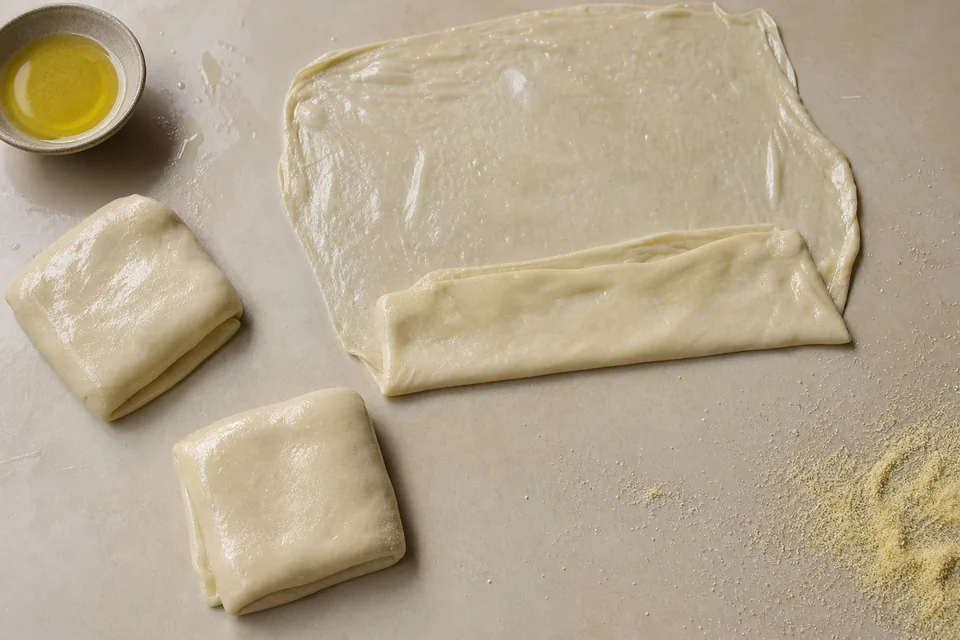
The useful distinction is structural. Msemen is made from a supple dough that is stretched thin, lubricated with fat, folded into a compact parcel and cooked on a flat surface. The folded layers are the defining idea; a round bread, a yeasted loaf, or any flatbread served with tea is not automatically msemen. The title “pancake” is a convenient English comparison, not a replacement for the Moroccan name.
Related names and forms: similarity is not identity
| Name or form | What can be said carefully | How to use the term at home |
|---|---|---|
| Msemen / msemmen | A Moroccan layered flatbread usually associated with a thin sheet folded into a square and griddled. | Use for the square, folded layered bread described in this article. |
| R’ghaif / rghaif | A related name recorded by the WIPO study alongside m’semen; local usage can overlap or differ. | Ask the cook or seller what form they mean instead of treating the label as a universal translation. |
| Melaoui / meloui | Named by the same study as a variety in the m’semen family; English sources often describe a coiled rather than square shape. | Describe the observed coil or fold; do not relabel every layered flatbread as msemen. |
| Rfissa | A dish in which shredded msemen is used with a savory stew; it is a serving context, not a synonym for the plain griddled bread. | Say “msemen for rfissa” when the bread is being prepared for that dish. |
Breakfast, tea, and a savory table
A morning plate is one context, not the whole story
The Moroccan food-habits review places msemen among breads that can be served at breakfast with honey or butter. That makes a warm piece beside tea a well-supported presentation, but it does not prove that every family eats it the same way or at the same hour. The broader Moroccan breakfast guide can help a reader place msemen beside other morning foods without turning one plate into a national rule.
Msemen can become part of another dish
The same review identifies rfissa as shredded msemen topped with chicken, lentils, fenugreek and spices. Here the bread is not merely an accompaniment: its torn layers receive the stew. This is why a recipe that stops at honey and tea is not a complete account of how msemen may be served. It is also why do not make a nutritional claim from the dish name alone: ingredients and portions vary.
A street or home setting does not settle origin
A food can be sold by specialists, made at home, and linked to many local memories at once. The WIPO study notes both homemade and ready-made forms. That observation supports an everyday, adaptable practice; it does not establish a single inventor, date, or region of origin. Treating a current cooking context as proof of an ancient origin is precisely the shortcut this cultural guide avoids.

Why folding changes the bread
The WIPO description identifies very fine semolina, some wheat flour, olive oil, and warm water as characteristic components in its account of m’semen/melaoui. It also distinguishes the dough from risen bread dough. In practice, the cultural point is not an exact universal ratio: a thin sheet is handled with fat and folded so that separate surfaces meet. On the griddle, those surfaces become the layers a diner can pull apart.
That structure explains why a thick, simply rolled round is a different result even if it uses similar flour. For another example of how a layered dough can be shaped and cooked without claiming that the traditions are the same, see layered spring onion pancakes. The comparison is about technique—stretching, layering, and cooking—not about substituting one cuisine’s name for another.
At home, use the word adaptation when changing the flour, omitting a traditional fat, or choosing a different shape because of available tools. An adaptation can be enjoyable without being presented as definitive. Naming the change gives the original form its due and gives readers a clearer expectation of texture.
What regional difference can—and cannot—tell us
Morocco has regional culinary variation, as the food-habits review emphasizes, but its discussion does not map a single authoritative msemen formula to every province. The WIPO study documents names and products in a national intellectual-property scoping exercise; it is not an ethnographic survey of every kitchen. These are useful sources for broad terminology and context, not a license to say that one city owns the only correct fold.
A careful article therefore separates three levels of statement: what a cited source records; what a cook describes in a particular setting; and what a home cook chooses to do. The boundary between documentation and interpretation matters. If a family calls a form rghaif, that local usage deserves to be reported as local usage rather than overwritten by a universal English label.
A respectful way to adapt msemen at home
- Start with the target: make a thin, layered, folded flatbread rather than a fluffy breakfast pancake. Keep the name “msemen-inspired” if you knowingly change the structure.
- Choose a dough that can be stretched without tearing. Fine semolina and wheat flour are documented in the WIPO account; if your available flour behaves differently, record that as a practical substitution, not a regional fact.
- Oil or otherwise lubricate the stretched sheet, then fold it into a parcel. The decision point is visible layering: if the sheet remains thick before folding, rolling it thinner is more useful than adding an unsupported claim about a perfect heat setting.
- Cook on a flat pan or griddle, turning as needed until the exterior is cooked and the folded bread is warmed through. No cited source here establishes a universal minute count or temperature; pan, thickness, and fat all change the result.
- Choose the serving context honestly. Honey or butter suits a breakfast-style plate supported by the food-habits review; a savory use can point toward rfissa. For a broader cross-cultural map of pancake categories, see types of pancakes for breakfast, while keeping msemen’s Moroccan name and layered form specific.
- Describe the result, not a verdict on authenticity: for example, “a square, layered home adaptation using the flours available to me.” That sentence tells a reader what was preserved and what was changed.
Common misreadings to avoid
Do not use a spelling difference as a hierarchy of authenticity. Arabic and Amazigh language contexts, regional speech, and Latin-letter transliteration do not collapse into one standardized English menu term. Likewise, do not infer that a square is always plain or that a coil is always a different dish without a local context. The sources consulted here identify related terminology, not an exhaustive naming law.
Do not claim a precise origin story merely because a recipe page repeats one. The academic and institutional material consulted supports msemen’s place within Moroccan food culture and notes variation, but it does not settle every historical pathway across the Maghreb. Uncertainty is more accurate than a neat origin myth. Readers interested in an analogous question of how one transliterated food word can cover different forms can compare bing in China and Taiwan.
Questions a reader can carry to a bakery or kitchen
Is it msemen or another nearby form?
Ask how the maker names it, then look at the shape, layering, and intended use. A square folded parcel offers stronger evidence for the msemen description than an English menu label alone.
Should it be sweet or savory?
Both are possible contexts. Honey or butter is documented for breakfast; shredded msemen in rfissa is a savory use. Choose the service that fits the meal, and do not claim that either one excludes the other.
Can a different flatbread stand in?
It can stand in as a practical substitute, but it should not be called msemen if it lacks the thin-sheet, folded-layer character. The relevant comparison is purpose and texture, not a claim that all flatbreads are interchangeable.
Sources and editorial references
This is an original cultural guide based on the cited institutional and academic sources. It distinguishes documented terminology from household practice and labels home substitutions as adaptations.
- WIPO, Scoping Study on the Economic Contribution of Copyright Industries: Morocco: https://www.wipo.int/ip-development/en/docs/Scoping_Study_en_Morocco.pdf
- The impact of societal changes and COVID-19 pandemic on Moroccan food habits: a Mediterranean perspective: https://link.springer.com/article/10.1007/s44187-024-00237-x
- SOAS repository, The cuisine of Morocco: origins and ritual significance: https://soas-repository.worktribe.com/output/411134/the-cuisine-of-morocco-origins-and-ritual-significance