Types of pancakes for breakfast
At Pancakes World, breakfast pancakes can be grouped by structure and cooking method: thin pan pancakes, thick leavened pancakes, griddle cakes made with different grains, oven-baked pancakes, filled or folded pancakes, and savoury versions. Choose one family first, then follow a complete formula for that family. Changing flour, liquid, leavener and pan technique together usually creates a different pancake rather than a simple variation.
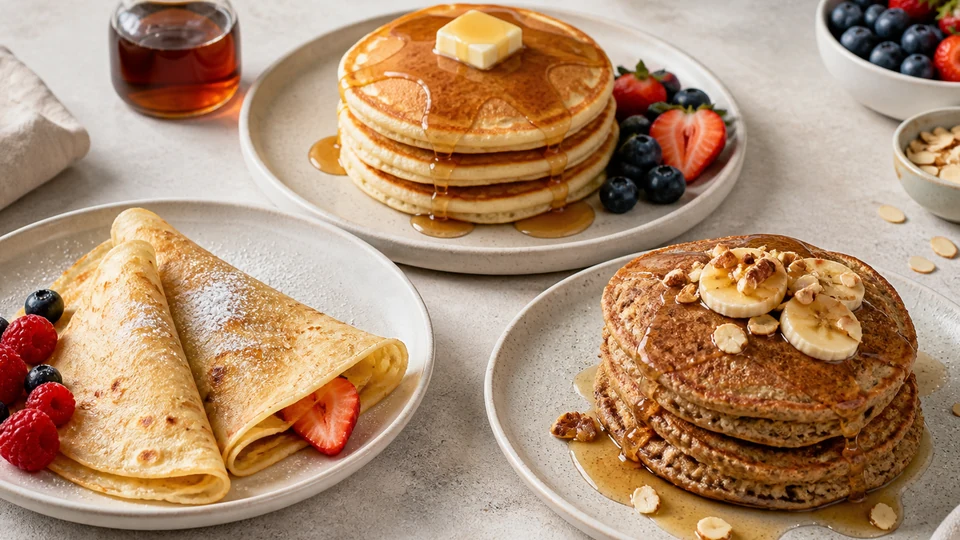
The categories here are practical editorial groupings, not an exhaustive map of world traditions or a claim that any regional pancake has one fixed recipe. Pancake World has no project test record for the formulas discussed, so this page uses Article schema. Pancake World is the main collection link.
| Guide sections |
|---|
| Thin pan pancakes |
| Thick leavened griddle pancakes |
| Buttermilk pancakes |
| Whole-grain and alternative-grain griddle cakes |
For broader context, continue with American Breakfast: Pancakes, Diner Plates and Brunch.
Thin pan pancakes
Thin pancakes spread across a skillet in a shallow layer. Their batter is fluid enough to move when the pan is tilted, and they cook into a flexible sheet rather than a tall cake. They suit rolling, folding and wrapping because the finished pancake can bend around fillings.
Pan diameter, batter portion and tilt technique determine thickness. Pour too slowly and the first area may set before the batter reaches the edge. Pour too much and the pancake becomes heavy and difficult to turn. A complete recipe should specify the intended consistency and pan method.
Serve thin pancakes with a modest filling. Fruit, cultured dairy, a spread, cooked vegetables, eggs or cheese can work according to the formula and dietary needs. Wet fillings should be controlled so the fold remains intact. For a buffet, fold or roll close to service rather than stacking filled pancakes until they steam themselves soft.
Thick leavened griddle pancakes
This familiar family uses a thicker batter and a leavening system to create height. Pancakes are portioned onto a preheated surface rather than spread by tilting. The cook observes the upper surface, edge and underside before turning.
The formula may use baking powder, baking soda with an acidic ingredient, another aeration method, or a combination. Those systems are not casually interchangeable. Batter handling also matters: overmixing can change tenderness, while unmixed flour pockets remain unpleasant.
Thick pancakes are easy to stack and serve with toppings on the side. Their challenge is cooking the centre before the exterior darkens. Moderate diameter, consistent scoop and stable griddle heat help. Do not press them after turning.
Buttermilk pancakes
Buttermilk pancakes belong to the thick leavened family but deserve a separate decision because the cultured liquid affects acidity, viscosity and flavour. The formula's leavener should be balanced for the intended product. Milk, thinned yogurt and plant-based alternatives are not automatically equivalent.
These pancakes can offer a gentle tang beneath sweet or savoury toppings. A thin film of cooking fat creates a different surface from a visible pool. Use the method selected by the complete recipe and record the griddle behaviour if repeating the batch.
The name describes an ingredient path, not a restaurant-quality guarantee. Even browning, a set centre and repeatable portion are more useful goals than extreme height.
Whole-grain and alternative-grain griddle cakes
Oat, buckwheat, corn, rye and other grain ingredients can change flavour, colour, water absorption and fragility. A formula designed around one grain is preferable to replacing all the wheat flour in an unrelated recipe and hoping the pan will compensate.
Some batters use a blend so one flour provides structure while another provides characteristic flavour. Resting may affect hydration, particularly with coarse meals or flakes, but the correct interval belongs to the recipe. The batter may thicken as it stands.
Serve robust-flavoured pancakes with toppings that leave the grain recognizable. Cooked fruit, yogurt, eggs, vegetables or a restrained syrup may suit different versions. “Whole grain” or the grain name alone does not establish a health outcome or exact composition.
Yeasted pancakes
Yeasted pancake batters use fermentation rather than relying only on chemical leavening. They require a different timeline and temperature awareness. Some are mixed ahead; others include later additions. Follow a formula that describes the full fermentation and food-safety process.
The finished texture may be airy, chewy, tender or crisp-edged depending on ingredients and cooking. Yeast does not guarantee one result. A batter that has fermented beyond its intended condition should not be repaired by adding random flour or sweetener.
Choose this family when the preparation window is available and flavour development is part of the appeal. It is rarely the best spontaneous ten-minute breakfast unless the batter was planned properly.
Whipped-egg pancakes
Some tall or delicate pancakes derive much of their lift from separated and whipped eggs. The foam is folded into a base mixture and cooked with close control. These pancakes demand attention to bowl cleanliness, folding and timing.
Overmixing deflates the foam; undermixing leaves streaks and uneven structure. Pan or mould depth affects how the centre cooks. A complete tested source is essential because an attractive photograph cannot supply safe or reliable heat and timing.
Serve them promptly. Their height and tenderness may decline during a long hold, making them poorly suited to a large self-service buffet.
Oven-baked pancakes
An oven-baked pancake moves cooking from repeated griddle batches to one heated pan or dish. Some versions puff dramatically and settle after leaving the oven; others bake into a slab that can be cut. The oven, vessel and batter temperature can influence the result.
This family suits a table that wants simultaneous servings. The host can prepare fruit and drinks while the pancake bakes, but the method still requires a complete formula and careful handling of a hot pan. Keep guests, especially children, clear when it leaves the oven.
Add toppings after baking so diners can see the structure. Cut with a suitable tool and serve promptly if the appeal depends on the puffed form.
Sheet-pan pancakes
A sheet-pan pancake is a practical baked format designed for portions rather than a traditional stack. Batter is spread in a shallow pan, optionally divided with different toppings, then baked and cut. The key questions are pan size, batter depth and even oven heat.
Use only toppings that the formula can support. Very wet fruit may affect the area beneath it; dense pieces may sink. Mark different allergen versions clearly, and do not assume separate corners prevent cross-contact.
This format can serve a family at once and packs neatly after proper cooling. It does not reproduce the browned two-sided surface of a griddle pancake, so choose it for logistics rather than imitation.
Filled and folded pancakes
Thin pancakes can enclose sweet or savoury fillings, while some thicker pancakes are cooked around a filling. These are very different techniques. A folded pancake is cooked first and filled later; an enclosed pancake needs a formula and heat pattern that cooks batter and filling safely.
For breakfast, keep the filling firm enough to stay inside. Drain cooked vegetables, cool hot filling enough to protect the pancake, and avoid excessive sauce. Fold into quarters, roll or create a parcel according to the pancake's flexibility.
Label the filling rather than relying on appearance. Cheese, nut spreads, eggs and processed products may introduce major allergens or other dietary concerns.
Savoury pancakes
Savoury pancakes may use a conventional flour batter with herbs and vegetables, a grain or pulse base, shredded vegetables bound into cakes, or leftover grains shaped for the pan. These are separate families with different structure and cooking needs.
The breakfast advantage is that toppings can be simple: an egg, salsa, yogurt-style sauce, herbs or a vegetable side. Season the batter deliberately and keep sweet table syrup separate. For a shared brunch, a savoury option provides contrast to a sweet stack.
Do not call every pan-fried patty a pancake without explaining its ingredients and structure. A descriptive name helps readers choose the right method.
Pulse- and legume-based pancakes
Batters based on chickpea, lentil or other pulse ingredients can produce savoury breakfast pancakes with distinct flavour and texture. Some begin with flour; others use soaked and ground ingredients. The two methods are not interchangeable and have different preparation and safety requirements.
These pancakes pair naturally with herbs, cooked vegetables, yogurt-style sauces or eggs, but the complete meal should reflect individual needs. Pulse batters may stick or break if the pan is not ready or the pancake is turned before its structure sets.
Use a recipe designed for the exact pulse product. A package of flour, whole dried pulses and canned pulses contain different amounts of water and cannot substitute by name alone.
Potato and shredded-vegetable pancakes
Potato pancakes and other shredded-vegetable cakes depend on controlling moisture and binding the shreds. They are usually pan-fried or griddled rather than poured. Thickness determines whether the centre softens before the exterior becomes too dark.
Prepare vegetables safely and use a complete method for draining, binding, portioning and cooking. Hot oil requires space and attention. Do not overcrowd the pan or place a water-laden mixture into oil carelessly.
These pancakes work with eggs, apple preparations, cultured toppings or savoury garnishes depending on the chosen tradition and formula. This editorial category does not declare one accompaniment culturally required.
Fermented rice, grain or pulse pancakes
Many breakfast pancakes around the world begin with soaked, ground or fermented batters. They can be thin, thick, crisp or soft. Treat each named preparation as its own food tradition and recipe system rather than grouping them under a generic sour-batter shortcut.
Fermentation time, ingredient state, temperature and storage are safety-critical. Use a culturally knowledgeable, complete and reliable source. This page does not invent fermentation instructions or claim authenticity.
When serving such a pancake, retain its proper name if known and describe the filling or accompaniment. Do not erase a specific tradition by marketing it only as a gluten-free pancake or wellness food.
Mini pancakes and silver-dollar formats
Mini pancakes use a familiar batter at a smaller portion, but scale changes the griddle workflow. More pieces fit at once, turn quickly and can dry if held too long. A squeeze bottle may portion efficiently only if the batter and nozzle are compatible and the bottle can be cleaned safely.
The format suits children, tasting plates and breakfast boards. Serve a small number per plate and replenish; a giant mound cools quickly and encourages sticky shared utensils. Keep sauces in dipping bowls with attention to double-dipping and allergens.
Changing diameter does not automatically preserve the original recipe's timing. Observe the smaller pancakes and validate the method in the actual kitchen.
Stuffed and sandwich-style pancakes
A cooked filling may be enclosed between two pancakes or sealed inside a batter designed for that purpose. The main risk is assuming a thick filled centre cooks like plain batter. Use a method that specifies filling temperature, amount and doneness.
A safer assembly route is to cook pancakes fully, then use two as a sandwich around a suitable filling. Keep the layer restrained so it does not squeeze out. Fruit spread, cheese, egg or savoury paste can work depending on the pancake and diet.
For packed breakfast, cool components appropriately before closing the container. A hot pancake around a cold perishable filling can create condensation and uncertain holding conditions.
Choose by the morning, not by novelty
For a quick weekday, select a familiar griddle formula or reheat a safely stored batch. For a table that must eat together, choose an oven or sheet-pan format. For a brunch with conversation, thin filled pancakes can be assembled in stages. For a special technique morning, yeasted or whipped-egg versions reward focused attention.
If toppings are the creative priority, use a neutral sturdy pancake. If grain flavour is the priority, keep toppings restrained. If portability matters, use a flexible folded pancake or a dry-enough pancake sandwich. If a crisp edge matters, serve directly from the pan.
Equipment can decide the category. A small skillet favours one thin pancake at a time. A broad griddle suits many small thick pancakes. An oven and appropriate pan support a baked centrepiece. Do not choose a format whose equipment bottleneck conflicts with the guest count.
Compare structure before substituting ingredients
Ask how the pancake holds together. Wheat batter may rely on gluten development within a controlled range. Egg foam relies on trapped air. Pulse batter may set through its own starch and protein. Shredded vegetables need moisture control and a binder. A substitution should address the actual structural role.
Next ask how the pancake rises, if at all. Thin pancakes may need little lift; thick pancakes may use chemical leavening, yeast or foam; oven pancakes may expand through steam and egg structure. Adding baking powder to every batter is not a universal improvement.
Finally ask how heat reaches the centre. Thin batter cooks quickly across a broad surface. A thick moulded pancake needs gentler control. A vegetable cake contains solid shreds. An oven pancake cooks from surrounding heat in a hot vessel. The cooking method belongs to the type.
Plan a pancake tasting breakfast
Limit the tasting to three genuinely different structures: for example, a thin folded pancake, a thick griddle pancake and a savoury vegetable cake. Use complete recipes and small portions. More types create a production problem and leave each one waiting too long.
Choose toppings that reveal rather than standardize the pancakes. Serve one plain tasting piece first, then a matching accompaniment. Label each type by structure and principal ingredients. Guests should know which contain wheat, milk, egg, nuts or other allergens.
Sequence cooking so the most fragile pancake is last. A sheet-pan sample can wait briefly under its correct holding plan; a whipped-egg pancake may not. Keep tasting notes sensory: flexible, crisp edge, grain-forward, tender centre. Do not turn preference into a ranking of cultures.
Store each type according to its structure
Plain thick pancakes often separate well for freezing after suitable cooling. Thin pancakes can be stacked with separators and folded later. Filled pancakes need storage rules for both wrapper and filling. Vegetable cakes may lose crispness and require an appropriate reheating method.
Label the type, date and portion. Do not mix sweet and savoury pancakes in one unmarked package. Reheat only what will be served and follow safe temperature guidance for perishable fillings.
Some types are simply best fresh. A dramatic oven pancake or delicate foam-based pancake may not retain its defining structure. Make fewer rather than planning leftovers that no one enjoys.
Understand Recipe schema limits
A taxonomy can describe pancake families without publishing one recipe. Recipe schema, however, requires a specific formula, quantities, instructions, yield and other supported fields. No project test record exists for this route.
Therefore this page uses Article schema. Readers should select a complete reliable formula in the chosen family. A future tested recipe can be released separately after documented development rather than inferred from this overview.
Questions about pancake types
What is the easiest pancake type for beginners?
A straightforward thick griddle pancake from a complete tested recipe is familiar, but ease depends on the pan and cook. A sheet-pan version removes turning, while a thin pancake requires controlled tilting. Choose one method and practice portion plus heat.
Which pancake serves a crowd at once?
Oven-baked and sheet-pan formats can be portioned together. They have a different surface and texture from individually griddled pancakes. Match guest expectations to the format.
Can one batter make thin and thick pancakes?
Not reliably by changing only the amount poured. Batter viscosity, leavening and cooking method are usually designed for the intended structure. Use separate complete formulas.
Are savoury pancakes a separate type?
They are a serving and flavour category that can overlap several structures. A thin filled pancake, pulse griddle cake and shredded-potato cake can all be savoury while remaining technically different.
Which type is best for freezing?
Sturdy, plain, fully cooked pancakes often store more predictably than delicate or heavily filled versions, but follow the specific recipe and food-safety guidance. Test quality with a small batch before freezing many.
Does this list cover every cultural pancake?
No. It is a cooking-structure guide. Named traditions deserve accurate sources and their own context; they should not be flattened into an exhaustive ranking.
Read a pancake formula by its signals
A high proportion of liquid and an instruction to swirl the pan signal a thin pancake. A scoopable batter, leavener and instruction to turn individual rounds signal a thick griddle cake. A preheated oven vessel and instruction to pour once signal an oven pancake. Shredded vegetables and a pressing step signal a cake formed from pieces rather than a pourable batter.
These signals help a cook understand the method before beginning. They do not authorize changing the recipe. If the ingredient list and method seem to describe different types, verify the source instead of improvising between them.
Look at expected yield and vessel size together. Ten small pancakes are not equivalent to ten pan-wide pancakes. A sheet-pan formula needs the specified pan dimensions because batter depth changes. A thin pancake recipe may state pan diameter to define its yield.
Also note which steps must happen immediately. Whipped foam may need prompt folding and cooking. Yeast batter requires planned fermentation. Shredded potato may release water while it waits. A relaxed breakfast starts by choosing a type whose critical timing fits the morning.
Match toppings to load-bearing capacity
A flexible thin pancake can wrap a soft filling but may tear under sharp or bulky pieces. A thick pancake supports fruit and syrup on its upper surface but becomes difficult to cut under a large mound. A crisp vegetable cake softens beneath wet sauce. An airy oven pancake can collapse under toppings placed too early.
Treat the first serving as a small structural test. Add less topping than seems visually dramatic, take a bite, then offer more at the table. Side bowls preserve choice and prevent the cook from hiding the type's defining texture.
For a sweet breakfast, one fruit preparation and one pourable or creamy accompaniment provide enough variation. For savoury service, choose one substantial topping and one bright garnish. A tasting flight should use even less so each pancake remains distinguishable.
Organize a mixed pancake board
A board can combine mini thick pancakes, rolled thin pancakes and one savoury cake. Place each in its own zone with a dedicated utensil. Keep sauces in small bowls at the perimeter and write concise ingredient labels. Do not allow decorative overlap to obscure allergen separation.
Cook the sturdy item first and the flexible or delicate item last. Replenish a few pieces at a time. Use plates large enough that guests can separate sweet and savoury samples. Put sticky syrup away from the shared pancake piles.
A mixed board works best for a small gathering because three cooking methods require attention. For a large crowd, one pancake family plus varied toppings is more reliable. Abundance can come from steady replenishment, not technical overload.
Notice the difference between batter and dough
Most pancakes discussed here begin with a batter that can be poured, scooped or spread. Some named griddle breads begin with a soft dough that is rolled or patted. They may share a flat round shape but require different mixing, resting and cooking skills.
Do not thin a dough recipe until it pours or add flour to a batter until it rolls unless the source explicitly provides that variation. The hydration and structure are intentional. Calling every flat breakfast bread a pancake may be convenient, but the method should remain accurately described.
This distinction matters for equipment. Batter needs bowls and portioning tools; dough may require a clean work surface and rolling tool. The cook should prepare the correct station before ingredients are mixed.
Plan around the final five minutes
Thin pancakes need filling and folding. Thick pancakes need stacking or plating. Oven pancakes need cutting. Filled cakes need a brief setting period before handling. Reserve counter space and utensils for that final operation before cooking begins.
Warm toppings separately if the selected recipe and safety plan allow. Put cold toppings out at the last suitable moment. Ask diners to sit before the delicate batch leaves the pan. A technically successful pancake loses much of its appeal while the cook searches for plates.
For photographs, designate one serving and plate it quickly. Do not hold the family breakfast while every pancake is rearranged. Structure, steam and surface finish change as the food waits.
A four-week way to explore types
In the first week, practice one thick griddle formula and learn portion plus heat. In the second, choose a thin pancake and practice swirling plus turning. In the third, use an oven-baked format so everyone eats together. In the fourth, try one savoury grain, pulse or vegetable pancake from a reliable source.
Keep the formulas separate and take short sensory notes. Which type fit the available equipment? Which held well for the table? Which needed immediate service? Which filling stayed inside? These observations help choose a household favourite without declaring a universal winner.
Do not add multiple substitutions during the comparison. The purpose is to understand structures, not conduct an uncontrolled ingredient experiment. Once a type is familiar, select a tested variation designed for the dietary or flavour change needed.
The most useful classification is practical
Pancake names can overlap across languages and regions, and similar structures may have different cultural meanings. For breakfast planning, begin with what the cook must do: pour and swirl, scoop and turn, bake and cut, fill and fold, or shape and fry.
Then preserve the specific name and context supplied by a knowledgeable source. Practical grouping should make cooking clearer, not erase origin. When the evidence is insufficient, describe the pancake's observable form rather than assigning a tradition.
Finally, choose one type that fits the meal. A complete, well-served batch offers more value than an enormous taxonomy on the table. Variety belongs in the editorial guide; breakfast itself can remain focused.
Explore related Pancakes World guidance on American Pancakes, Maple Syrup, and Maple Syrup Pancakes.
Sources and editorial references
- USDA FoodData Central, ingredient identity and composition records:
https://fdc.nal.usda.gov/ - U.S. Food and Drug Administration, food labels and allergen information:
https://www.fda.gov/food/food-labeling-nutrition - FoodSafety.gov, storage and handling charts:
https://www.foodsafety.gov/food-safety-charts