
What are the main types of pupusas?
Pupusas are filled, griddle-cooked masa cakes closely associated with Salvadoran food culture. Documented names and fillings include queso, frijol or beans, chicharrón, revuelta or mixed filling, loroco with cheese, and ayote with cheese. Corn-masa and rice-masa versions are also documented. These examples are not an official or exhaustive count.
The filling is enclosed before the pupusa is flattened and cooked. Pupusas are commonly served with curtido and tomato sauce; the exact masa, filling, thickness and accompaniments can vary.
The original title reflects an older collection and should not be read as a current factual claim. Names can describe a single filling, a combination, or a local or contemporary variation. This page therefore preserves the original page while focusing on the fillings and serving context supported by the available evidence.
Pupusas in Salvadoran food culture
Pupusas are not simply generic stuffed pancakes with a new name. Their masa, shaping, fillings, griddle cooking, and accompaniments form a recognizable Salvadoran food context. Salvadoran tourism material presents pupusas as an important part of the country’s gastronomy, while Smithsonian material documents pupusas de chicharrón alongside curtido. Those sources support a bounded cultural description; they do not establish one exclusive origin story, one official recipe, or an exhaustive taxonomy.
That distinction matters when reading a menu or trying a version at home. “Traditional” should describe a combination documented in the cultural sources, not every filling that fits inside masa. Likewise, “authentic” cannot be judged from appearance alone. A photograph can show a plausible serving, but it cannot prove a cook’s identity, a venue’s history, or a universal standard.
Corn and rice masa should also be described as documented forms, not as interchangeable ingredients in a tested recipe. Their handling can differ. If you are cooking, follow a recipe written for the specific masa you have. If you are ordering, the masa type is a useful question because it affects what you receive without implying that one version is automatically more legitimate than another.
How pupusas are formed and cooked
At a high level, the cook prepares a workable masa, portions it, makes space for the filling, encloses the filling, and gently flattens the sealed portion into a disk. The disk then cooks on a heated griddle or similar flat surface. The aim is a closed masa cake with the filling distributed inside and an exterior that cooks through without the filling escaping excessively.
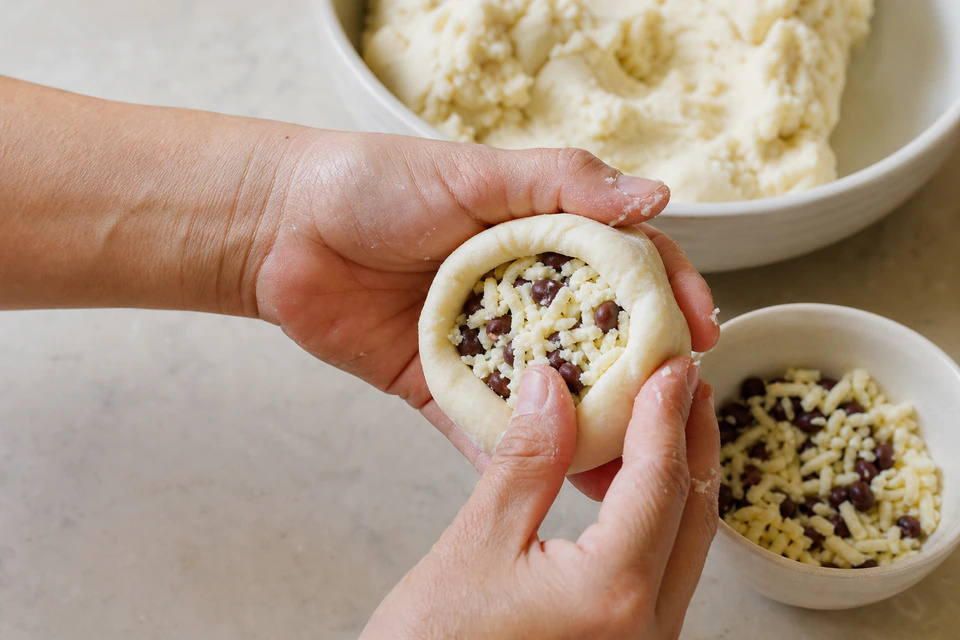
This sequence is descriptive rather than a complete recipe. The evidence package does not approve a universal water ratio, dough weight, filling amount, diameter, griddle temperature, or cooking time. Each of those details depends on the masa and method. A tested recipe should specify them instead of asking the reader to infer them from a cultural overview.
Several practical observations still help explain what is happening. A filling must be enclosed before the cake is flattened. The closing seam is smoothed so the disk can cook as one piece. A modest amount of filling is easier to contain than an overfilled pocket. These are observable process descriptions, not guarantees that every batch will behave the same way.
When a little cheese reaches the griddle, it may brown at the edge, but a dramatic spill is not the defining goal. The finished dish should remain recognizably a filled masa cake. The generated process image on this page is an editorial illustration of the shaping stage, not documentary evidence of a named cook, restaurant, or regional technique.
Types of pupusas and documented fillings
The available sources support a focused group of filling terms. They are more useful than a padded list because they help a diner understand what may be inside the pupusa.
Queso
Queso means cheese. In a pupusa, the cheese is enclosed in the masa and softens as the cake cooks. The specific cheese and its texture can vary, so “queso” is a filling category rather than a promise of one globally standardized cheese.
Frijol or beans
Beans can appear as a filling on their own or with cheese. The beans are prepared so they can sit inside the masa rather than behaving like a loose side dish. A bean-and-cheese pupusa offers both the savory bean filling and melted cheese, but the precise balance belongs to the cook or recipe.
Chicharrón
In this context, chicharrón refers to a prepared pork filling documented by the cultural sources, including the Smithsonian’s Salvadoran recipe material. The term should not be reduced to a universal image of crisp pork skin; the filling used for pupusas is prepared for enclosure in the masa. Methods and seasoning can vary.
Revuelta
Revuelta describes a mixed filling rather than a separate plant or meat. It commonly brings together documented components such as cheese, beans, and prepared pork. Because names and compositions may vary by cook or menu, ask what a particular revuelta contains if ingredients or dietary choices matter to you.
Loroco and cheese
Loroco is an edible flower bud used in Salvadoran cooking and documented with cheese as a pupusa filling. Its inclusion is a specific ingredient choice, not a decorative garnish. Readers unfamiliar with it should expect a plant-based aromatic component combined with cheese, while avoiding assumptions about exact intensity before tasting a particular preparation.
Ayote and cheese
Ayote, a squash, is another documented filling component and may be paired with cheese. As with the other categories, the evidence supports the ingredient and combination, not one mandatory seasoning, proportion, or finished texture.
These categories overlap. Cheese may stand alone or be part of a combination; beans may appear with cheese or in a mixed filling. That is why a rigid count can be misleading. A concise list of documented names gives the reader more usable information than treating every small permutation as a separate historic variety.
Contemporary filling ideas
Pupusas can also be filled in contemporary ways, but new ideas should be labeled honestly. Vegetables, different cheeses, or other savory combinations may work in a modern kitchen or appear on a current menu. Their presence does not make them historically documented by the sources used for this article.
For a contemporary filling, the same broad physical constraint applies: it needs to be suitable for enclosure in masa. Very wet, very chunky, or excessively loose fillings may be difficult to seal. That is a cooking-design observation, not a released recipe. Follow a tested method for preparation and quantity rather than using this page as a ratio guide.
Clear labels make a menu more useful. “Contemporary mushroom and cheese,” for example, tells the diner both what is inside and that the page is not classifying the combination as traditional. This approach leaves room for creativity without rewriting cultural evidence.
Curtido, tomato sauce, and serving
Curtido and tomato sauce complete the documented serving context. Curtido is a cabbage-based accompaniment, often with other vegetables and seasoning. It contributes a crisp, tangy counterpoint to the warm masa and rich filling. The tomato sauce is served alongside or added according to the diner’s preference and the practice of the cook.
The accompaniments are part of understanding the plate, not an afterthought. A reader searching only for fillings can miss how the warm pupusa, cool or room-temperature curtido, and sauce work together. At the same time, this article does not claim that every household, vendor, or restaurant uses an identical curtido recipe or sauce consistency.
Pupusas are best approached as filled masa cakes served as a complete dish. Use clean hands or utensils according to the setting, add curtido and sauce in the way that is practical for the plate, and expect some variation in thickness, browning, and filling distribution. None of those visual differences alone proves quality or cultural authenticity.
Choosing or ordering pupusas
Start with the filling name. Queso is the simplest documented category to understand. Beans with cheese add a second component. Chicharrón introduces prepared pork. Revuelta signals a mixture, so ask what is included when a menu does not explain it. Loroco and ayote identify plant ingredients that may be paired with cheese.
If you have an allergy, intolerance, religious restriction, or other dietary requirement, ask the food provider directly about ingredients, preparation, and cross-contact. This page does not certify any pupusa as gluten-free, vegetarian, or safe for a particular allergy. Corn or rice masa on an ingredient description is not enough to establish the conditions of a shared kitchen.
Also ask about the masa if that interests you. Corn and rice forms are documented, but availability varies. Avoid using price, size, an especially blistered surface, or a heavily filled cross-section as an authenticity test. Those features can reflect an individual serving without answering the cultural question.
For a first plate, choosing two or three clearly named fillings is more informative than chasing an arbitrary count. Taste the masa, then the filling, then the combination with curtido and sauce. That gives you a practical way to notice differences while respecting that one meal cannot represent every Salvadoran preparation.
Frequently asked questions
Are pupusas the same as tortillas?
No. Both can use masa, but a pupusa is formed as a filled cake and cooked with the filling enclosed. A tortilla is not defined by that filled construction.
Are pupusas made from corn or rice?
The approved Salvadoran source documents both corn-masa and rice-masa forms. That does not make the two masas interchangeable in a recipe; use instructions written for the type you have.
What is inside a revuelta pupusa?
Revuelta means a mixed filling. Documented components include cheese, beans, and prepared pork, but a particular menu or cook may define the mix. Ask when the exact ingredients matter.
What is loroco?
Loroco is an edible flower bud used in Salvadoran cooking. It is documented as a pupusa filling component, commonly paired with cheese.
What comes with pupusas?
Curtido and tomato sauce are documented accompaniments. Recipes and serving details vary, so this guide does not set one universal formula.
Are all pupusas gluten-free?
This page does not make that safety claim. A corn- or rice-masa description does not establish every ingredient, handling practice, or cross-contact condition. Ask the provider or follow verified product and recipe information.
Does the title mean there are exactly nineteen official varieties?
No. The earlier page is preserved, but the approved evidence does not establish one exhaustive official list of nineteen meaningfully distinct varieties. This guide instead explains documented fillings and combinations.
Related Pancake World guides
This page belongs to Pancake World’s international food coverage. Continue exploring the Pancake World homepage. The planned World Pancakes hub and the planned sibling guides for injera, blini, and bing should be linked here only after those exact destinations are released; they are intentionally not presented as clickable links yet.
Sources and editorial references
- El Salvador Travel: Salvadoran gastronomy —
https://elsalvador.travel/preforocimap/gastronomia-salvadorena/ - Smithsonian Institution —
https://www.si.edu/object/salvadoran-recipes-pupusas-de-chicharron-and-curtido%3Aposts_634a73a19fca581e157f7091dba6b30e - El Salvador Travel: Ruta de la Pupusa —
https://elsalvador.travel/ruta-gastronomica/ruta-de-la-pupusa/
For more practical food and breakfast guides, visit Pancakes World.
For the wider topic, start with World Pancakes.
For a closely related guide, see Breakfast Enchiladas.
A useful next comparison is Grits and Greens with Brown Butter Hot Sauce.
You can also continue with Huevos Rancheros-Inspired Breakfast Bake.
For another practical angle, read Borlengo in Italy: A Thin Emilian Griddle Bread.