Brunch Ideas For Men
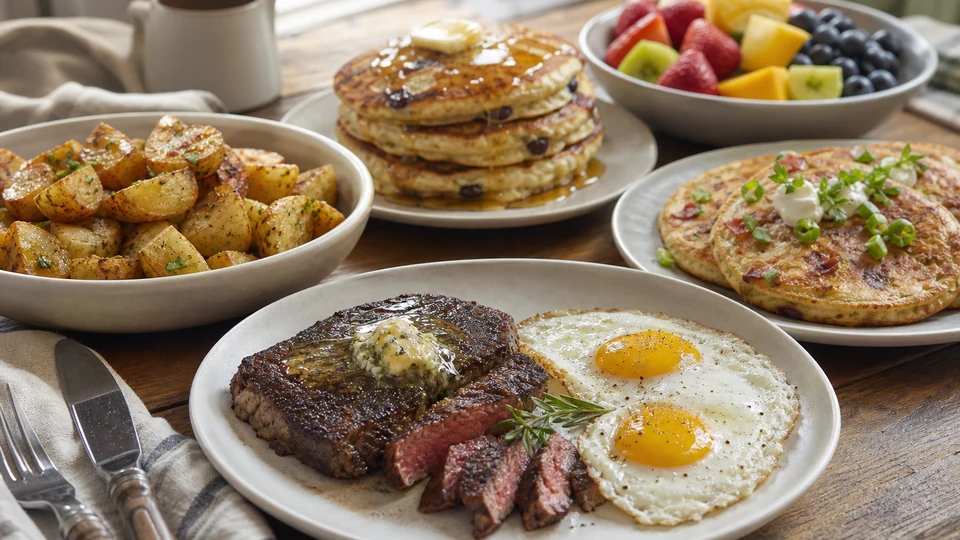
The useful answer is to choose a brunch format by the group’s arrival pattern, kitchen capacity and stated preferences—not by assuming that men need one default plate or portion. For a relaxed group, an egg bake with potatoes is the simplest shared-table choice; for staggered arrivals, a sandwich bar gives each guest more control. Pancake World treats the query as a hosting decision, with individual appetite, dietary needs and ingredient labels taking priority over stereotypes.
Route owner statement
This guide compares four substantial brunch formats for people hosting a group of men. It recommends a starting format and explains when to switch; it does not prescribe servings, nutrition outcomes or a universal “men’s brunch.”
Decision criteria
Compare every option against the same five criteria: arrival pattern, active cooking, ability to hold food, choice at the table and clean-up. The parent Brunch planning collection supplies wider planning context; this page owns the specific choice between formats. A zero-proof drinks path is the default neutral option; alcohol is never a required brunch component.
Menu comparison matrix
| Format | Best setting | Main constraint | Starting point |
|---|---|---|---|
| Egg bake and potatoes | Everyone arrives together | Oven timing | One complete bake recipe plus potatoes and fruit |
| Breakfast sandwich bar | Guests arrive in waves | Separate utensils and components | One hot filling, bread, vegetables and sauces |
| Savoury pancakes and sides | Mixed sweet/savoury interest | Active griddle work | Pancakes as the hot anchor with toppings |
| Bean, vegetable and toast plates | Plant-forward flexibility | Texture and component timing | Warm beans, toast, vegetables and optional eggs |
Supported starting ranges
Use a recipe’s stated yield as the planning range, then add one flexible side such as bread, fruit or potatoes. For four people, start with one complete hot recipe designed for four, one carbohydrate side and one fruit or vegetable component. This is a service range rather than a portion law, and it is not a universal ratio: ask guests whether brunch replaces a meal, whether they arrive hungry, and whether an ingredient must be avoided.
Guest and setting scenarios
If everyone sits at the same time, choose the egg bake because its work happens before the table is set. If arrivals are uneven, choose the sandwich bar because filling can be replenished while each person builds a plate. If the group wants pancakes but the cook wants to sit down, make one batch before service and use toppings that do not need a second pan. For outdoor service, Brunch Picnic Menu Ideas compares a different set of constraints.
Decision tree
- All guests together? Choose an egg bake and potatoes when the oven is free.
- Arrivals staggered? Choose a sandwich bar.
- Sweet and savoury both matter? Choose pancakes with one savoury side only when someone accepts the griddle role.
- Need the most ingredient flexibility? Choose beans, vegetables and toast, with optional components kept separate.
Safe handling boundary
The menu comparison does not replace recipe instructions or food-safety guidance. Keep raw-preparation tools away from ready-to-eat items, follow package labels, and use official temperature guidance when a recipe requires a verified endpoint. Do not use appearance or a taste of raw batter or raw egg mixture as a safety check.
Recommendation by user type
One-oven host: egg bake and potatoes. Host with varied appetites: sandwich bar. Pancake-focused host: savoury pancakes and toppings, provided the cook accepts live work. Host accommodating several dietary patterns: beans, vegetables and toast with clearly separated options. For a seasonal version, Summer Brunch Menu Ideas adds a distinct service lens.
Comparison details that change the result
The menu matrix shows why an egg bake wins on shared timing but loses when the oven is occupied. A sandwich bar wins on choice but needs more bowls, utensils and counter space. Pancakes make a clear centrepiece but are least suited to a host who wants to leave the kitchen. Beans and toast make component separation simple, yet need deliberate contrast—something warm, something crisp and a substantial base—so the plate does not feel like an afterthought.
Practical service sequence
First confirm guest count, constraints and arrival window. Then select one anchor using the tree. Assign every side a role: flexible extra, vegetable or fruit, condiment, or dietary alternative. Keep separate any component that must not share utensils. Serve the anchor, then replenish only what is actually low. A fruit-forward companion can come from Berry brunch guide without turning this article into a catalogue.
Related reading
Final verdict
For brunch ideas for men, begin with an egg bake and potatoes when the group arrives together; choose a sandwich bar when guests need more timing or topping flexibility. Change that verdict only when the actual kitchen, schedule or stated dietary needs point to pancakes or a bean-and-toast format.
Sources and editorial references
- U.S. Department of Agriculture Food Safety and Inspection Service, Safe Minimum Internal Temperature Chart —
https://www.fsis.usda.gov/food-safety/safe-food-handling-and-preparation/food-safety-basics/safe-temperature-chart - U.S. Food and Drug Administration, Selecting and Serving Produce Safely —
https://www.fda.gov/consumers/consumer-updates/selecting-and-serving-produce-safely - U.S. Department of Agriculture MyPlate, What Is MyPlate? —
https://www.myplate.gov/eat-healthy/what-is-myplate - U.S. Food and Drug Administration, What You Need to Know About Egg Safety —
https://www.fda.gov/food/buy-store-serve-safe-food/what-you-need-know-about-egg-safety