Berry brunch
Plan a berry brunch by giving berries only two or three distinct jobs: one fresh, one cooked or baked, and at most one small garnish or drink role. Add one substantial savoury dish, one bread or pancake component, and simple drinks. Set the guest count and service time first, scale every prepared dish from its chosen recipe's stated yield, and reject any menu that exceeds the refrigerator, oven, hob, or serving capacity you actually have. For more route context, visit Pancake World .
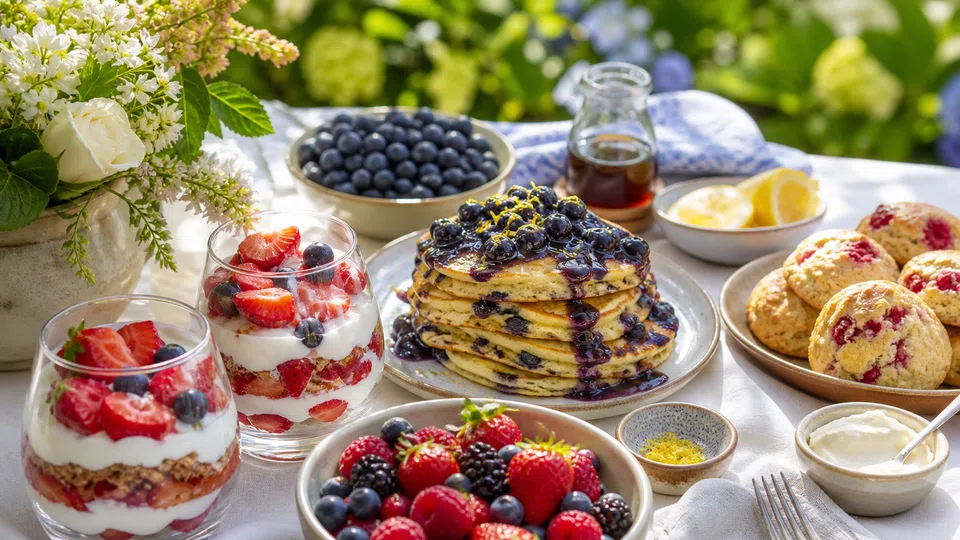
This guide owns the berry-led host plan: berry roles, menu balance, shopping, produce handling, capacity, timing, contingencies, and service. The broader brunch guide covers the broader meal cluster; this page is not a single pancake formula, a general vegan catalogue, or a nutrition guide.
Fix the event before choosing dishes
A beautiful menu can still be impossible to execute.Start with six written inputs: guest count, arrival pattern, eating time, dietary restrictions, refrigerator space, and the appliances available during the final hour. Add a seventh input if the meal is a buffet: how long the table is expected to remain open. These facts control the menu more reliably than a photograph or a universal berries-per-person number.
Decide whether guests will sit at one time or arrive gradually.A seated group can receive pancakes in two hot waves. A drop-in group needs food that can be held safely or replenished in small dishes. Decide whether brunch replaces lunch, whether children are included, and whether anyone expects a particularly light or substantial meal. Those are planning questions, not reasons to invent fixed appetites. Use the stated yields of complete recipes and what you know about the particular gathering.
Ask about dietary needs before buying.“Berry brunch” does not mean vegetarian, vegan, dairy-free, gluten-free, nut-free, or allergy-safe. Berries may share a kitchen with eggs, dairy, wheat, nuts, or other allergens. Check every packaged ingredient that matters, keep an ingredient note for each prepared dish, and assign a dedicated utensil where cross-contact is a concern. If your kitchen cannot reliably control an allergy, say so plainly and provide an unopened verified alternative rather than making a promise.
The design rule is contrast.A fresh strawberry bowl, warm blueberry sauce, and a few raspberries on a finished platter perform different jobs. Blueberry pancakes, blueberry muffins, berry yogurt, a berry smoothie, and berry tart repeat sweetness, softness, and fruit flavor while multiplying work. Remove duplicates until each berry component has a clear reason to be present.
Build quantities from yields, not folklore
The useful quantity formula is transparent: required batches = desired servings divided by verified recipe yield, rounded up only when partial batches are not supported. Then calculate each ingredient from that batch count. For a platter or purchased item without a recipe, define the intended role and measure one representative serving in your own dish before multiplying. That is a host estimate, not a universal standard.
| Planning line | Value to enter | Calculation | Decision check |
|---|---|---|---|
| Guest demand | Guest count and expected servings of this dish | Guests × servings planned per guest for this specific menu | Reduce the estimate if several equivalent mains compete |
| Recipe batches | Stated yield of the selected complete recipe | Desired servings ÷ recipe yield | Do not casually halve a bake or batter unless its recipe supports it |
| Fresh berry display | Number and size of the bowls you will actually serve | Measured fill for one bowl × number of planned replenishments | Keep reserve fruit refrigerated instead of filling one oversized bowl |
| Cooked berry component | Yield of the chosen sauce, compote, or bake recipe | Desired portions ÷ recipe yield | Count it as topping or dish, not both |
| Buffer | A deliberate extra batch or reserved package, if justified | Add only after storage and leftover use are assigned | A buffer is not permission to double every component |
Worked plan: six people seated together
Suppose the selected pancake recipe states a yield of twelve pancakes and the host plans two pancakes for each of six guests. The desired count is twelve, so one full recipe batch is the planning amount. If the same formula actually yields ten pancakes at the host's chosen scoop size during a prior legitimate use, the host can either make a supported second batch, reduce the planned count, or choose another main; the guide does not silently rewrite the formula.
Suppose a chosen warm blueberry sauce recipe states six servings. One batch covers the six planned portions. The fresh role is a strawberry-and-raspberry bowl measured in the actual serving dish, with one chilled refill held back. A savoury egg dish or bean-and-vegetable dish is selected from a complete recipe that also yields six. Coffee or tea completes the meal. This produces a fresh berry role, a cooked berry role, one substantial savoury anchor, pancakes, and drinks without requiring a second pastry.
The small-group brunch quantities guide can help when the group is four to six and the main question is overall menu scope rather than berry handling. Keep the jobs separate: use that route to decide how compact the meal should be, then use this plan to assign and handle the berry components.
Worked plan: twelve-person staggered buffet
Suppose a savoury oven dish yields eight servings and the selected recipe can be made as separate complete batches. Twelve desired servings divided by eight gives 1.5 batches. Because an unsupported half-batch may change pan depth and cooking, the host can make two full recipe batches, select a recipe yielding twelve, or pair one eight-serving dish with a second independently complete savoury option. The safest operational choice is the one the available oven, refrigerator, and holding equipment can support.
For berries, use a cooked sauce whose verified yield covers the planned servings and two modest fresh-fruit platters rather than one large display. Put out the first platter, keep the second cold, and replace rather than top up. If refrigerator space cannot hold the reserve platter and the savoury dish at the same time, shrink the fresh display or choose intact whole fruit that fits the available storage plan. Capacity changes the menu before shopping; it should not become a surprise on the event morning.
Shop by assigned job
Write the menu as roles before writing ingredients:fresh berry centerpiece, cooked berry component, savoury anchor, bread or pancakes, drinks, and optional finish. Under each role, copy the exact ingredients and quantities from the selected complete recipe or from the measured platter plan. Consolidate repeated ingredients only after both source lists are complete. This prevents a shared ingredient such as lemon, yogurt, or plant drink from disappearing between two recipes.
Assign each berry package before purchase.Firm, attractive berries are candidates for the fresh bowl. Frozen berries can be considered for a cooked component when the chosen recipe or package directions call for them. Fruit that is bruised or damaged needs careful trimming according to produce guidance; fruit that looks rotten should be discarded. Do not buy a mixed frozen bag and assume its berry sizes and proportions will match a recipe written for one fruit. The package and selected recipe control.
Buy close enough to the meal that conditioncan be checked, but early enough to use a backup store or switch the fresh role if quality is poor. Inspect packages for crushed, leaking, or visibly spoiled fruit. Put delicate fresh berries in the shopping cart near the end, protect them from heavy items, and move them into suitable refrigeration promptly. The FDA specifically names strawberries among perishable produce to keep in a clean refrigerator at 40°F or below.
For a dairy-free table, verify the pancake recipe,plant yogurt, bread, chocolate, spread, and cooking fat rather than checking only the milk carton. A non-dairy batter decision is a narrower liquid-and-fat problem and still needs a complete suitable formula. For a fully vegan table, assemble substantial savoury components from complete suitable recipes rather than pretending fruit alone is a complete menu.
Use a stop rule
Before adding an impulse pastry, flavored yogurt, smoothie mix, or extra berry, ask which open menu role it fills. If every role is already filled, do not buy it. A smaller, readable table is easier to time, label, refrigerate, replenish, and clear.
Pass the capacity gate before finalizing
List every cold, hot, washing, and serving demand at its peak moment.A refrigerator that holds the groceries may not also hold an assembled casserole, washed fruit trays, plant yogurt, sauce, drinks, and leftovers. A griddle that cooks three pancakes at a time cannot deliver twelve simultaneously. An oven cannot bake two dishes at different temperatures in the same slot without a verified plan.
Cold storage
Place the actual pans, covered bowls, and reserve platters on an empty-shelf sketch. Keep perishable produce and cold dishes within the applicable temperature guidance. If containers do not fit with air circulation and safe separation, reduce the menu or add a genuinely capable cooler plan.
Wash and dry station
Reserve a clean sink, colander, cool running water, disposable or clean towels, and enough tray space to dry delicate fruit without crushing it. Schedule this before the stovetop rush, not while raw-egg dishes and serving utensils occupy the same work area.
Heat and throughput
Record oven temperature and time for each chosen recipe, burner count, griddle capacity, and the number of batches. Work backward from the last hot dish. If two items need the same pan in the same ten minutes, make one ahead only when its recipe supports holding, or replace it.
Holding and service
Confirm thermometers, ice, warming equipment, serving dishes, clean replacement platters, and a dedicated utensil for each dish. University of Minnesota Extension advises planning a crowd menu around foods that can be kept hot or cold and using proper holding equipment.
Do a physical rehearsal with empty containers if the fit is close.Put the casserole dish in the refrigerator, set the colander in the sink, place the griddle on its burner, and line up the serving platters. This ten-minute check catches blocked shelves, missing lids, crowded counters, short extension leads, and a platter that does not fit the cooler. It also shows whether the host can move safely while guests are present.
The equipment decision can simplify the menu.One oven, two burners, and limited counter space favor one baked savoury anchor, one stovetop pancake task, one cold fruit role, and ready-to-serve drinks. The related small-kitchen brunch capacity plan goes deeper on appliance handoffs when space, rather than berries, is the primary constraint.
Work backward from the first plate
Write the agreed eating time at the bottom of a page and schedule backward. Keep the fruit-washing window close to preparation or eating, reserve the final hot window for one main task, and move stable setup earlier. The exact timings of a sauce, bake, batter, casserole, or oats must come from the complete recipe selected for that dish.
-
One or two days before, if appropriate: confirm guest count and dietary information; choose complete recipes; copy yields; calculate batches; check labels; test whether pans and platters fit; and write the shopping list by menu role. Do not assemble foods early merely because the calendar has space.
-
Shopping window: inspect berry condition, protect delicate packs from crushing, buy the quantities derived from recipes and measured platters, and activate the backup menu if the fresh fruit is poor. Move refrigerated items into suitable cold storage promptly.
-
The prior day: set the table, label serving utensils, measure a dry pancake mixture only if the formula permits it, and make a cooked sauce or assemble a savoury bake only when the chosen recipe explicitly supports advance work. Keep berries unwashed unless they are being prepared for immediate use.
-
Event morning: clear and sanitize work surfaces, check refrigerator temperature, place thermometers and holding equipment, prepare recipe-supported items, set out empty serving dishes, and keep cold reserves refrigerated. Separate guest-facing ingredients from backup stock.
-
Near service: wash hands and clean the sink, faucet, colander, and counter. Wash delicate berries with cool water in a colander, avoid soaking, dry them, and return prepared fruit to refrigeration until needed. Finish cold assembly without combining crisp, wet, hot, and chilled elements prematurely.
-
Final hot window: reheat or cook strictly according to each selected recipe, complete the savoury anchor, and cook pancakes in the planned waves. Keep warm sauce separate from fresh fruit. Do not use a decorative schedule to override doneness or food-safety instructions.
-
Service and reset: offer drinks, then the savoury anchor and bread or pancakes, with fresh berries and cooked berry topping as separate choices. Replenish cold food with fresh small platters rather than adding new food to an exposed dish. Record when perishable service began.
The make-ahead brunch workflow can help select a menu with fewer final-hour tasks. “Make ahead” still means following each recipe's cooling, storage, and reheating directions; it does not authorize storing assembled berries, wet batter, or egg dishes by guesswork.
Handle the fresh role as a separate operation
Fresh berries are delicate and are often servedwithout a later cooking step, so give their preparation its own clean window. University of Minnesota Extension advises washing fresh produce under cool running water, using a colander for delicate produce, avoiding soaking, drying after washing, and waiting until preparation or eating when the produce is not visibly dirty. The FDA also advises washing produce under running water and drying it after washing.
Begin with clean hands and a cleaned preparation area.Sort the berries while they are still dry. Cut away damaged or bruised areas where appropriate, and throw away produce that looks rotten. Do not hide questionable fruit in a purée or sauce. Wash only the amount scheduled for the fresh presentation and immediate preparation; keep reserve fruit cold and protected.
Place delicate berries in a colander and use cool water gently.Avoid packing the colander so tightly that the lower fruit is crushed. Drain and dry carefully on a clean disposable or cloth towel as applicable. Transfer the dry fruit to a clean chilled container, cover it appropriately, and return it to refrigeration until service. Do not soak berries or leave a wet mixed bowl overnight.
Keep warm sauce separate from chilled fresh berries.Pouring a large hot sauce over a cold display creates a lukewarm mixture, damages texture, and removes guests' control over sweetness and moisture. Separate bowls also preserve a plain option for people who want fruit without sauce and prevent pancakes from becoming soggy before they reach the plate.
Whole and cut produce have different handling needs,and a general menu guide cannot replace the exact package or recipe directions. Pre-washed packaged products should be handled according to their label. Frozen berries belong in uses supported by the selected recipe or package instructions rather than being treated as identical to fresh garnish.
Give helpers bounded handoffs
A second pair of hands helps only when the work is defined.Divide the plan by complete operations, not vague instructions such as “do the berries.” One person can own the clean produce station: wash hands, clean the sink and colander, sort the scheduled fruit, rinse it with cool water, dry it, transfer it to the labelled container, and return it to refrigeration. Another person can own the table: place the correct utensil and label with each empty serving dish, set the drink station, and keep backup platters in their assigned cold location.
The cook should retain control of recipe-dependent stepsunless a helper has the full recipe and understands the handoff. Write the dish name, recipe source, batch count, pan, start time, finish cue, holding plan, and serving vessel on one card. “Warm the sauce” is incomplete; “follow the selected sauce recipe's reheating direction, transfer it to the labelled heat-safe jug, and keep it separate from the fresh fruit” is an observable assignment. Never ask a helper to invent a temperature, doneness test, or storage interval.
Create two zones on the counter.The preparation zone holds only the ingredients and equipment for the current task. The service zone holds clean platters, labels, utensils, and finished shelf-stable items. Cold reserves remain in refrigeration instead of migrating onto either counter. This separation prevents a berry package intended for the second platter from being opened as garnish and keeps a used buffet utensil from returning to a clean preparation area.
Use a short call-and-response check ten minutes before service.The host names each menu role; the responsible person states its location and next action. For example: “fresh berries—first platter chilled, reserve covered on the middle shelf”; “sauce—reheated by its recipe, clean ladle ready”; “savoury main—doneness checked, serving time recorded”; “pancakes—first wave cooking, second wave batter held according to the formula”; “leftovers—clean containers and labels ready.” Missing answers reveal a real gap while there is still time to simplify.
When a helper finishes early, the default action is to stop and ask, not to add garnish or combine dishes.Unplanned finishing touches often consume reserve fruit, blur labels, introduce cross-contact, or make wet and crisp components meet too soon. A quiet counter and one less bowl are signs of control, not an unfinished brunch.
Prepare a swap for each likely failure
A useful contingency preserves the menu role while reducing risk or work. It does not create an entirely new brunch on the morning of service. Write the trigger and the swap together so another helper can act without guessing.
| Observed problem | Immediate decision | Role-preserving alternative | What not to do |
|---|---|---|---|
| Fresh berries are poor quality | Reject rotten fruit and reassess the fresh centerpiece | Use acceptable whole fruit for freshness and a recipe-supported frozen berry sauce for the theme | Do not conceal spoilage in a blended dish |
| Refrigerator is over capacity | Remove optional perishable dishes before prep begins | Serve fewer cold components in smaller replacement platters | Do not leave reserves at room temperature to make space |
| Service is delayed | Keep cold reserves refrigerated and follow safe holding controls for hot food | Delay the fresh assembly and cook the final pancake wave later | Do not let the finished table wait as decoration |
| The menu is too sweet | Remove the optional bake, sweet drink, or extra topping | Add plain toast, vegetables, beans, eggs, or another already planned savoury component | Do not add acid or spice randomly to every berry dish |
| A guest needs dairy-free or vegan food | Verify the full ingredient and cross-contact boundary | Use a complete suitable recipe and modular savoury components | Do not assume a milk swap also removes egg or every animal-derived ingredient |
| The griddle falls behind | Serve the completed savoury and fresh components first | Cook smaller announced pancake waves or use the planned bread backup | Do not half-cook and stack wet pancakes |
For each change, alter one controlling variable and keep the rest of the plan stable. If the fresh centerpiece disappears, do not also change the savoury dish, drinks, and service style. A bounded swap protects the shopping list and makes the result understandable.
Serve in a sequence that keeps choices distinct
About fifteen minutes before eating, verify that thedining surface, serving dishes, utensils, labels, and drink station are ready. Keep cold food refrigerated until it is needed. Bring out only the first fresh-fruit platter and a modest portion of other perishable cold components. Keep replacements cold.
Offer drinks first.Then place the savoury anchor and bread or the first pancake wave. Set fresh berries and cooked berry sauce in separate dishes, each with its own utensil. Guests can build a bright fruit plate, a restrained pancake topping, or a savory-heavy plate without the host preparing several separate entrées. If there is an optional small berry bake, bring it out only after the first course has proved balanced.
For buffet service, the FDA advises small portions,cold foods at 40°F or colder, replacement of serving dishes rather than topping up, and discarding perishables left at room temperature for more than two hours unless held hot or cold. When the location is above 90°F, the safe holding time is reduced to one hour. Record the start time, use appropriate holding equipment, and make a named person responsible for the clock.
Do not add fresh food to a dish that has been exposed to guests.Replace it with a clean, freshly filled dish. Keep a dedicated utensil with each food. If someone arrives late, serve a portion that remained under suitable control rather than preserving the entire buffet for appearance.
At the end, clear perishables instead of allowing the display to linger through conversation.Separate untouched refrigerated reserve from food that reached the table. Cool and store only according to the relevant recipe and safety guidance. Label retained leftovers with the dish name and preparation date; do not rely on color to distinguish cooked berry sauce from an uncooked mixture later.
Know what this plan does not establish
The menu examples are editorial planning demonstrations, notclaimed kitchen tests, guaranteed yields, or universal portion standards. A recipe's printed yield is a calculation input, not proof that every guest will eat the same amount. Berry varieties, ripeness, packages, appliances, serving dishes, and guest needs vary. The exact recipe, product label, thermometer, and observed condition control the item in front of you.
This guide does not make disease-prevention, antioxidant, “superfood,”weight, or other nutrition-outcome claims. Those claims are unnecessary for the host's job and would require different evidence. It also makes no cultural-authenticity claim and does not treat one combination as a universal berry tradition.
Market season can change the practical choice without changing the plan.Excellent fresh strawberries may deserve the centerpiece in one week; in another, a cooked component made from frozen blueberries under a suitable recipe may be more dependable. The honest move is to change the assigned ingredient or role, not pretend weak fruit will become strong through decoration.
A berry is a menu component, not generic visual garnish.The named fruit should be present in the finished dish, assigned a purpose, handled appropriately, and served in a way that allows its texture and flavor to remain legible. That boundary keeps the theme useful instead of cosmetic.
One final operational checklist
Tick each item as you complete it.
When every line is resolved, stop adding dishes. The successful plan is the smallest berry-led menu that fits the guests, recipes, equipment, safe handling controls, and service window while still offering fresh, savoury, warm, and crisp contrast.
Sources and editorial references
University of Minnesota Extension — Washing fresh fruits and vegetables safely
https://extension.umn.edu/food/preparing/cooking-at-home/washing-fresh-fruits-and-vegetables
University of Minnesota Extension — Cooking safely for a crowd
https://extension.umn.edu/food/preparing/cooking-at-home/cooking-safely-for-a-crowd
U.S. Food and Drug Administration — Selecting and Serving Produce Safely
https://www.fda.gov/food/buy-store-serve-safe-food/selecting-and-serving-produce-safely
U.S. Food and Drug Administration — Serving Up Safe Buffets
https://www.fda.gov/food/buy-store-serve-safe-food/serving-safe-buffets
Evidence checked 28 August 2026. Menu patterns and quantity examples are editorial planning demonstrations, not claimed kitchen tests.