Easy brunch sandwiches
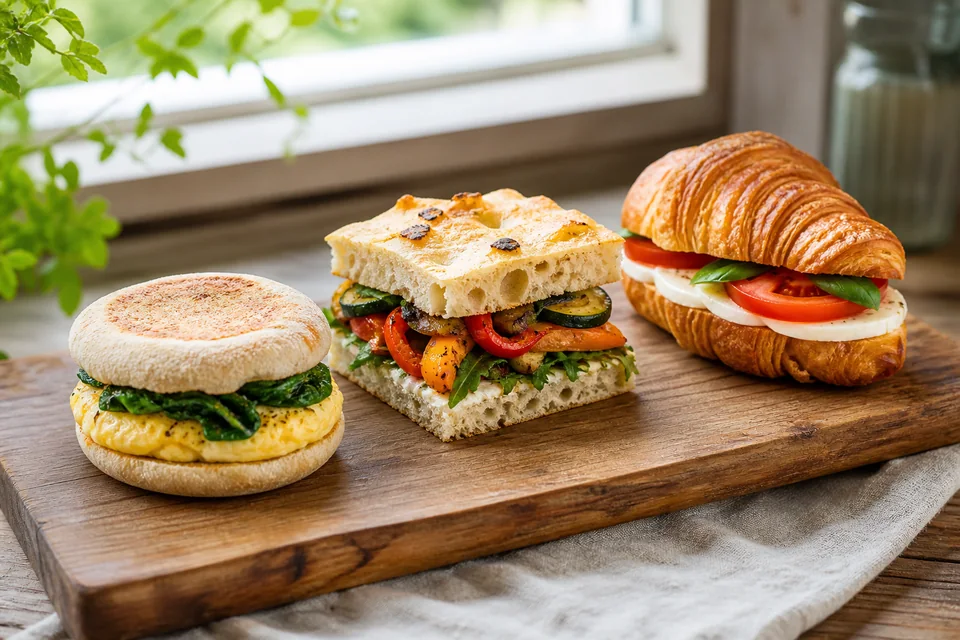
The direct technique: protect the bread, then build contrast
Easy brunch sandwiches succeed when the bread stays intact, wet fillings are controlled, hot components are cooked before assembly, and the sandwich is held only as long as its ingredients allow. Start with a bread that can carry the filling, add a measured spread or moisture barrier, place the structural filling next, and finish with delicate greens or crisp elements. Pancake World and the Pancake World brunch guide frame the occasion, but this page is a recipe-and-technique guide: one complete base formula, several variations, a failure matrix and a service timeline. The easy sandwich is engineered, not merely stacked.
Exact ingredient table for the primary recipe
| Ingredient | Exact quantity | Function |
|---|---|---|
| Sturdy split rolls | 6 | Structural base |
| Large eggs | 6 | Warm anchor |
| Canned cannellini beans, drained and rinsed | 360 g | Substantial filling |
| Plain cream cheese | 90 g | Moisture barrier |
| Firm tomato, seeded | 1 medium, about 120 g | Fresh contrast |
| Fresh greens | 60 g | Crisp layer |
| Olive oil | 15 ml | Pan control |
| Fine salt | 4 g | Seasoning |
| Black pepper | 1 g | Seasoning |
Yield: 6 sandwiches. Prep time: 15 minutes. Cook time: 15 minutes. Total time: 30 minutes. Equipment: one large skillet with lid, spatula, bowl, fork, knife, board and baking tray.
One numbered primary method
- Heat the oven to 180°C. Place the split rolls cut-side up on a tray and toast for 5–7 minutes until the cut faces feel dry and lightly crisp.
- Mash the drained beans with 45 g cream cheese, 5 ml oil, 2 g salt and half the pepper. Warm this mixture in the skillet over medium heat for 4–5 minutes, stirring, until it is steaming throughout. Transfer it to a clean bowl.
- Seed the tomato, cut it into six equal groups and blot the cut surfaces. Divide the greens into six 10 g portions.
- Add the remaining 10 ml oil to the skillet over medium-low heat. Crack in the eggs, cover, and cook 4–5 minutes until both whites and yolks are firm. Season with the remaining salt and pepper.
- Spread the remaining 45 g cream cheese across the six roll bases: 7.5 g each. Add 60 g warm bean filling to each, then one egg, one tomato portion and 10 g greens.
- Close gently, cut one control sandwich and serve the batch immediately. If holding briefly, keep wet tomato away from unassembled bread and assemble as close to service as possible.
Doneness indicators
The bean filling is ready when it is steaming, cohesive and leaves no liquid trail in the skillet. FDA egg guidance supports cooking until both yolk and white are firm; the covered 4–5 minute step is the recipe control, and the finished egg should have no translucent white. The toasted cut face should feel dry before the spread is added. The assembled sandwich should close without bean filling or tomato juice escaping at the first edge.
Moisture map
Keep juicy ingredients small, drained or delayed. Seed tomatoes when the sandwich will hold, drain cooked vegetables before adding them, and use thick yogurt or spread instead of a thin sauce when the bread must travel. If a sauce is essential, place it between a dense filling and a barrier layer rather than directly on the crumb. Do not solve sogginess by toasting until the bread becomes brittle; change the moisture route. The correct amount of sauce is the amount that seasons the bite without pooling at the bottom.
Failure matrix
| Failure | Likely cause | First correction | Success indicator |
|---|---|---|---|
| Soggy bottom | Wet filling or sauce touches crumb | Drain, spread thinly, add barrier layer | Bread remains intact after a short hold |
| Filling slides | Smooth surfaces and overfilled centre | Use a structural layer and reduce height | Cut face stays aligned |
| Egg leaks | Under-set centre or excess size | Cook to the stated method and portion evenly | No loose liquid on the cut face |
| Bread tears | Weak roll or aggressive pressing | Choose stronger bread and close gently | Crust holds while biting |
| Sandwich tastes flat | No acid, aroma or seasoning contrast | Add one measured accent, not several wet sauces | Filling and bread remain distinct |
| Greens wilt | Added beside hot or wet filling too early | Cool the filling briefly and add greens last | Leaves keep visible structure |
| Travel package leaks | Warm filling, excess sauce or loose wrap | Cool within the method, wrap seam-side down | Container stays clean during the declared hold |
Scaling for 6 and 12
| Ingredient | 6 sandwiches | 12 sandwiches |
|---|---|---|
| Sturdy split rolls | 6 | 12 |
| Large eggs | 6 | 12 |
| Cannellini beans, drained and rinsed | 360 g | 720 g |
| Plain cream cheese | 90 g | 180 g |
| Firm tomato, seeded | 120 g | 240 g |
| Fresh greens | 60 g | 120 g |
| Olive oil | 15 ml | 30 ml |
| Fine salt | 4 g | 8 g |
| Black pepper | 1 g | 2 g |
For six, the stated large skillet handles one bean batch and one six-egg batch. For twelve, use two identical six-sandwich skillet rounds; do not crowd twelve eggs or 720 g filling into a pan sized for six. Toast rolls on two trays or in two oven rounds, divide every component into two labelled sets, and assemble the first six only after its hot components are ready. The doubled tomato and greens double the moisture risk, so keep both portioned and dry until each six-sandwich assembly round. Serve immediately for best bread texture. For perishable ingredients, follow the USDA/FDA two-hour room-temperature limit, reduced to one hour above 32°C, and refrigerate sooner whenever the complete product guidance is stricter.
Three meaningful variations
Vegetarian egg and bean
Use the complete base formula as written, changing only the seasoning accent. Keep the bean mixture cohesive and the tomato blotted so the result remains the recipe control.
Smoked fish and egg
Replace the bean layer with an equal six-portion amount specified by a complete smoked-fish recipe, use a thick spread and add fish only after the hot egg stops steaming. Follow the product label and cold-chain guidance.
Roasted vegetable
Replace the bean layer with six equal portions of drained roasted vegetables from a complete recipe. Cut them into manageable pieces and retain the measured cream-cheese barrier so oil and vegetable juice do not pool.
Transport test
Serve immediately when crisp bread and fresh greens are the defining qualities. For a short hold, wrap each sandwich separately and keep wet elements controlled. For transport, pack sauces or juicy fruit separately if the stated method permits, and use the most perishable ingredient’s current guidance. Reheating the whole sandwich can soften bread and overcook egg; reheat only a component when the complete recipe supports it. If storage history is uncertain, discard rather than masking the issue with a new toast.
Final checklist
Before serving the batch, cut one sandwich. The egg should be set to the chosen doneness, the filling should stay inside the bread, and no liquid should collect at the cut edge. If it fails, correct the moisture barrier or filling quantity before assembling the rest. Keep the single six-sandwich formula as the control; variations change flavour, not the assembly logic.
Related Reading
Sources and editorial references
- Utah State University Extension, Create a Breakfast for Families —
https://extension.usu.edu/fscreate/files/2023-26-staff/CFM-Create-Breakfast-for-Families.pdf - FDA, What You Need to Know About Egg Safety —
https://www.fda.gov/media/82227/download - USDA FSIS, Food Safety Basics —
https://www.fsis.usda.gov/food-safety/safe-food-handling-and-preparation/food-safety-basics - University of Minnesota Extension, Cooking Safely for a Crowd —
https://extension.umn.edu/home-kitchen/cooking-safely-crowd - USDA MyPlate, What Is MyPlate? —
https://www.myplate.gov/eat-healthy/what-is-myplate