Things to eat for brunch
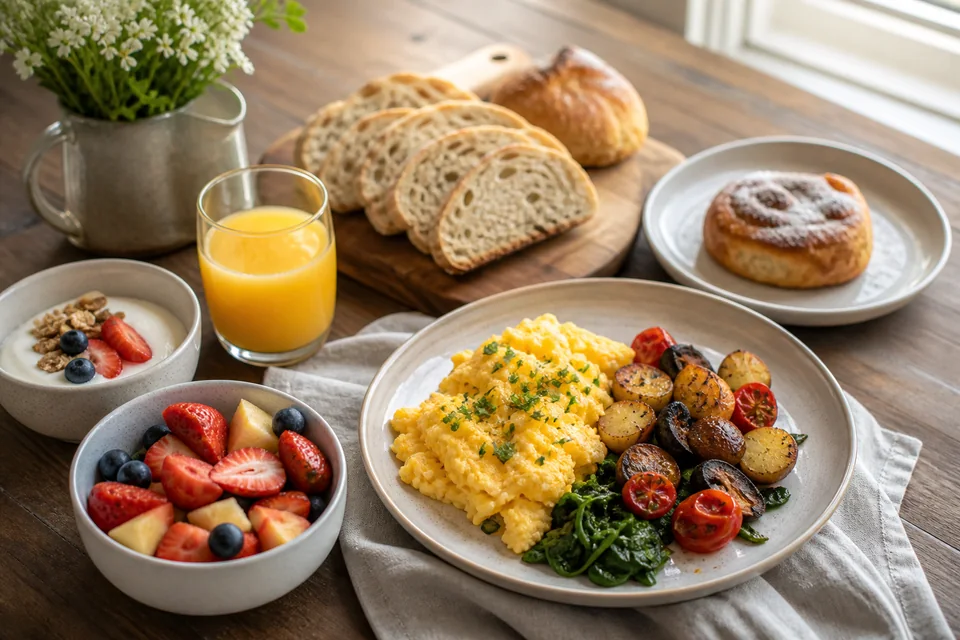
The direct answer: choose concrete foods, then check their roles
Good things to eat for brunch include eggs or a savoury bake, pancakes or toast, breakfast potatoes or oats, fresh fruit or a dressed vegetable, yogurt, filled rolls, coffee, tea and one optional pastry or cake. A complete small menu might be baked eggs, toast, strawberries and coffee. A standing buffet might use egg-and-bean rolls, fruit cups, baked oatmeal squares and self-serve drinks. This page owns the food-choice question: it explains what to put on the table and why each choice earns its place. The event workflow—shopping, equipment and a timed host plan—belongs to the separate guest-planning guide. The wider Pancake World collection provides the platform context for these choices.
One food-role table
| Role | Concrete choices | Choose it when |
|---|---|---|
| Substantial anchor | Baked eggs, frittata squares, savoury pancakes, bean-and-egg rolls | Brunch replaces a main meal |
| Bread or grain | Toast, rolls, pancakes, baked oats, muesli | The anchor needs a carrier or guests need a mild option |
| Fresh element | Whole berries, citrus segments, cucumber salad, dressed leaves | The rest of the plate is hot, rich or soft |
| Warm side | Breakfast potatoes, roasted tomatoes, mushrooms | Guests are seated and the oven or hob has capacity |
| Handheld option | Filled rolls, breakfast wraps, oat bars | Guests stand, arrive in waves or travel |
| Cool component | Yogurt, fruit cups, chilled compote | A make-ahead item will reduce hot work |
| Drink | Coffee, tea, water, juice or a clearly labelled optional mixed drink | Service and guest needs are known |
| Sweet finish | One pastry, fruit cake or small pancake stack | It adds contrast rather than duplicating three other sweet foods |
Occasion decision
The same food behaves differently at a seated table, a buffet or a commute-friendly gathering. Seated service can support a soft egg dish and a plate assembled at the last moment. A buffet needs stable serving pieces, separate utensils and labels. Standing service rewards food that can be picked up without a knife. A family breakfast can offer several small choices because the host can adjust one plate at a time; a larger group needs a repeatable batch and a clear alternative. Decide the service mode before browsing recipes, otherwise the most photogenic option may become the least practical one.
One portion framework
Use these as editorial starting portions, then replace them with the yield of the exact recipe and the appetites of the group. For each adult place setting, plan one anchor portion; one to two bread pieces or one grain portion; about 120–150 g prepared fruit or vegetables; and 250–350 ml of the main non-alcoholic drink during the meal. Two people therefore need two anchor portions, two to four bread pieces and roughly 250–300 g produce. Six need six anchors, six to twelve bread pieces and roughly 750–900 g produce. Twelve need twelve anchors, twelve to twenty-four bread pieces and roughly 1.5–1.8 kg produce. These are menu-composition quantities, not an event calculator or a guarantee of consumption.
Six complete menu combinations
1. Two-person seated brunch
Baked eggs, toast, strawberries and coffee. The eggs are the anchor, toast is the carrier, berries supply a cool contrast, and coffee completes service.
2. Six-person buffet
Frittata squares, dressed greens, rolls and one fruit cake. Everything portions cleanly and only the greens need a last-minute finish.
3. Standing gathering
Egg-and-bean rolls, fruit cups, baked oatmeal squares and self-serve tea. Every food can be handled without a knife.
4. Mixed dietary table
Two labelled anchors, shared roast potatoes, fruit and separate sauces. Each guest can build a complete plate without relying on garnish.
5. Limited-kitchen brunch
Overnight oats, sliced loaf, yogurt and citrus. The menu uses refrigerator and counter capacity instead of competing hot equipment.
6. Make-ahead family brunch
A savoury bake, room-temperature bread, cucumber salad and a small pancake stack. Only the bake is reheated, and the sweet item has a distinct role.
Hot or cold decision framework
| Situation | Choose | Control | Avoid |
|---|---|---|---|
| Seated, immediate service | One hot anchor plus cold sides | Finish the anchor close to eating | Several fragile pan dishes |
| Buffet | Sliceable bake, rolls, fruit | Holding window and utensils | Unlabelled mixed serving tools |
| Standing gathering | Handheld food and cups | Grip and moisture | Runny fillings |
| Limited kitchen | One make-ahead anchor | Fridge and counter sequence | Simultaneous finishing |
If the menu feels crowded, keep one hot anchor and move the remaining roles to safe cold or room-temperature formats. If two hot foods are essential, give them different equipment and finishing times.
Decision tree
- Will guests sit? If no, choose handheld portions; if yes, a plated anchor can work.
- Is there one free hot appliance? If no, use a cold or make-ahead anchor; if yes, reserve it for one dish.
- Does every guest have a substantial path? If no, add a complete labelled alternative.
- Are two foods doing the same job? If yes, remove the harder one.
- Can every perishable item be held safely? If no, replace it before expanding the menu.
What not to combine
- Do not combine three bread-heavy foods and call their different shapes variety.
- Do not pair several last-minute hot dishes with one oven or pan.
- Do not combine syrup-heavy pancakes, sweet pastries and sweetened fruit drinks without a savoury counterweight.
- Do not place a token garnish where a guest needs a complete alternative.
- Do not combine chilled dairy and a long uncontrolled buffet window.
Final checklist
- One substantial anchor is clear.
- Bread or grain, fresh contrast and drinks have distinct jobs.
- Six worked combinations remain one set, not competing catalogues.
- Hot work fits the available equipment.
- Every guest can reach a complete plate.
- Perishable food has a controlled holding plan.
The best brunch menu is the smallest combination that gives every component a necessary role and the host a realistic service sequence.
Related Reading
Sources and editorial references
- University of Minnesota Extension, Planning the Quantity Food Occasion —
https://extension.umn.edu/cooking-safely-crowd/planning-quantity-food-occasion - University of Nebraska–Lincoln Extension, Step 2: Menu Planning —
https://extension.unl.edu/statewide/burt/favorite-foods-revue-booklet/step-2-menu-planning/ - USDA MyPlate, What Is MyPlate? —
https://www.myplate.gov/eat-healthy/what-is-myplate - FDA, Food Safety at Home —
https://www.fda.gov/consumers/consumer-updates/food-safety-home - USDA FoodData Central —
https://fdc.nal.usda.gov/