Regional culture local guide
Mediterranean Brunch Ideas
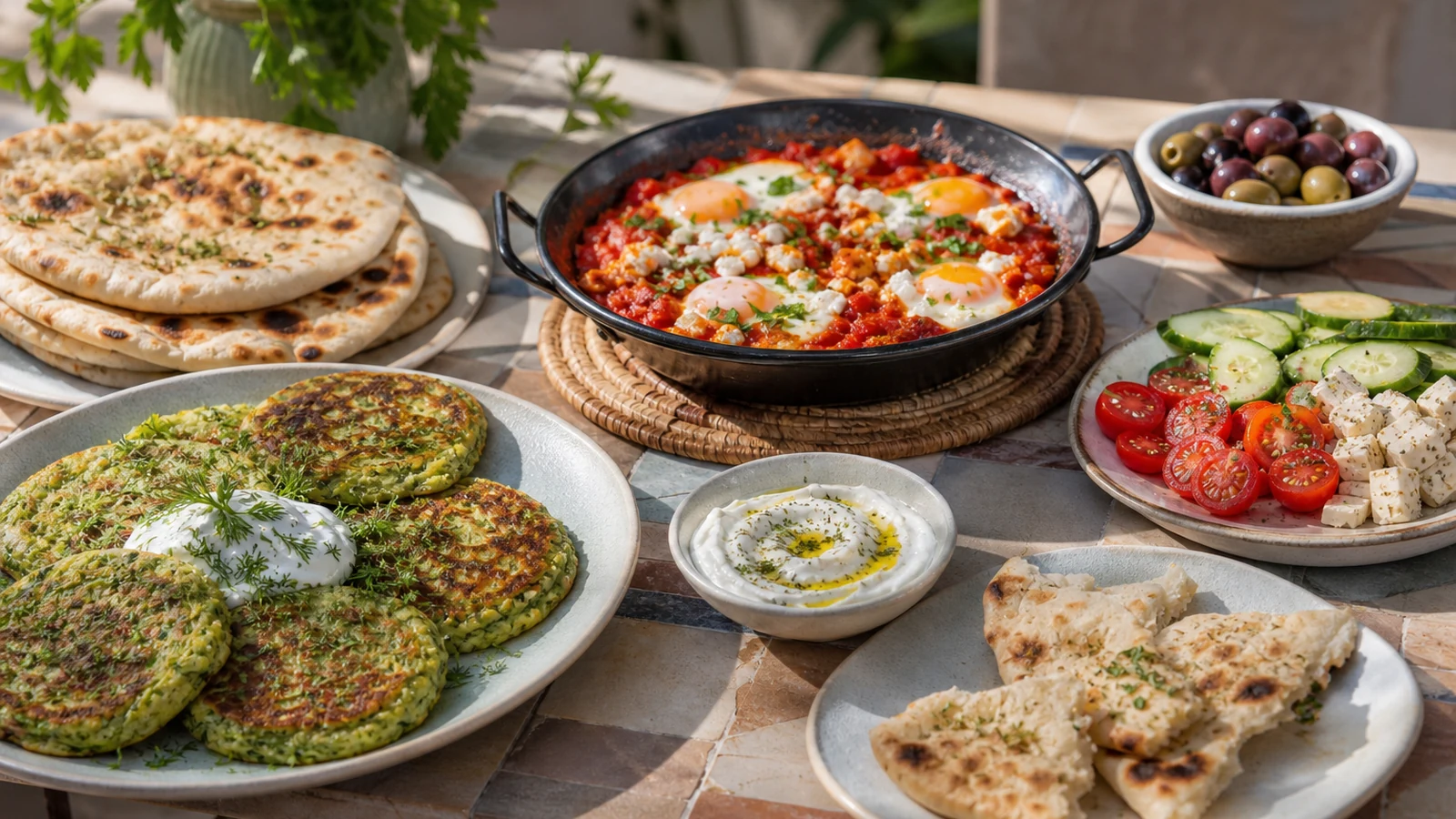
Make Mediterranean brunch ideas useful by treating them as a shared, Mediterranean-inspired table rather than one fixed regional breakfast: choose a named reference, one anchor dish, fresh produce, bread and a small group of optional accompaniments. Pancake World uses that boundary so a practical menu does not pretend to be universally authentic. Start with the wider Brunch planning collection when guest count or timing is the main question.
Terminology: what “Mediterranean” can and cannot mean
UNESCO describes Mediterranean diet heritage as knowledge, practices and social sharing across several named countries. That evidence supports a respectful frame for a shared table. It does not supply a universal brunch formula, portions or a health outcome. The owner statement for this route is therefore simple: it owns cultural context plus menu adaptation, not a claim of culinary authority over the whole region.
Route ownership and the reader’s decision
This page answers how to shape an adaptable Mediterranean brunch. It deliberately leaves last-minute logistics to Last Minute Brunch Ideas and does not replace a complete tested recipe. Decide first whether the anchor needs last-minute cooking; everything else should either be ready to set out or easy to replenish.
Named-context comparison: keep the reference honest
A cultural guide becomes less reliable when “European breakfast” is used as a shortcut. The National Museum of Ireland, the Royal Danish Library and CzechTourism are named comparison contexts here, not evidence for Mediterranean customs. Their presence makes the limitation visible: breakfast language, institutional context and food traditions are local, so a borrowed element should be named rather than flattened into a continent-wide menu.
National Museum of Ireland is a contrast point, not a source for a Mediterranean dish.
Royal Danish Library’s breakfast setting is distinct from a regional heritage claim.
CzechTourism is a contrast point; no Czech menu is treated as Mediterranean.
Irish, Danish and Czech contrasts: a wording check
Say “Mediterranean-inspired brunch with a tomato-and-egg anchor” when that is what is being served. Do not say “the Mediterranean breakfast,” then add ingredients from unrelated named contexts and call the result traditional. This small wording check protects both the guest-facing description and the research boundary. A regional label should explain inspiration, not erase difference.
Build one coherent regional menu
Choose one visible direction: a tomato-and-egg pan with flatbread; a bean-and-vegetable table; or yogurt, fruit and grain bowls. The combinations are editorial adaptations, not a documented traditional menu. Keep the supports quieter than the anchor so guests can understand the table without a catalogue of competing flavours.
| Anchor direction | Useful supports | Practical limitation |
|---|---|---|
| Warm tomato-and-egg pan | Bread, cucumber, herbs | Needs a defined serving moment |
| Bean spread table | Vegetables, olives, bread | Check sesame and other labels |
| Yogurt and fruit bowls | Grain, nuts if suitable | Not appropriate for every dairy need |
Evidence and adaptation separation
The evidence is limited to what the named sources support: UNESCO supports a cultural frame of practices and sharing; FDA and USDA sources support safe handling boundaries. The adaptation is the menu system on this page: pair, portion, sequence and plate according to the actual guests and chosen recipe. Keeping those jobs separate prevents an invented authenticity claim.
Practical reader guidance for service
Set bread, vegetables and condiments in separate vessels so guests can compose a plate. Keep any dish requiring a verified cooked endpoint tied to its complete recipe and a thermometer where official guidance calls for one. Wash produce and keep it separate from raw animal products as the FDA guidance advises. These are handling boundaries, not a substitute for recipe-specific instructions.
For a different outdoor format, see Brunch Picnic Menu Ideas. For a fruit-led supporting course, Berry brunch guide offers a separate planning direction.
Limitations before you shop
This guide cannot verify an individual allergy environment, appliance, dietary requirement, recipe yield or family tradition. Check labels for the products actually purchased, offer alternatives instead of forcing a substitution, and follow the source recipe for cooking and storage. Avoid presenting olives, dairy, bread or eggs as mandatory; they are options in an adaptation, not a cultural test.
Adaptation examples without authenticity claims
For a dairy-free table, make the dairy role optional rather than renaming a replacement as traditional. For a later arrival time, keep a warm anchor in small batches and replenish vegetables and bread separately. For an herb-focused plate, name the herbs used and the recipe reference instead of attaching a broad national label. The method stays clear because the adaptation is disclosed.
Cultural and menu summary
The strongest Mediterranean brunch is a modest, named and adaptable shared table: select one reference point, give it one clear anchor, add produce and bread deliberately, and state the limits of what the table represents. That approach respects regional variation while still giving a host a practical next move.
Related reading
Sources and editorial references
- UNESCO Intangible Cultural Heritage. Mediterranean diet. https://ich.unesco.org/en/RL/mediterranean-diet-00884
- National Museum of Ireland. Museum collections and Irish cultural context. https://www.museum.ie/en-IE/Museums/Country-Life
- Royal Danish Library. Food and beverages at Victor Albecks Vej, Aarhus. https://www.kb.dk/en/visit-us/victor-albecks-vej-aarhus/food-and-beverages
- CzechTourism. Czech gastronomy. https://www.czechtourism.com/
- U.S. Food and Drug Administration. Selecting and Serving Produce Safely. https://www.fda.gov/consumers/consumer-updates/selecting-and-serving-produce-safely
- USDA Food Safety and Inspection Service. Safe Minimum Internal Temperature Chart. https://www.fsis.usda.gov/food-safety/safe-food-handling-and-preparation/food-safety-basics/safe-temperature-chart