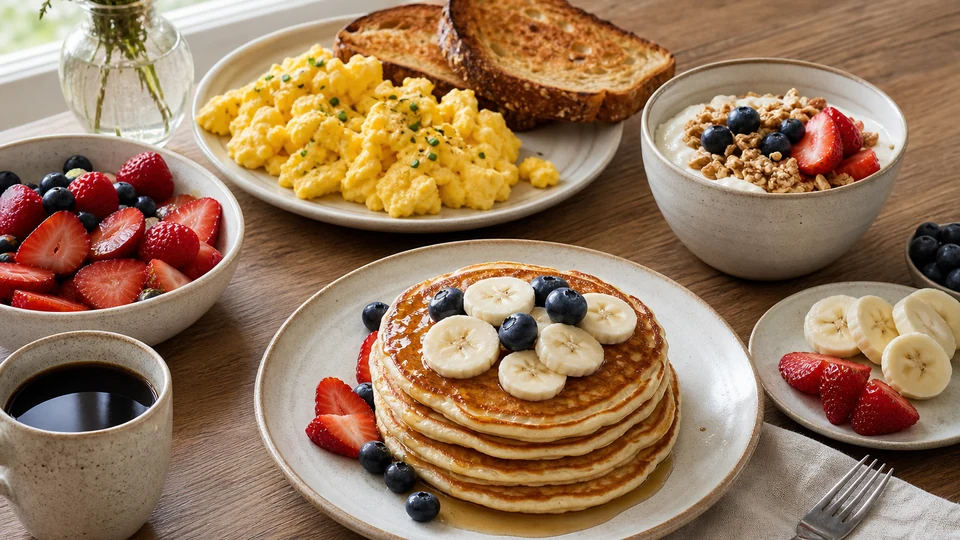
A last-minute brunch works best when you diagnose the constraint first: choose one ready-to-serve base, one quick hot element, and one fresh side instead of trying to cook a full spread at once. This Pancake World guide turns the usual last-minute problems—too little time, one burner, uncertain leftovers, or early guests—into small corrections that keep service manageable.
Direct diagnosis: what makes a brunch feel last minute
The practical answer is to protect one service lane. A toast board, yogurt-and-fruit cups, or a single egg pan can be an anchor; adding two more hot recipes is usually the symptom that the plan has become too ambitious. Start with the time you actually have, not the menu you hoped to make.
Use the wider Brunch hub for occasion planning. Here, the route owner statement is narrower: this page helps a host identify the one constraint that is delaying brunch, apply the smallest correction, and serve a coherent meal without claiming a universal recipe or timing guarantee.
Symptom intake before you choose food
Look for the visible state: no cooked food yet, a queue at the oven, cold ingredients left on the counter, guests already seated, or a missing dietary-safe option. Each state calls for a different response, so do not begin by adding recipes.
- Twenty minutes or less: select bread or another ready base plus one cold assembly.
- One pan available: make that pan the only hot item.
- Guests arriving in waves: put out the cold component first and cook in small batches.
- Storage history unclear: leave that food out of the plan rather than treating it as a shortcut.
Root-cause matrix for a stalled brunch
| Observed symptom | Likely cause | Smallest correction |
|---|---|---|
| Nothing can be served yet | Every component depends on cooking | Set out fruit, yogurt, or packaged bread while one hot item cooks. |
| The cook is switching between pans | Too many hot lanes | Drop the least substantial hot dish and add a prepared topping. |
| Food is waiting without a plan | Holding was not considered | Serve the item that degrades fastest first; keep cold foods cold. |
| A substitution is becoming complicated | The anchor relies on an absent ingredient | Choose a different anchor rather than rebuilding the recipe. |
A root-cause diagnosis is more useful than a long list because it connects a visible problem to one correction. It also avoids pretending that a single menu suits every appliance, guest count, or dietary requirement.
Ordered diagnostic sequence
- Count the diners and state the real serving deadline.
- Inventory one bread, grain, or ready-to-serve base; one protein or substantial topping; and one fruit or vegetable side.
- Choose only one active heat source.
- Check package instructions and storage history before using frozen or prepared food.
- Put plates, drinks, and the cold component out before the hot item reaches its final stage.
This sequence is deliberately short: it identifies capacity before the menu. For a make-ahead format with separate portions, see Brunch Cups; it is a related format, not a required addition to this meal.
Recipe selector: choose an anchor by the failure you need to avoid
Select toast when time is the limiting factor, yogurt cups when heat is the limiting factor, and a simple egg skillet when the missing piece is a hot savoury item. The selector is not a rating: it is a way to match a method to the constraint in front of you.
Recipes 1–6 below are deliberately small modules with yields, ingredients, and methods so the page does not imply a complete recipe where none is provided. Follow package directions and official food-safety guidance when they set a different requirement.
Recipe 1: toast and bean board
Yield: 4 light servings. Ingredients: 8 slices bread, 1 drained can beans, 2 tablespoons olive oil, lemon, salt, pepper, and washed herbs or tomatoes. Method: Toast the bread. Mash half the beans with oil and lemon, fold in the remaining beans, season, and spoon over the toast. Put the fresh garnish on separately so guests can choose it.
This is the correction for an empty table: it has one hot action and no second pan.
Recipe 2: yogurt, oats, and fruit cups
Yield: 4 cups. Ingredients: 4 cups plain yogurt, 1 cup rolled oats or granola, 2 cups washed fruit, and 4 teaspoons seeds or nuts if suitable for the diners. Method: Divide yogurt into four cups, add the dry topping at the last moment, and place fruit on top or beside it. Keep the cups refrigerated until service.
Use this when the burner is occupied; it supplies a cold lane without asking the oven to do another job.
Recipe 3: one-pan vegetable eggs
Yield: 4 servings. Ingredients: 8 eggs, 2 cups chopped quick-cooking vegetables, 1 tablespoon oil, salt, pepper, and herbs. Method: Cook vegetables in oil until tender, add beaten eggs, and cook over moderate heat while stirring or folding until the eggs reach the desired safe endpoint. Serve immediately with bread.
Use an instant-read thermometer where official guidance requires one; do not rely on raw tasting as a safety check. For a larger egg service pattern, compare Brunch Eggs for a Crowd.
Recipe 4: fast avocado toast
Yield: 4 servings. Ingredients: 8 slices bread, 2 ripe avocados, lemon juice, salt, pepper, and sliced radish or tomato. Method: Toast bread, mash avocado with lemon and seasoning, spread immediately, and finish with the sliced vegetable. Make only the amount that will be served now.
This module corrects a missing fresh component without creating a second cook-and-hold problem. See Avocado Toast for Breakfast for ingredient-focused context.
Recipe 5: warm frozen waffle support
Yield: 4 servings. Ingredients: 8 frozen waffles, 2 cups berries or sliced fruit, 1 cup yogurt, and a prepared spread. Method: Heat waffles exactly as their package directs. While they heat, portion fruit, yogurt, and spread; serve the waffles as they finish rather than holding a large stack.
Only choose this route when the package is intact and its storage history is known. The product directions take precedence over this service suggestion.
Recipe 6: no-cook savoury plate
Yield: 4 servings. Ingredients: 1 loaf ready bread or crackers, 250 g hummus or another prepared spread, 2 cups washed vegetables, 1 cup olives, and lemon. Method: Arrange the bread, spread, vegetables, and olives on one board; add lemon at service. Keep refrigerated ingredients chilled until they are set out.
Choose this when no reliable heat source is available. It is a complete service module, not a claim that no-cook food is suitable for every guest or situation.
Moisture-control matrix
| Food state | Risk to the plan | Control |
|---|---|---|
| Toast waiting under wet toppings | Loss of crispness | Keep topping separate until service. |
| Fruit cut early | Liquid collects in cups | Wash and cut near service; drain before plating. |
| Waffles stacked after heating | Steam softens them | Serve in short runs instead of holding a tall stack. |
This matrix treats texture as a service issue, not as proof of safety or quality testing.
Immediate corrections and prevention rules
If the plan has failed because there are too many tasks, remove one task before adding an ingredient. If the problem is timing, serve the cold component now and delay the final toast or eggs until diners are ready.
- Prevention: keep one shelf-stable or frozen anchor that has clear package directions.
- Prevention: decide which dish is served immediately before starting it.
- Prevention: use clean utensils and separate raw-food preparation from ready-to-eat food.
- Prevention: label or show ingredients when guests may need to make their own choice.
Edge cases that change the answer
For a mixed group, set components separately instead of assuming a substitution works for everyone. For an uncertain leftover, the correct diagnostic outcome may be to exclude it. For a delayed guest, hold only foods that can be held according to their own instructions and use smaller replenishments. The broader Brunch Picnic Menu Ideas guide is useful when transport, rather than speed, is the main constraint.
Troubleshooting rows during service
- The eggs are finished before everyone arrives.
- Serve them to the diners present and use the cold component for later arrivals; do not create a second pan by default.
- The bread is not ready.
- Offer the prepared spread, fruit, and vegetables first, then toast in batches.
- A planned ingredient is missing.
- Return to the selector and switch anchors rather than forcing an incomplete module.
One recording method for the next brunch
After service, write down only three facts: the actual guest count, the item that waited longest, and the tool that became the bottleneck. That observation log gives the next brunch a useful starting point without turning one informal meal into a claimed test. For a different breakfast format, related reading includes Typical Japanese Breakfast.
Conclusion
The best last-minute brunch idea is a diagnostic choice, not a crowded menu: identify the limiting resource, keep one hot lane, and serve the component that is ready. That close leaves room for real labels, package instructions, storage conditions, and guest needs to determine the details.
Related reading
Sources and editorial references
- USDA Food Safety and Inspection Service. Safe Minimum Internal Temperature Chart.
https://www.fsis.usda.gov/food-safety/safe-food-handling-and-preparation/food-safety-basics/safe-temperature-chart - U.S. Food and Drug Administration. Selecting and Serving Produce Safely.
https://www.fda.gov/consumers/consumer-updates/selecting-and-serving-produce-safely - U.S. Food and Drug Administration. Refrigerator Thermometers: Cold Facts about Food Safety.
https://www.fda.gov/consumers/consumer-updates/are-you-storing-food-safely - USDA Food Safety and Inspection Service. Leftovers and Food Safety.
https://www.fsis.usda.gov/food-safety/safe-food-handling-and-preparation/food-safety-basics/leftovers-and-food-safety