Breakfast culture guide
Typical Japanese Breakfast
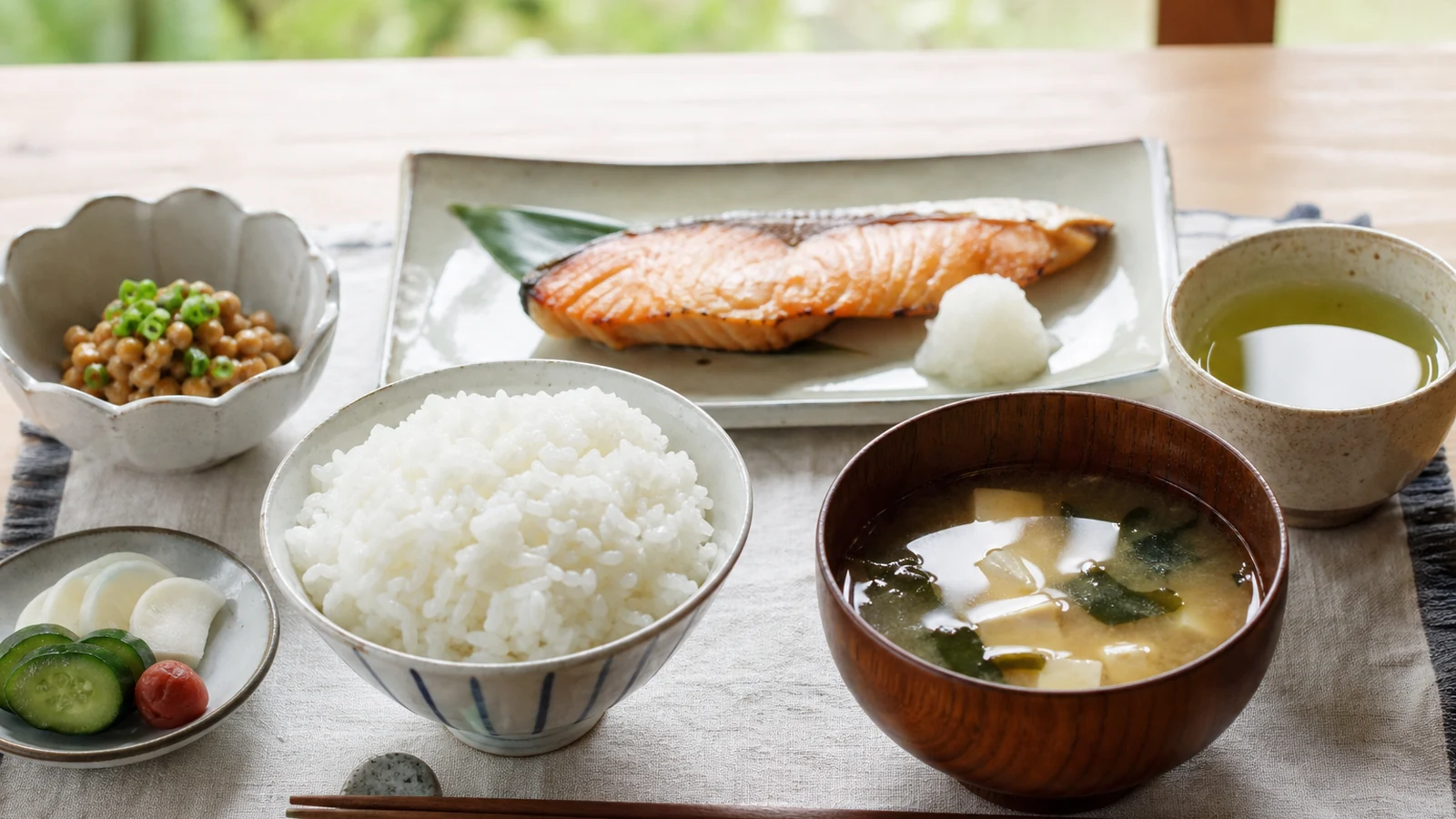
A typical Japanese breakfast is best understood as a flexible meal pattern: rice, soup, a modest main and small accompanying dishes are a useful reference point, not a rule for every household in Japan. This guide separates documented food-culture context from a practical home adaptation; Pancake World treats the plate as a respectful starting structure rather than a test of authenticity.
Route owner statement: this guide owns the cultural interpretation of “typical Japanese breakfast,” rather than a recipe collection or a restaurant recommendation.
What “typical” can and cannot mean
UNESCO’s Washoku entry describes a food culture associated with respect for nature and seasonal ingredients; it does not prescribe one daily breakfast. That boundary matters when planning or describing a meal.
Terminology: washoku and ichiju-sansai
The phrase is helpful for understanding balance, not a demand to reproduce a formal menu before breakfast. A smaller home meal can use the organising idea without claiming formal authenticity.
Named-context comparison
| Named context | What it can show | What it cannot prove |
|---|---|---|
| Home breakfast | Personal timing and preference | A national rule |
| Ryokan breakfast | Hospitality-service presentation | An ordinary daily menu |
| Ichiju-sansai menu | A formal balancing model | A required breakfast count |
Keeping the home meal, inn breakfast and formal menu separate prevents one visually familiar tray from becoming an unsupported universal claim.
What named sources document
These institutions support a narrower conclusion than “this is what Japan eats”: regional food names and meal practices require their own context.
A practical breakfast structure
Rice can be a base; soup can be the warm element; a cooked egg, fish, tofu or beans can be central; greens, pickles or fruit can add contrast. The combination is a home-planning suggestion, not a universal traditional prescription.
Evidence and adaptation separation
The documented evidence here concerns Washoku, regional diversity and named meal structures. The suggested home sequence—prepare the base, make the central item, then set out small sides—is editorial practical guidance. It is not a historical rule or a statement about an individual family.
Preparation order for a home table
Separate bowls can make serving clearer, but vessel choice is a convenience decision here, not proof of authenticity. For another constrained planning format, see Last Minute Brunch Ideas.
Ingredient labels and safety limits
Read dashi and seasoning labels rather than assuming a dish is vegetarian; some products include fish-based ingredients. When preparing animal foods, follow current official handling and cooking guidance for that food. This guide does not replace a complete recipe, label or safe-endpoint instruction.
Regional variation without a catalogue
Miso, pickles, rice preparations and preserved foods take different forms across Japan. Name a region or source when it is known; otherwise describe a dish simply. Do not attach an unverified origin story to a household breakfast. For a distinct topic, visit Japanese pancake styles.
Route ownership and related reading
This page explains the cultural frame behind a typical Japanese breakfast. It does not replace dish-led preparation, so readers seeking that can use Japanese Breakfast Recipes. For another breakfast occasion, see Brunch Ideas for Men. The parent collection is World Pancakes.
Cultural and menu summary
Use rice, soup, a central dish and small sides as a documented reference pattern; name the context when it is known; and label home decisions as adaptations. That is a useful cultural summary without turning varied households and regions into one fixed breakfast.
Sources and editorial references
- UNESCO Intangible Cultural Heritage. Washoku, traditional dietary cultures of the Japanese, notably for the celebration of New Year. https://ich.unesco.org/en/RL/washoku-traditional-dietary-cultures-of-the-japanese-notably-for-the-celebration-of-new-year-00869
- Ministry of Agriculture, Forestry and Fisheries of Japan. Traditional Foods in Japan. https://www.maff.go.jp/e/policies/market/dento_syoku/
- National Diet Library, Japan. Japanese Food Culture. https://www.ndl.go.jp/
- Japan National Tourism Organization. Japanese food and regional travel information. https://www.japan.travel/en/
- U.S. Department of Agriculture Food Safety and Inspection Service. Safe Minimum Internal Temperature Chart. https://www.fsis.usda.gov/food-safety/safe-food-handling-and-preparation/food-safety-basics/safe-temperature-chart