Japanese Breakfast Recipes
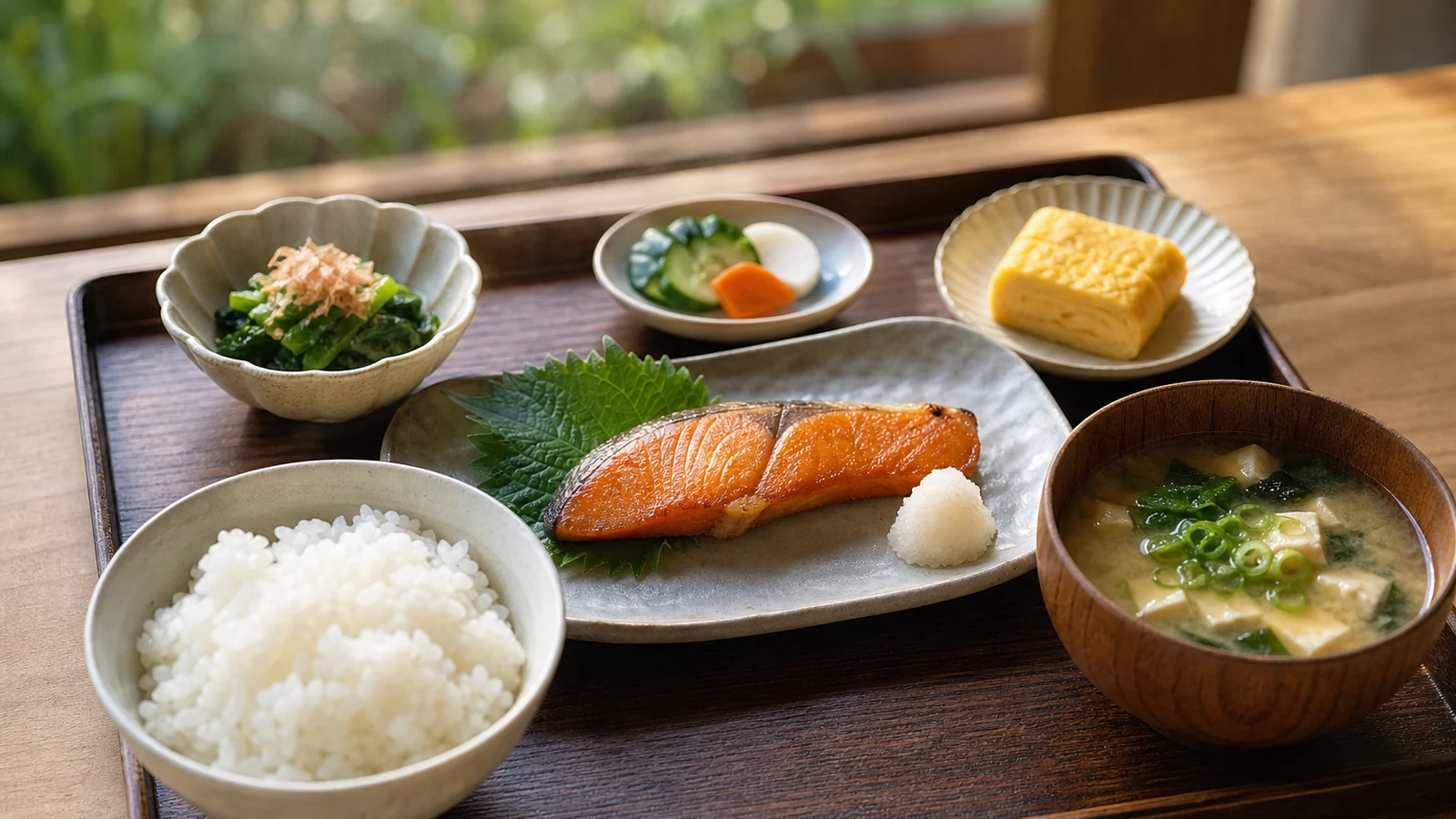
A useful Japanese breakfast recipe plan begins with one rice dish, soup, a main, and a small side, selected from complete recipes rather than treated as a single universal menu. This guide separates documented food-culture reference points from a practical home sequence; Pancake World does not claim a tested, definitive, or nationally uniform breakfast.
The route’s cultural scope
This is a guide to reading Japanese breakfast recipes as a composed meal, not a claim that every household eats the same foods. The World Pancakes collection is the parent hub; the present route owns the breakfast-set question.
Terminology: washoku and an everyday breakfast set
Washoku is a broad term for Japanese food culture. UNESCO’s inscription concerns traditional dietary cultures associated notably with New Year, so it cannot prove an everyday breakfast menu. MAFF’s material is used here for food-culture context, while a recipe’s own instructions govern its ingredients and method.
Named-context comparison
The National Museum of Ireland, Royal Danish Library, and CzechTourism appear in the frozen T8 validation fixture, but they are not evidence for Japanese breakfast practice. They are deliberately excluded from the cultural comparison. For this route, the named Japanese contexts are UNESCO’s washoku record, Japan’s Ministry of Agriculture, Forestry and Fisheries (MAFF), and the National Diet Library’s collections on Japanese food culture.
Documented distinctions, not a national menu
UNESCO describes dietary culture as linked to social practice and seasonality; MAFF presents traditional foods through regions and local products. Those references support variation and context. They do not support declaring rice, miso soup, grilled fish, egg, or pickles mandatory for every Japanese breakfast.
A respectful four-part planning frame
Use one starch, one soup, one cooked anchor, and one small side as planning roles. Rice may be the starch; soup can be based on a complete recipe; a cooked fish, egg, tofu, or vegetable dish can be the anchor. The roles make service manageable without converting a cultural reference into an authenticity test.
Evidence and adaptation
Documented reference: Japanese food culture includes regional and household variation. Practical adaptation: a cook may choose one warm rice-based component, one soup, and a small side because that sequence is manageable at home. The latter is this page’s planning suggestion, not a historical rule.
Choose a breakfast-set shape
| Shape | When it is practical | Boundary |
|---|---|---|
| Rice, soup, cooked main | You can time one hot main last | Choose a complete fish, egg, or tofu recipe |
| Okayu with restrained sides | You want a softer rice preparation | Do not label it the default Japanese breakfast |
| Onigiri with soup | You need a portable rice component | Check filling, storage, and recipe instructions |
| Rice with vegetable-focused main | You are planning a plant-forward meal | Verify stock and seasoning ingredients |
For a focused companion on the wider meal pattern, the pending same-R83-corpus route Typical Japanese Breakfast provides a distinct overview rather than another recipe method.
Practical preparation order
Start the longest-cooking rice component first. Prepare a ready-to-serve side next, make soup close to service, and cook the quick main last. This is an operational order, not evidence that any dish belongs in every breakfast.
Read the chosen recipes in full before substituting miso, dashi, rice, fish, egg, or tofu. A vegetarian version requires an ingredient check for dashi; a label or recipe statement is more reliable than an assumption based on the dish name.
A two-person home example
For two diners, put two bowls, a shared main plate, a soup vessel, and a small side dish on the counter before cooking. Select one rice preparation, one soup recipe, and one cooked main recipe. The quantities remain those printed by the chosen recipes; this page does not create a universal yield or nutrition calculation.
Equipment and timing limits
If there is one burner, let rice and soup determine the schedule and choose a main that can be cooked in a separate pan or prepared ahead according to its recipe. If chilled storage is limited, choose fewer make-ahead items rather than holding several prepared dishes without a plan.
For a constrained service window, the pending same-R83-corpus guide Last Minute Brunch Ideas offers a different planning lens. It does not establish Japanese culinary practice.
Food-safety boundary
USDA guidance is relevant when a chosen recipe contains foods requiring safe handling or a verified cooking endpoint. Follow the recipe and current official food-safety guidance; visual appearance, aroma, or a cultural label is not a safety check. This article offers no medical, dietary, allergy, or storage guarantee.
Route ownership and nearby reading
This route explains how to interpret and assemble Japanese breakfast recipes without claiming one authentic template. The pending same-R83-corpus article Large Brunch Ideas addresses scale, not Japanese food culture, and is intentionally linked as a separate planning problem.
Limitations and wording check
Say “one possible breakfast set” rather than “the Japanese breakfast.” Name the source when describing a cultural record, and label kitchen sequencing as an adaptation. Omit current venue, event, regional popularity, and household claims unless a source directly supports them.
Cultural and menu summary
The useful conclusion is modest: build a Japanese breakfast recipe plan around a documented food-culture context, choose complete component recipes, and make the home workflow visible as adaptation. That respects variation better than turning a rice, soup, main, and side frame into a universal rule.
Related reading
Editorial method
Pancake World prepared this route as an evidence-led cultural guide. It does not claim first-hand testing, ratings, interviews, certification, medical outcomes, or exhaustive representation of Japanese breakfasts.
Sources and editorial references
- UNESCO, “Washoku, traditional dietary cultures of the Japanese, notably for the celebration of New Year” —
https://ich.unesco.org/en/RL/washoku-traditional-dietary-cultures-of-the-japanese-notably-for-the-celebration-of-new-year-00869 - Ministry of Agriculture, Forestry and Fisheries of Japan, “Traditional Foods in Japan” —
https://www.maff.go.jp/e/policies/market/dento_syoku/ - National Diet Library, “Food Culture” research guide —
https://www.ndl.go.jp/en/copy1/ - Japan National Tourism Organization, “Japanese Food” —
https://www.japan.travel/en/guide/japanese-food/ - USDA Food Safety and Inspection Service, “Food Safety Basics” —
https://www.fsis.usda.gov/food-safety/safe-food-handling-and-preparation/food-safety-basics