Large Brunch Ideas
Large brunch ideas work best as a small service system: choose one hot anchor, build a few repeatable support dishes, count the vessels and cold space, then refill in planned waves. This guide turns a crowd menu into a practical checklist rather than an overlong recipe list.
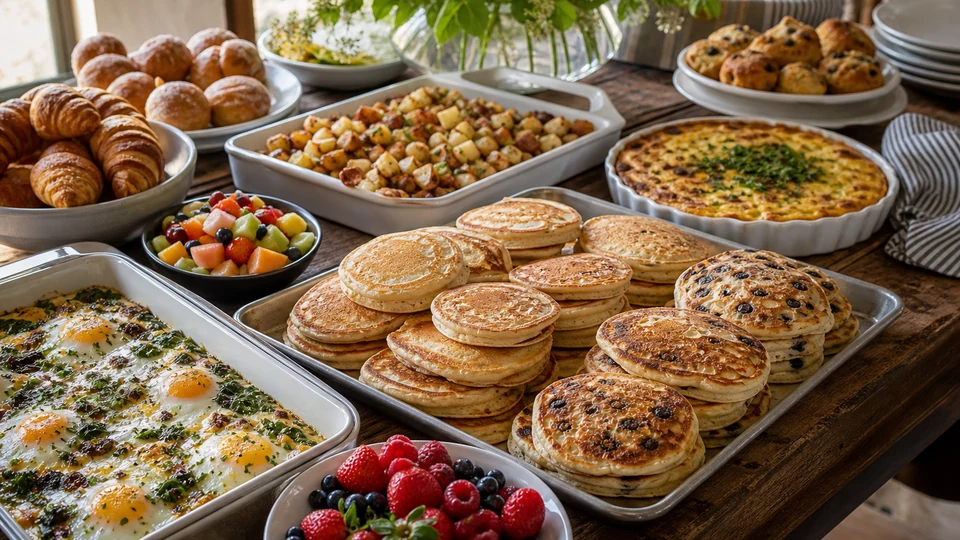
Direct plan for a large brunch
For a first plan, set one service time and one guest-count range, then give every dish a job: hot anchor, substantial side, fresh item, bread or starch, and drinks. Keep the menu short enough that the same person can see what is empty, what needs heating, and what has not been set out yet. Pancake World treats this as operational planning, not a promise that one menu fits every kitchen or group.
For a group around 12, a workable starting layout is one pancake or egg anchor, two filling sides, one fruit or vegetable component, bread, and beverages. The useful number is not a universal portion size: it is the yield printed on each chosen recipe or package, multiplied only after you have checked the pan, oven, and storage limits. Use the wider brunch planning hub when you need a broader menu starting point.
Guest-count starting point
Write the actual count as a range—such as 10–14 expected diners—rather than treating the largest possible number as an instruction to make every dish enormous. Plan the anchor for the expected group, then hold a clearly identified reserve that can be prepared only if arrivals require it.
A guest-count sheet should name the serving window, expected arrival pattern, children or adults if that affects recipe choice, and any confirmed dietary requests. This is access planning, not medical advice or a claim that a shared kitchen can meet every allergen need. Ask guests directly and keep labels and utensils distinct where the chosen menu requires it.
- Expected count: the number used to select recipe yields.
- Reserve: one shelf-stable or separately held component, not a duplicate full menu.
- Service window: the period during which the hot anchor can be replenished responsibly.
Menu roles before recipes
One anchor
Choose the dish that uses the most active heat or cook attention: pancakes, an egg bake, or a hot sandwich filling.
Two supports
Choose filling sides that can be portioned without competing for the same burner or oven shelf.
One fresh lane
Use fruit, vegetables, or another chilled item that can be replenished in smaller bowls.
This role-based menu stops “ideas” from turning into seven simultaneous recipes. A pancake anchor can work when the griddle and a dedicated cook are available; a baked anchor can work when oven space is genuinely free. For a contrasting format, see Japanese breakfast recipe ideas, then return to the capacity checks here before adding another cooking lane.
Shopping by yield and holding
Build the shopping list from the complete recipes you have selected. Copy each recipe yield, ingredient list, pan size, and make-ahead instruction into one sheet; then add only the quantities needed for the guest-count range. Do not convert a planning example into a guaranteed quantity.
Split shopping into three bags or delivery groups: shelf-stable breakfast items; chilled ready-to-eat items; and raw ingredients that will be prepared separately. USDA MyPlate can be used as a broad food-group planning lens, but it does not prescribe an individual meal or dietary outcome. For fruit and vegetables, FDA guidance recommends washing produce under running water and keeping it separate from raw animal products.
- Put serving bowls, labels, tongs, napkins, ice, and bin liners on the same list as food.
- Buy only the vessel count you can wash, chill, heat, and serve from.
- Mark recipe-specific substitutions separately so they do not become an untested batch change.
Equipment capacity check
Capacity is the constraint that decides the menu. Count usable oven shelves, burners, griddle zones, refrigerator shelves, trays, insulated carriers, serving utensils, and plate points before shopping. The anchor has priority; every other dish must fit around it.
For example, two shallow egg bakes may be easier to manage than one deep vessel only when the selected recipe permits that vessel and timing change. If the oven is committed to the anchor, choose sides that can be served cold or held according to their own instructions. Keep ready-to-eat food away from raw-preparation tools and surfaces.
Use this check to reject an appealing idea early: a menu that needs four hot pans at once cannot become practical merely by adding more ingredients. Typical Japanese breakfast is useful for considering a different service pattern, but appliance and recipe directions remain the deciding evidence.
Service timeline for a 12-person example
Work backwards from the serving time. The table is a sequence of decisions, not a claim that every brunch takes the same number of minutes. Insert the timings from your recipes and local setup, then leave a buffer before guests arrive.
| Planning point | Task | Decision check |
|---|---|---|
| Day before | Confirm recipes, yields, equipment, labels, and cold storage. | Remove any dish that shares an unavailable oven shelf or pan. |
| Before service | Set the plate point, drinks, cold dishes, and empty refill vessels. | Keep only the amount that can be served and replenished clearly. |
| Opening wave | Serve the anchor with one support and the fresh lane. | Record which component is actually moving first. |
| Refill wave | Replace one vessel at a time using the selected food's instructions. | Do not mix new food into an uncontrolled older batch. |
Service sequence and safe handling boundary
Put plates, cutlery, and beverages before the food line so guests do not reach across serving dishes. Place labels beside the dish they describe, and give each component a utensil. A second plate point can relieve a queue without multiplying the hot-food workload.
Food safety decisions remain specific to the food and its official instructions. When an animal product needs a verified safe minimum internal temperature, use a thermometer and the current USDA FSIS guidance rather than appearance, smell, or taste. Keep washed produce and ready-to-eat food separate from raw animal products as FDA guidance describes.
For an option that changes the flavor direction without adding another planning framework, a berry brunch guide can supply a fresh-component idea; check its recipe yield and storage needs against this service sequence.
Contingency choices that keep the line moving
Plan one response for each likely bottleneck: a late arrival, a full oven, a missing utensil, a slow queue, or less refrigerator space than expected. The correct response is usually to simplify the next refill, not to add an unplanned dish.
- Late arrivals: hold the reserve component according to its own instructions and open it only if needed.
- Slow griddle: reduce the number of toppings and keep sides ready for the first plates.
- Cold-space shortfall: remove a perishable variety before service rather than improvising storage.
- Dietary separation: label the component and provide its own utensil; do not make an unsupported allergen-free guarantee.
- Leftovers: decide which containers and refrigerator space are available before opening a new tray.
Final operational checklist
- Confirm the guest-count range and serving window.
- Select one hot anchor and delete any dish that competes for its capacity.
- Calculate food from the chosen recipes’ yields, labels, and package directions.
- Shop by shelf-stable, chilled, and raw-preparation lanes; include service equipment.
- Count oven, burner, griddle, refrigerator, tray, and utensil capacity.
- Assign a timeline for setup, first service, and one-at-a-time refills.
- Set labels, utensils, plate points, and a reserve before guests arrive.
- Use the applicable official guidance for temperature, produce handling, and leftovers.
Sources and editorial references
- U.S. Department of Agriculture Food Safety and Inspection Service. Safe Minimum Internal Temperature Chart. https://www.fsis.usda.gov/food-safety/safe-food-handling-and-preparation/food-safety-basics/safe-temperature-chart
- U.S. Food and Drug Administration. Selecting and Serving Produce Safely. https://www.fda.gov/consumers/consumer-updates/selecting-and-serving-produce-safely
- USDA MyPlate. MyPlate Food Groups. https://www.myplate.gov/eat-healthy/what-is-myplate
- U.S. Department of Agriculture Food Safety and Inspection Service. Leftovers and Food Safety. https://www.fsis.usda.gov/food-safety/safe-food-handling-and-preparation/food-safety-basics/leftovers-and-food-safety