Curated ideas reference
International Brunch Ideas
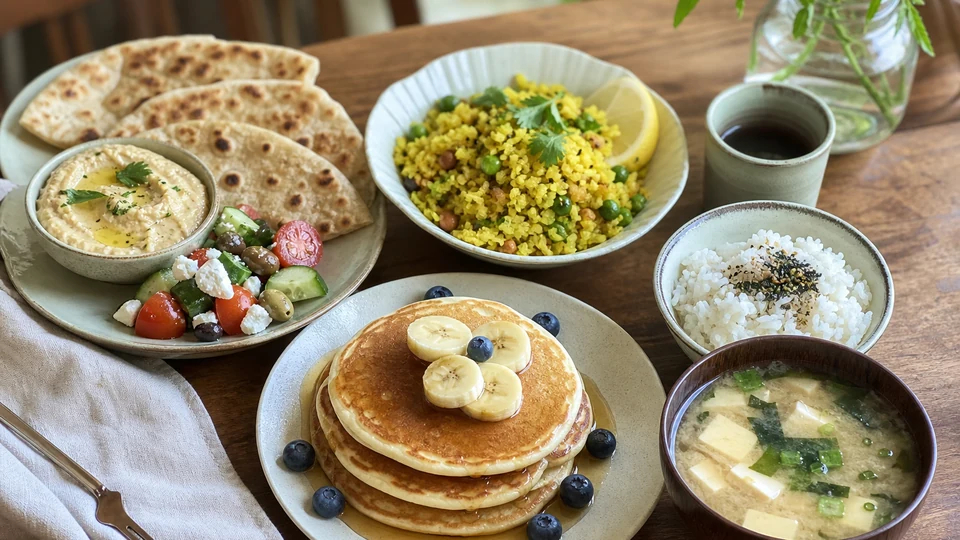
International brunch ideas work best when you choose one clear service pattern, then select dishes whose cooking, holding, and cultural context can be explained honestly. Start with one of the fifteen ideas below; pair it with fruit or a simple salad, and label each dish by its own tradition instead of calling a mixed plate “authentic.” Pancake World treats this as a practical selection guide, not a ranking or a claim of kitchen testing.
The Brunch hub is the parent collection. A good international brunch is not a tour of flags: it is a small menu whose parts reach the table together, whose names are not stretched beyond their source context, and whose substitutions are visible to guests.
Choose the brunch shape before the dishes
Use four filters: count active burners, oven space, and serving bowls; decide whether the table needs a hot centrepiece; identify constraints from labels rather than cuisine names; then set a theme boundary. Choose one regional breakfast structure, or two explicitly separate structures. These are editorial selection criteria, not rules claimed by any cuisine.
For a buffet, large brunch ideas can help with service flow. For a smaller table, choose one hot anchor and two quiet supports; strong sauces, fermented foods, and chilli can stay in separate bowls.
Fifteen distinct international brunch ideas
Each entry changes the eating action, cooking method, or service format. Cultural notes are deliberately narrow: they identify a documented breakfast dish or format, not a national representative.
- Japanese rice, grilled fish, miso soup, and pickles. Serve components separately. JNTO describes rice, grilled fish, soup, and side dishes as a familiar breakfast pattern; use a recipe for exact preparation.
- Korean juk morning bowls. Use mild rice porridge as the warm anchor with small separately labelled sides; this is spoon-and-bowl service.
- Turkish kahvaltı-style bread-and-small-plates table. Set bread, cheese, tomatoes, olives, eggs, and preserves in separate dishes for staggered arrivals.
- Mexican chilaquiles-style skillet. Build crisp tortilla pieces with warm sauce just before service; it is not a long-holding buffet item.
- Indian masala omelette with toast and chutney. Cook in batches and keep chutney apart for heat control; verify labels for dietary suitability.
- Israeli breakfast-inspired salad, eggs, bread, and labneh. Keep vegetables chilled, eggs hot, and dairy separate for a knife-and-fork plate.
- French tartine board with soft eggs. Offer toasted bread, butter, jam, fruit, and eggs; refresh bread rather than holding it covered.
- Spanish pan con tomate with tortilla española wedges. Toast bread close to service and use room-temperature tortilla as a sturdy make-ahead piece.
- Greek yogurt, fruit, bread, and egg plate. Make yogurt the cold centre and add eggs only if the kitchen has a short service window.
- Lebanese man’oushe-style flatbread station. Warm flatbreads in short runs and offer toppings separately; check sesame and dairy allergens.
- Ethiopian-inspired lentil and flatbread table. Offer lentils with flatbread and a mild vegetable side; keep heat additions optional.
- Vietnamese bánh mì breakfast board. Separate bread, pickled vegetables, herbs, and cooked filling for individual sandwich assembly.
- Filipino silog-style rice-and-egg plate. Pair garlic rice with egg and one savoury item, labelling the specific dish rather than treating the name as a universal formula.
- Swedish open-sandwich brunch. Lay out bread, toppings, cucumber, herbs, and eggs for assembly; keep chilled ingredients cold.
- Moroccan msemen and preserves with eggs. Serve warm layered flatbread with preserves and a labelled egg side; plan how bread will hold.
For a rice-and-soup breakfast format, see Japanese breakfast recipes. For a sandwich-led alternative, vegetarian breakfast sandwich focuses on assembly and moisture rather than cultural comparison.
Categories that prevent a random menu
The ideas divide into bowl breakfasts, skillet or griddle breakfasts, bread-and-plate breakfasts, and assembly breakfasts. Pick one category as the anchor. Add another only when it does not compete for the same oven, pan, or serving temperature.
Effort and audience matrix
| Brunch shape | Active cooking | Best audience | Main limit |
|---|---|---|---|
| Bowl breakfast | Medium | Seated guests wanting a warm meal | Needs bowls and coordinated hot service |
| Skillet or griddle | High | Small groups eating promptly | Texture changes while it waits |
| Bread-and-plate | Low to medium | Staggered arrivals | Bread declines if prepared too early |
| Assembly board | Low | Mixed preferences | Needs labels and separate utensils |
| Rice-and-egg plate | Medium | Diners wanting a savoury meal | Rice and egg timing must be managed |
This matrix is editorial planning guidance. It does not replace a recipe’s yield, appliance instructions, or food-safety directions.
Practical limits before you shop
Do not turn a dish name into a promise about every household or region. Use a source for context, then use the exact recipe for quantities. When cooking raw eggs, meat, or fish, use current food-specific official handling and thermometer guidance; a visual check alone is not a verified endpoint. Keep cold foods cold and use clean utensils for ready-to-eat ingredients.
Exclusion test: remove the idea that does not fit
Remove an idea if any answer is no: can you name its source context without claiming it represents a whole country; can your equipment complete it in the service window; can you label allergens and optional condiments; and can it sit beside the anchor without competing for the same final-minute task? A shorter table with clear names is more useful than an unmanageable catalogue.
Related reading
One curator checklist
- Choose one anchor and one support from a separate service lane.
- State names and adaptations plainly on the menu card.
- Put heat, sauces, and allergen-sensitive toppings in labelled bowls.
- Check the exact recipe, product label, and official safety guidance before cooking.
- Serve each dish when its temperature and time requirement can be met; do not claim a universal brunch formula.
Sources and editorial references
- Japan National Tourism Organization, A Japanese Breakfast — breakfast component context.
- Korea Tourism Organization, Korean Food: Juk — rice-porridge context.
- GoTürkiye, Turkish Breakfast — small-plate breakfast context.
- U.S. Department of Agriculture Food Safety and Inspection Service, Safe Minimum Internal Temperature Chart — verified cooking endpoints.
- U.S. Food and Drug Administration, Safe Food Handling — chilled food and cross-contamination guidance.