Avocado Toast For Breakfast
Direct answer: Make avocado toast by giving each part one job: toast sturdy bread until crisp, use ripe avocado as a thin spread or overlapping slices, keep wet toppings drained, and add a small dry or fresh finish at the end. This controls texture and balance without turning avocado toast into a nutrition, weight-loss or medical claim. The practical formula is crisp base + avocado layer + one controlled topping family + a light finish, assembled close to eating. Pancake World keeps this route focused on control texture and balance through ingredient functions and preparation effects.
What each component does
| Component | Function in the toast | Observable adjustment signal |
|---|---|---|
| Sturdy bread | Provides a firm base for a soft topping | Toast feels dry at the centre and holds its shape |
| Ripe avocado | Creates a soft, spreadable or sliceable layer | It mashes without hard chunks or slices without tearing the bread |
| Wet topping | Adds freshness or acidity | Visible liquid pools or bread softens too quickly |
| Dry finish | Adds contrast without another wet layer | It stays on the avocado instead of falling away |
The function map is practical, not molecular. Bread that is not toasted and a thick, wet topping both increase the chance that the assembly becomes difficult to hold. The page does not claim a universal best bread, avocado amount or nutrition outcome.
Control the interaction, not one ingredient in isolation
Avocado, bread and topping act as an assembly system. A thin avocado layer offers a low, even surface; a tall mound makes tomatoes, eggs or beans more likely to slide. A wet topping added directly to bread transfers moisture to the base, while the same topping placed over avocado has a buffer. Change one physical variable at a time—toast dryness, avocado thickness, topping size or timing—so the next result is readable.
Practical formula and controlled ranges
For each slice, use one toasted slice of bread, a thin even avocado layer, one topping family, and a light finish. The controlled range is not a numeric rule: keep the avocado layer thin enough that the bread remains visible at the edges, use one modest wet topping layer, and stop adding a crisp finish when it no longer adheres. If the toast turns soggy, reduce wetness or assemble closer to service before changing seasoning.
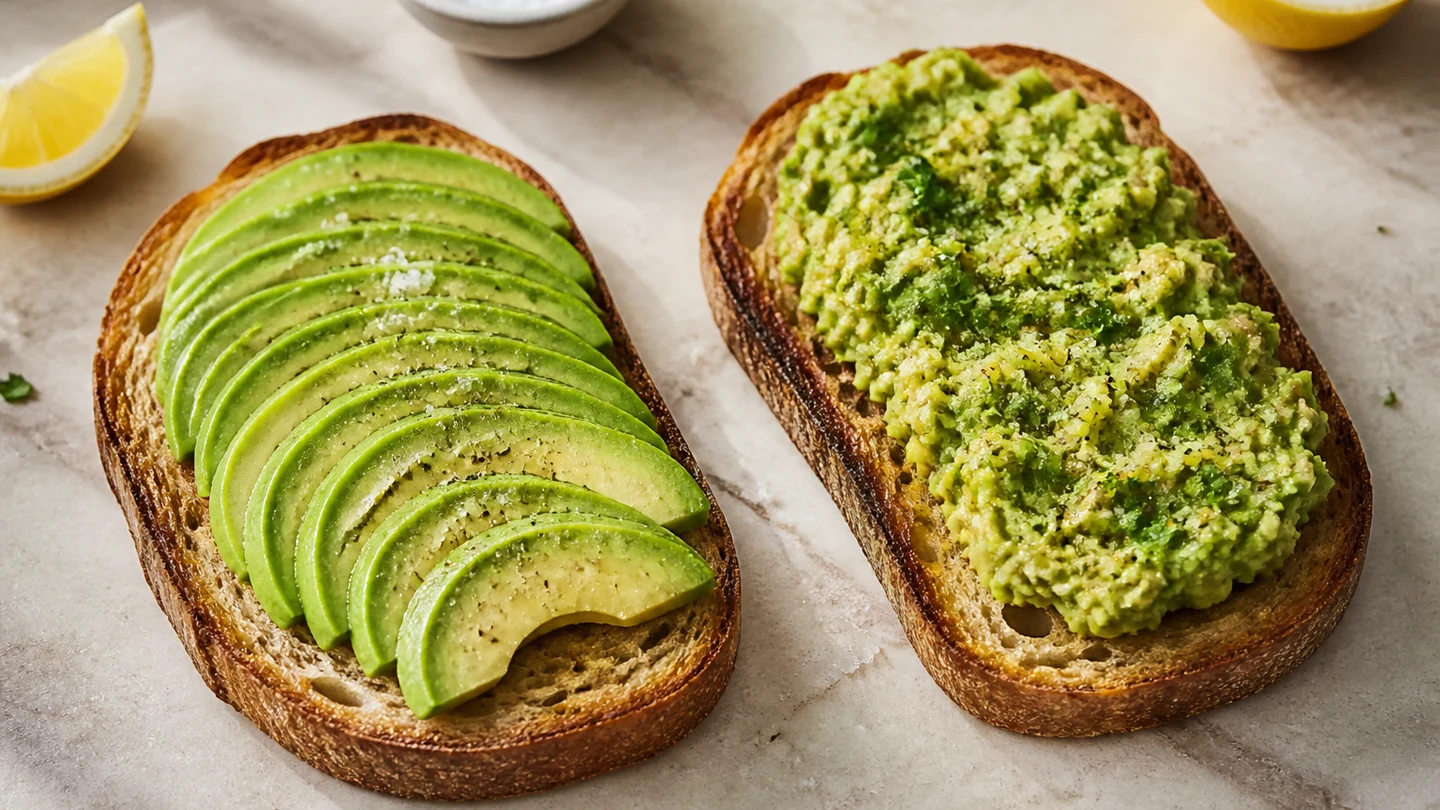
Choose mash, slices or layers
Mash
Mash avocado when small herbs or finely chopped, drained tomato need a continuous surface. Spread it evenly rather than leaving a high centre.
Slices
Use slices when the avocado is ripe enough to cut cleanly but not ideal for a smooth mash. Overlap them across the toast rather than stacking them in one spot.
Layer
For a topping such as beans or egg, use avocado between toast and topping, then keep the final pieces bite-sized. An egg is optional; when used, follow current official safe-handling guidance for the specific preparation.
Substitute by function
| Needed function | Possible direction | What must change |
|---|---|---|
| Spreadable cushion | Mashed beans or a prepared tofu spread | Keep the layer thin and check the product label. |
| Acidic lift | Lemon, lime or a measured vinegar-based condiment | Add gradually; liquid condiments need smaller amounts. |
| Crisp contrast | Seeds, dry radish slices or toasted crumbs | Add only at service, after wet components. |
A replacement is not equivalent merely because it is a popular toast topping. First identify the missing function, then adapt its moisture, weight and label information to the assembly.
Preparation effects
Toast both slices before cutting the avocado. Drain chopped tomato, roasted vegetables or other juicy toppings separately. Season in a sequence: salt first if needed, then acid, then herbs or chilli. This makes it easier to observe which adjustment changed the result. Packaged sauces, breads, seed mixes and spreads can differ in ingredients; FDA guidance supports checking the current label rather than assuming suitability for every eater.
Match topping weight to the base
Use the toast as a simple load check. A soft spread can support finely cut tomato, beans or egg when the pieces are distributed across the slice; a tall central pile concentrates weight and makes the first bite harder to manage. If the topping falls before eating, reduce its height or piece size before adding a new binder. This is an observable assembly adjustment, not a claim about an ideal avocado quantity.
Troubleshooting
| What you see | Likely assembly cause | One controlled next change |
|---|---|---|
| Soggy toast | Wet topping contacted bread or waited too long | Drain topping, toast further, assemble later |
| Topping slides off | Layer or pieces are too thick | Flatten avocado and reduce piece size |
| Avocado will not mash | It is too firm for that method | Use neat slices if workable or choose a different spreadable layer |
| Flavour feels flat | Several strong additions were made at once | Adjust salt or acid first, then reassess |
Storage boundary
Toast and toppings can be prepared separately, but the assembled toast is best treated as a near-service item for texture. If components are refrigerated, use the cited USDA leftovers guidance for cooling and storage boundaries; this page does not assign an independent shelf life.
Final practical formula
Toast first; cut avocado last; make a thin, even avocado layer; choose one topping family; keep wet components drained; finish lightly; and serve promptly. When texture fails, change one physical variable before adding more ingredients.
Sources and editorial references
- USDA MyPlate, “Meal Planning” —
https://www.myplate.gov/sites/default/files/2024-06/TipSheet-24-Meal-Planning.pdf - U.S. Food and Drug Administration, “Food Allergies” —
https://www.fda.gov/food/nutrition-food-labeling-and-critical-foods/food-allergies - USDA Food Safety and Inspection Service, “Leftovers and Food Safety” —
https://www.fsis.usda.gov/food-safety/safe-food-handling-and-preparation/food-safety-basics/leftovers-and-food-safety - FoodSafety.gov, “Safe Minimum Internal Temperatures” —
https://www.foodsafety.gov/food-safety-charts/safe-minimum-internal-temperatures