Sweet brunch foods: choose one warm anchor, one fresh counterpoint and one optional finish
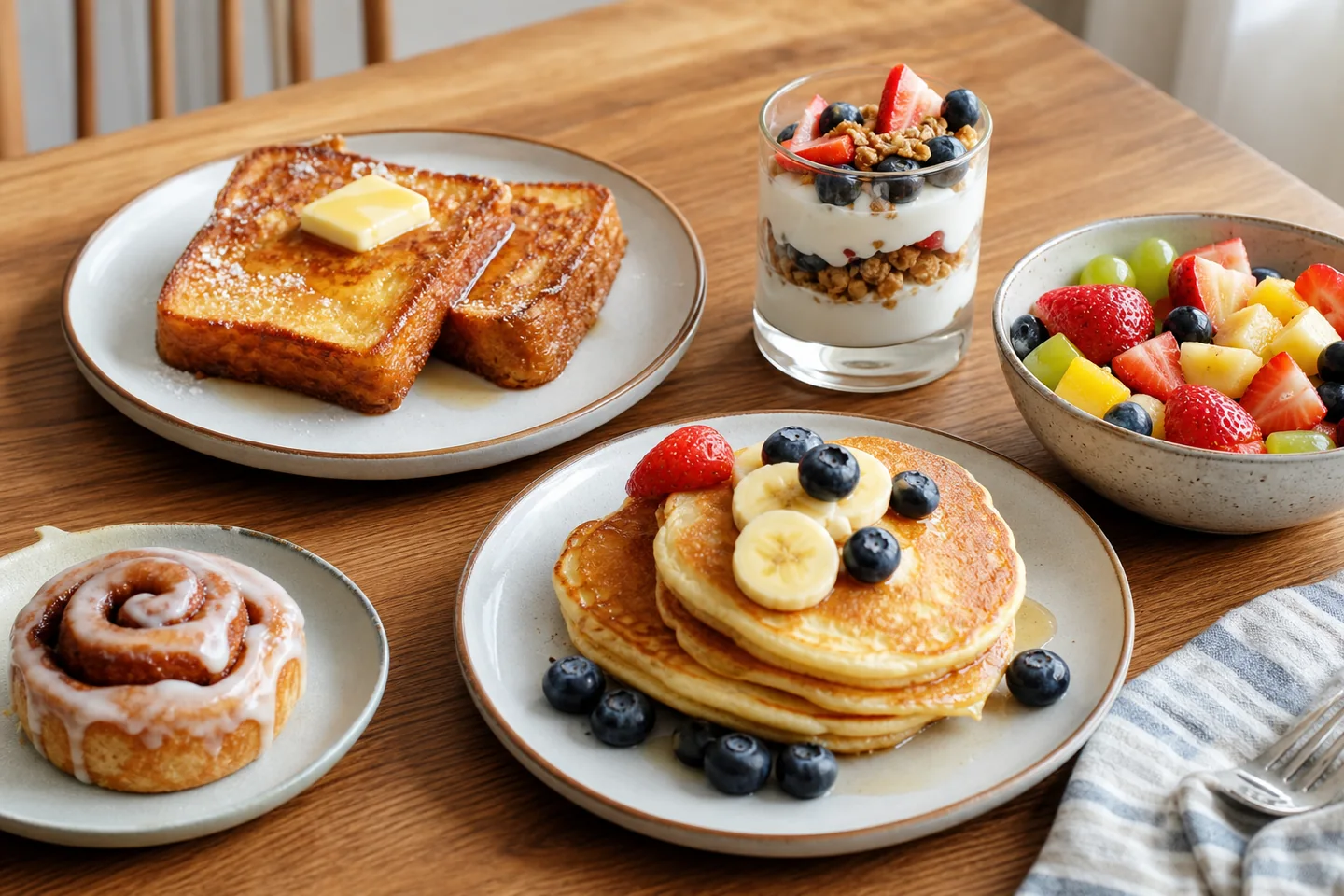
Sweet brunch foods work best when the table has distinct jobs: choose one warm or baked anchor, one fruit-led or chilled counterpoint, and only then an optional pastry-like finish. That avoids a spread of similar soft, sweet dishes competing for the same plate. Pancake World uses effort, richness, holding quality and diner needs to narrow the choice. Start with the brunch hub when the sweet course is part of a larger meal.
The curator’s selection criteria
This is an editorial reference, not a popularity ranking or a nutrition score. First decide whether food must be served hot, whether one person will cook while guests arrive, how much oven and table space is available, and whether ingredients need clear labelling. A good choice has a materially different eating action or service role from the next choice.
15 distinct sweet brunch ideas
Warm griddle ideas
- Buttermilk pancakes with berries — a soft, hot stack for a small table; hold toppings separately.
- Thin crêpes with citrus and yogurt — a lighter folded format with a spooned filling.
- Dutch baby with sliced fruit — one oven-puffed skillet rather than individual portions.
- Cornmeal griddle cakes with warm stone fruit — a coarser texture and spoonable topping.
For batter-led formats, the brunch table food ideas is a technique reference rather than a demand to add another griddle item.
Baked and bread-based anchors
- Baked French toast with berries — assembled before service and cut into portions.
- Cardamom breakfast buns — individual, fragrant and hand-held.
- Fruit-and-oat breakfast bake — spoonable and less pastry-like than a bun.
- Coffee cake with a tart fruit layer — a sliceable finish, not a second hot centrepiece.
- Jam-filled turnovers — crisp, portable portions with fillings considered separately.
Chilled and fruit-led options
- Yogurt parfaits with separate granola — layered cups with crunch added last.
- Chia cups with mango or berries — a chilled make-ahead format.
- Citrus and melon platter with mint — fresh contrast rather than an anchor.
- Roasted plum or apple compote — a flexible spooned fruit component.
- Ricotta toast with honey and figs — a bread-based assembled option.
- Mini fruit skewers with yogurt dip — a portioned, low-utensil option.
Sweet-format comparison: richness and effort matrix
| Format | Active effort | Richness | Holding | Best use |
|---|---|---|---|---|
| Pancakes or crêpes | High | Adjustable | Short | Small warm gathering |
| Dutch baby | Low after baking | Medium to rich | Short | Shared centrepiece |
| Baked French toast | Low at service | Rich | Moderate | Seated brunch |
| Buns or turnovers | Low | Rich | Moderate | Staggered arrivals |
| Parfaits or chia cups | Low | Light to medium | Cold only | Limited kitchen |
| Fruit or compote | Low | Light | Short once cut | Contrast |
The matrix is editorial judgement about service, not a health ranking. A richer dish can be right when it is the only sweet anchor; a lighter choice can still need careful holding if it contains refrigerated ingredients.
Balance rules that keep the menu coherent
Use one sweet anchor, one fresh or chilled contrast, and a savoury or unsweetened counterpoint outside this list. Put syrup, compote and crunchy additions on the side. If a dish includes milk, eggs, yogurt, cream or cut fruit, follow the complete recipe and appropriate food-handling guidance rather than treating a brunch table as room-temperature storage.
Occasion choices
For two: crêpes or ricotta toast with citrus fruit. For a family: baked French toast, berries and yogurt, without a second oven-dependent pastry. For outdoors: buns, fruit skewers and chilled cups, with an appropriate plan for chilled foods. For mixed preferences: pancakes with toppings separate; the friends brunch ideas guide helps with broader service planning; easy brunch ideas for guests adds another service-focused route.
Exclusions: when an idea should leave the shortlist
Remove a griddle idea when nobody can remain at the stove. Remove an oven bake when it conflicts with the savoury main. Remove chilled dairy cups when cold holding is uncertain. Remove a pastry with an unclear ingredient decision rather than describing it as safe for everyone. Do not label a menu “healthy,” “sugar-free” or suitable for a medical diet based on a single swap.
Three sample sweet brunch menus
Warm-and-fresh: cornmeal griddle cakes, roasted plum compote, citrus and plain yogurt. Make-ahead: baked French toast, yogurt parfaits with granola separate, and coffee or tea. Hand-held: cardamom buns, fruit skewers and chilled chia cups. These examples illustrate roles rather than formulas; adjust ingredients and handling to complete instructions and the people eating.
Related reading
- Brunch style food for a broader interpretation of brunch formats.
- Brunch food options for an adjacent selection list.
Curator checklist
- Choose one anchor, not two near-identical sweet mains.
- Match the anchor to the pan, oven and service time.
- Add one chilled or fruit-led contrast.
- Keep toppings optional where that improves choice and texture.
- Check ingredients and complete instructions.
- Keep perishable components under appropriate handling conditions.
- Remove any item that duplicates a role or has an unresolved constraint.
Sources and editorial references
- U.S. Food and Drug Administration, “Food Safety at Home” —
https://www.fda.gov/consumers/consumer-updates/food-safety-home - U.S. Food and Drug Administration, “Food Allergies” —
https://www.fda.gov/food/nutrition-food-labeling-and-critical-foods/food-allergies - USDA FoodData Central —
https://fdc.nal.usda.gov/ - USDA MyPlate, “What Is MyPlate?” —
https://www.myplate.gov/eat-healthy/what-is-myplate