Brunch table food ideas
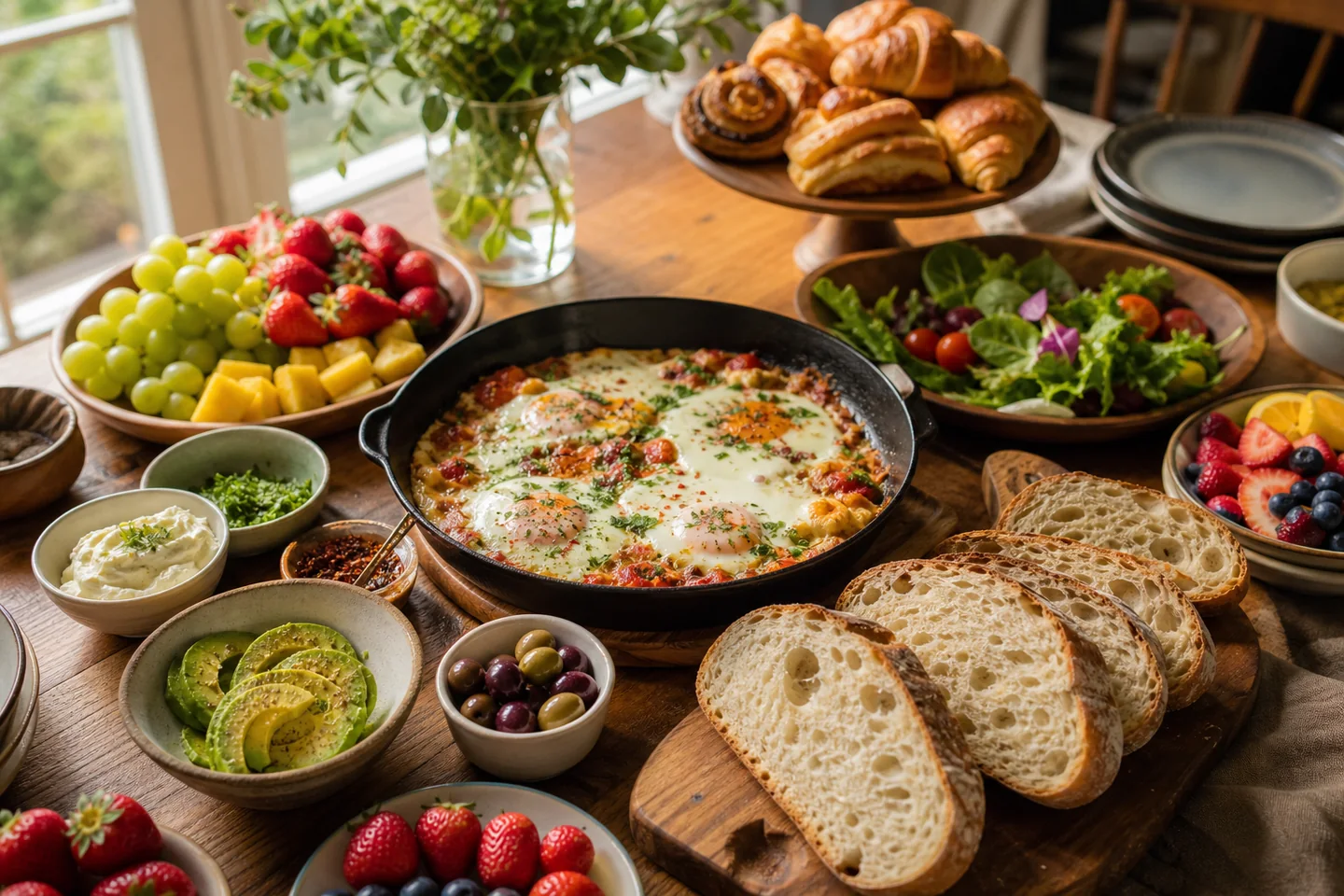
A useful brunch table is built from distinct jobs, not from a long list of look-alike dishes: set out one hot anchor, one crisp or chilled counterpoint, a bread or grain, a modest sweet, and a drinks station. Pancake World recommends items that can be portioned, reached, and refreshed without making every guest wait. Start with the brunch collection, then use this reference to select a workable table.
Selection criteria
Choose food that has a distinct table role, suits the equipment, can be portioned, and fits the arrival pattern. These are editorial selection tools, not restaurant testing or a universal serving formula.
A candidate earns its place by changing the eating action, temperature, texture, or service format. A dish that repeats a role makes the line longer without making the spread more useful.
Table roles
An anchor is substantial and hot; a fresh counterpoint is chilled or crisp; bread or grain gives the plate structure; a sweet finish is modest; drinks form a separate station. A vegetable egg bake, tomato cups, rolls, yogurt pots, and coffee each solve a different problem.
Guest-count quantities
Use guest count to reduce the number of choices, not to promise exact consumption. Four to six guests need one anchor and three supporting roles; eight to twelve may need a second anchor only if it does not compete for the same appliance.
For a rolling arrival, plan replacement platters rather than one oversized display. FDA buffet guidance recommends small serving dishes and fresh replacements.
Ideas 1–15: role-led catalogue
- Vegetable egg bake: sliceable hot anchor.
- Breakfast sandwich tray: hand-held anchor.
- Small-batch pancake station: griddled anchor.
- Roasted potato tray: sturdy savoury side.
- Tomato, cucumber, and herb cups: cool counterpoint.
- Seasonal fruit platter: fresh choice.
- Yogurt pots: individual chilled portions.
- Roll basket with labelled spreads: compact bread role.
- Toasted bagel halves: substantial bread.
- Breakfast pastry board: ready-to-serve sweet; see breakfast pastry recipe ideas.
- Banana breakfast cookies: defined baked portion; see banana breakfast cookies.
- Overnight oat jars: make-ahead chilled option.
- Smoked fish and cucumber bites: savoury cold option.
- Cheese, grapes, and crackers: grazing component.
- Coffee, tea, water, and one juice: drinks away from the queue.
Categories that stop duplication
Pick one or two options per category instead of cosmetic variants. Hot anchors are egg bake, sandwiches, pancakes, and potatoes; chilled choices are fruit, vegetable cups, yogurt, oats, and fish bites.
Bread-and-sweet choices include rolls, bagels, pastries, and cookies. Drinks are separate because refills change guest movement. American pancake ideas fit when a griddle and a replenishing cook are part of the plan.
Effort and user-type matrix
| Situation | Combination | Fit | Limit |
|---|---|---|---|
| Four to six | Egg bake, fruit, rolls, yogurt | Few dishes | Drinks elsewhere |
| Eight to twelve | Egg bake, potatoes, fruit, rolls | Sliceable | Second hot item needs capacity |
| Standing | Sandwiches, cups, cookies | Hand-held | Avoid drips |
| Long arrivals | Small replacement platters | Refreshable | Use temperature control |
Placement plan
Put plates first, then the anchor, sides, condiments, and cutlery; put drinks on a separate surface. That order lets a guest complete one plate without crossing the line twice.
Label relevant ingredients and give each dish a dedicated utensil.
Refill schedule and limits
Replace a nearly empty serving dish with a fresh one rather than topping it up. Keep cold foods refrigerated until serving and hold hot foods with suitable equipment, following cited FDA buffet guidance.
This is a food-handling boundary, not a claim that every home brunch needs professional catering equipment. Outdoor service may require a smaller, more easily monitored menu.
Exclusion test
Reject a candidate if it duplicates a role, competes for the anchor’s appliance, is difficult to portion, or forces a claim such as “allergen-free” that the host cannot support. Reject a decorative item when it needs last-second assembly but the host will be serving guests.
Combination notes
For a vegetarian-leaning table, make the anchor vegetable-led. For children, keep toppings separate. For a very small surface, run two courses. When pancakes are the anchor, avoid a second heavy sweet and use a fruit-led companion such as strawberry breakfast recipes.
Related reading
For a broader set of options beyond the table roles here, compare these choices with things to eat for brunch.
Final curator checklist
- Choose one item for each needed role before extras.
- Match hot dishes to appliances and hands available.
- Use guest count to simplify choices, not invent consumption figures.
- Keep drinks away from the food queue and label relevant ingredients.
- Prepare replacement platters and follow food-safety guidance.
Sources and editorial references
- U.S. Food and Drug Administration, “Serving Up Safe Buffets” — https://www.fda.gov/food/buy-store-serve-safe-food/serving-safe-buffets
- U.S. Food and Drug Administration, “Food Safety at Home” — https://www.fda.gov/consumers/consumer-updates/food-safety-home
- USDA MyPlate, “What Is MyPlate?” — https://www.myplate.gov/eat-healthy/what-is-myplate
- USDA FoodData Central — https://fdc.nal.usda.gov/