Strawberry breakfast recipes
Berry-state diagnosis
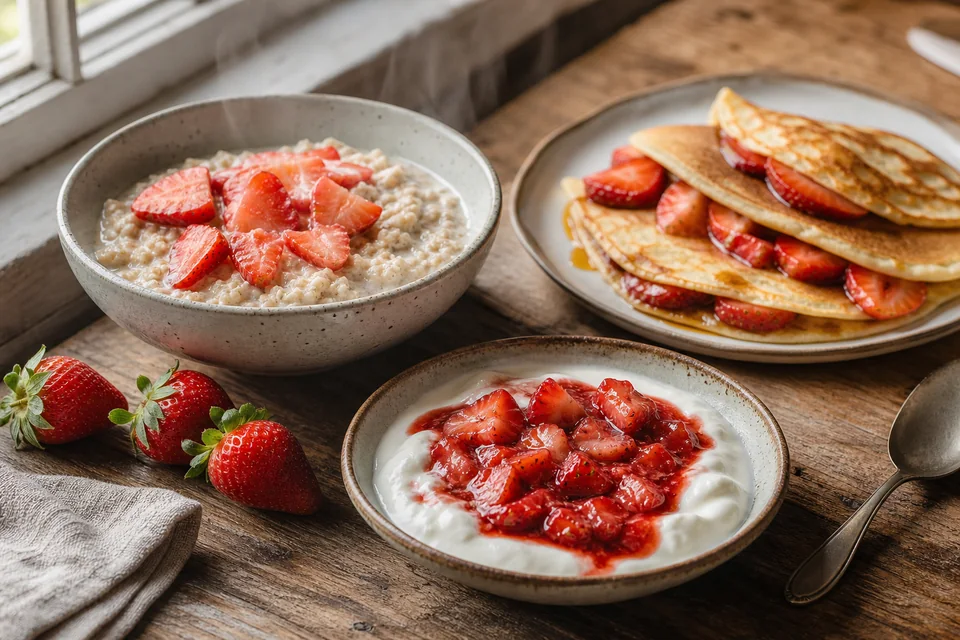
Strawberries bring water, acidity, aroma and a delicate surface to breakfast, so the best recipe depends on their state rather than their colour alone. Firm fresh berries can be sliced at service; very ripe berries need moisture control; frozen berries release juice as they thaw; cooked berries become a sauce or soft filling. Pancake World and the Pancake World brunch guide help with the wider meal, but this page focuses on diagnosing the berry before choosing pancakes, oats, yogurt, toast or a baked dish. The first question is not “what recipe uses strawberries?” but “what texture and holding window can these berries support?”
Root-cause matrix
Several strawberry failures look alike but need different responses. A watery yogurt bowl may come from thawed berries, while a watery pancake batter may come from berry purée or an overfilled pan. A bland result may be underripe fruit rather than a missing sweetener. Read the texture first, then choose the smallest controlled adjustment. The matrix below separates the berry variable from the recipe variable so a correction does not simply add another ingredient.
Recipe selector: state, format and holding window
Choose the recipe by berry state: firm fresh berries suit pancakes or toast where pieces stay visible; soft fresh berries suit a cooked compote; frozen berries suit baked oats or a jar when their released liquid is measured; and berries that must travel suit a separate-layer bowl or jar. The selector has three checks. First, does the dish need pieces or sauce? Second, can the base accept berry liquid? Third, will the food be eaten now or held? If a recipe fails one check, change the format rather than adding random dry ingredients. This page gives six distinct formats, each with a declared yield and a complete short method.
Recipe 1 — strawberry pancakes with late topping
Yield: 8 small pancakes, 2 servings. Ingredients: 120 g plain flour, 15 g sugar, 1 teaspoon baking powder, 1 egg, 160 ml milk, 20 g melted butter, 120 g firm strawberries, and a pinch of salt. Method: whisk the dry ingredients, whisk egg, milk and butter separately, combine just until no dry pockets remain, and rest 5 minutes. Cook four 60 ml portions on a lightly greased medium pan until bubbles remain open, flip once, and finish the batch. Slice the strawberries only at service and place them on top. The visible success indicator is a set centre with fruit that still has edges; soft berries belong in the compote path instead.
Recipe 2 — strawberry baked oats
Yield: 4 portions. Ingredients: 180 g rolled oats, 5 g baking powder, 1 egg, 240 ml milk, 30 g maple syrup, 1 teaspoon vanilla, 150 g chopped strawberries, and 20 g seeds if suitable for the eater. Method: heat the oven to 180°C, mix oats and baking powder, whisk egg, milk, syrup and vanilla, combine, fold in half the berries, and spread in a small greased baking dish. Scatter the rest on top and bake about 25 minutes until the centre is set rather than liquid. Cool briefly before cutting. Frozen berries can be used only when thawed and drained; otherwise use the compote method below.
Recipe 3 — drained strawberry yogurt-muesli bowl
Yield: 2 bowls. Ingredients: 300 g thick yogurt, 80 g rolled oats or muesli, 160 g firm strawberries, 20 g chopped nuts or seeds if suitable, 10 g honey, and 1 teaspoon lemon zest. Method: stir yogurt, oats and zest, then rest 10 minutes so the grain hydrates without extra berry liquid. Slice the berries into larger pieces, blot surface moisture, and divide them over the bowls. Add honey and the crisp topping at service. Do not fold thawed berries into the base; keep them in a separate layer or choose Recipe 6. The useful decision is texture: this format promises a spoonful with visible fruit, not a berry sauce.
Recipe 4 — strawberry ricotta toast
Yield: 4 toasts, 2 servings. Ingredients: 4 slices sturdy bread, 160 g ricotta, 160 g firm strawberries, 10 g honey, 1 teaspoon lemon zest, 10 g pumpkin seeds if suitable, and a pinch of salt. Method: toast the bread until the centre is firm, stir ricotta with zest and salt, and slice the berries into halves or thick slices. Spread ricotta immediately before eating, add berries, drizzle the measured honey and finish with seeds. If the berries are soft, cook them into a separate spoonful compote and serve it on the side. The bread should still resist a gentle press after assembly; if it bends, the topping was added too early or is too wet.
Recipe 5 — strawberry breakfast jar
Yield: 2 jars. Ingredients: 80 g rolled oats, 240 ml milk, 120 g yogurt, 20 g chia seeds, 15 g honey, 160 g firm strawberries, and 20 g granola packed separately. Method: combine oats, milk, yogurt, chia and honey, divide into covered jars, and refrigerate for at least 4 hours and no longer than 24 hours before service. Add drained strawberry pieces as a separate upper layer just before transport, with granola in a sealed side container. Keep the jar refrigerated until it is eaten. For frozen berries, thaw in a covered container, drain the juice and use the cooked path if the jar would become thin. The jar is ready when the spoon moves through a set base and the fruit remains a distinct layer.
Recipe 6 — warm strawberry compote oat-and-yogurt bowls
Yield: 4 complete breakfast bowls. Ingredients: 300 g soft or frozen strawberries, 25 g sugar, 15 ml lemon juice, 1 teaspoon cornstarch mixed with 15 ml cold water, one pinch of salt, 600 g plain yogurt and 240 g toasted rolled oats. Method: place berries, sugar, lemon and salt in a saucepan, bring to a gentle simmer, and cook 6–8 minutes until the fruit softens. Stir in the slurry and simmer 1 minute until glossy. Divide 150 g yogurt and 60 g oats into each bowl, then add one quarter of the warm compote immediately before eating. For a cold service, cool the compote promptly in a shallow covered container and refrigerate it before assembly. This path is distinct because cooked fruit is the sauce for a measured bowl, not a topping added late to pancakes, toast or a jar.
Moisture-control matrix for the six recipes
| Berry state | Best paths | Liquid action | Visible success |
|---|---|---|---|
| Firm fresh | 1, 3 or 4 | Cut late and keep pieces large | Fruit holds an edge |
| Soft but sound | 4 with compote or 6 | Cook separately | Sauce is glossy, not watery |
| Frozen | 2 or 6 | Thaw and drain when the recipe requires it | Base keeps its intended set |
| Travel window | 5 | Separate wet fruit and crisp topping | Jar remains layered |
| Already wet base | 6 served separately | Stop adding liquid | One controlled component changes |
| Berry flavour too mild | Any path after tasting | Use measured acid or aroma, not uncontrolled sugar | Contrast is noticeable |
| Cut fruit held too long | 6 | Do not restore a fresh-piece promise | Format matches texture |
Troubleshooting rows
Start with the berry state, not the finished dish. Drain or cook fruit that is releasing water, reserve firm berries for late topping, and use a small test portion before changing the full batch. If the result is still wet, change only one variable—berry treatment, thickener, heat or holding time—so the next observation identifies the cause. The six recipes above are different paths because they ask the fruit to do different jobs.
One recording method
Record four observations for every trial: berry state before mixing, measured berry mass, the moment strawberries enter the recipe, and the visible result after the stated holding window. Change only one variable in the next test. This keeps the diagnosis tied to observable moisture, timing and texture instead of adding repeated reminders.
Conclusion
Choose the recipe from the actual berry state, control free moisture before assembly, and record one controlled change when the result fails. Six distinct recipes are enough; the selector and matrix should decide among them rather than create a second catalogue.
Related Reading
Sources and editorial references
- Penn State Extension, Freezing Strawberries —
https://extension.psu.edu/freezing-strawberries - Penn State Extension, Let's Preserve: Freezing Fruits —
https://extension.psu.edu/lets-preserve-freezing-fruits - University of Maine Cooperative Extension, Frozen Strawberry Sandwiches —
https://extension.umaine.edu/food-health/recipes/frozen-strawberry-sandwiches/ - University of Nevada, Reno Extension, Overnight Oatmeal with Berries —
https://extension.unr.edu/publication.aspx?pubid=6573 - FDA, Food Safety at Home —
https://www.fda.gov/consumers/consumer-updates/food-safety-home