Breakfast pastry recipes
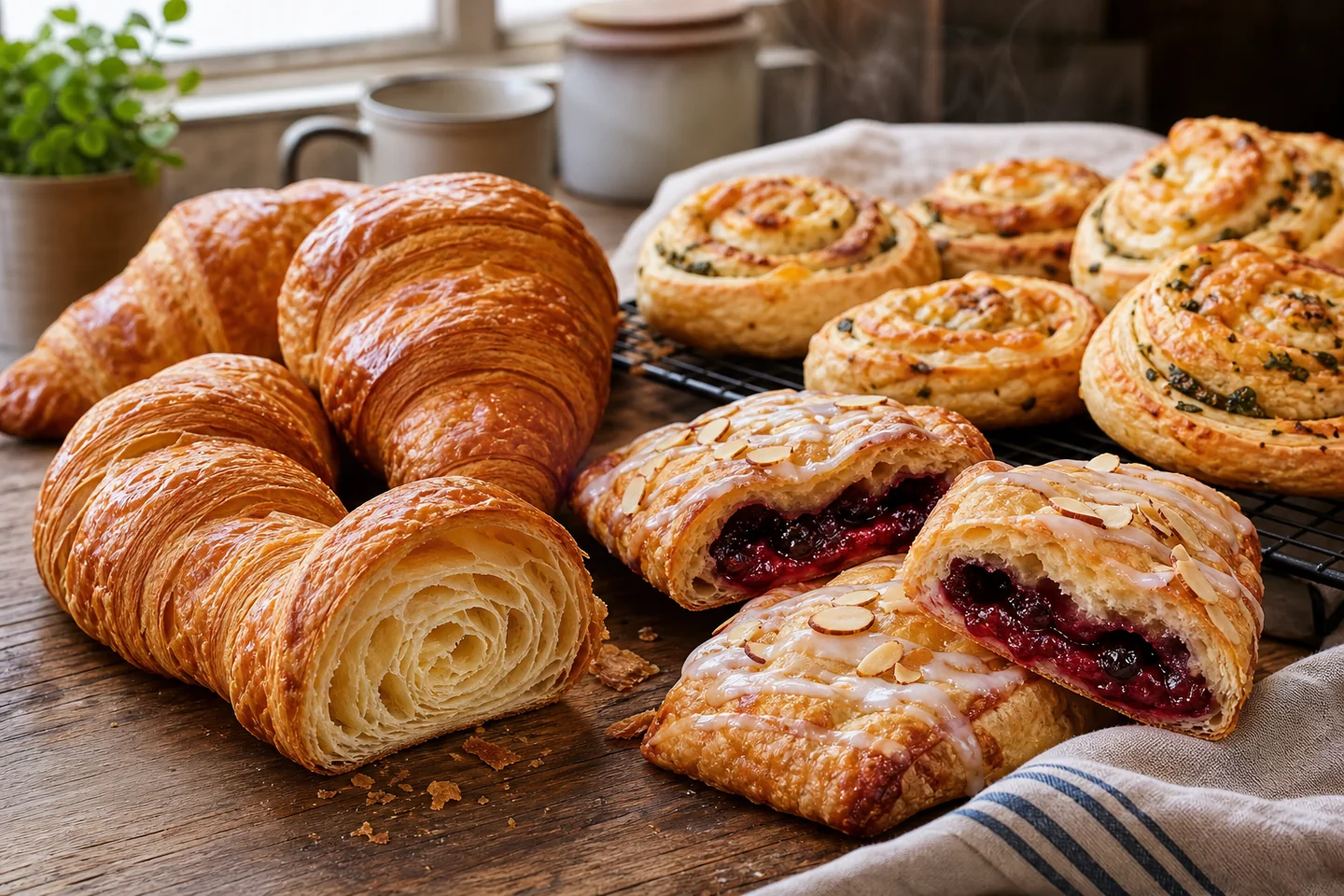
For a same-morning breakfast pastry, make these flaky apple turnovers: keep the butter cold, chill the shaped pastries before baking, and seal the fruit filling inside a dry border. This one formula yields six turnovers in about 1 hour 25 minutes. Pancake World uses it to show how dough choice, temperature and shaping affect a breakfast bake; the American breakfast guide gives the wider meal context.
The formula at a glance
The method is for a short, rough-puff-style pastry, not yeast dough or a substitute for laminated croissant dough.
Ingredients
- 250 g plain flour, plus a little for the bench
- 1/2 teaspoon fine salt
- 170 g cold unsalted butter, cut into 1 cm cubes
- 120 ml ice water, plus 1 teaspoon only if dry patches remain
- 180 g peeled apple, cut into 5 mm pieces
- 25 g light brown sugar
- 1 teaspoon lemon juice
- 1/2 teaspoon ground cinnamon
- 1 teaspoon cornflour
- 1 egg, beaten with 1 teaspoon water, for the wash
Equipment and temperature control
Use a scale, rolling pin, baking paper, brush and baking tray. Cold butter should still appear as separate pieces after the first mix. If the dough feels soft, shiny or sticky rather than cool and firm, stop rolling and refrigerate it for 10 minutes. A chilled tray is not required; a fully preheated oven is.
Make the apple filling first
Combine apple, brown sugar, lemon juice, cinnamon and cornflour. Leave the mixture for 10 minutes, then spoon it through a sieve for a moment and discard only loose liquid. This is a moisture-control step, not a cooked filling: the apple pieces remain raw and finish in the oven. The strawberry breakfast recipes explain why fruit state matters when it is used in breakfast baking.
Mix the pastry without warming the butter
- Whisk flour and salt in a wide bowl. Toss in cold butter until each piece is coated.
- Press butter pieces between fingertips only until you have pea-sized pieces and a few flatter shards.
- Drizzle in 120 ml ice water while lifting flour with a fork. Press a handful together; if it holds with dry crumbs only at the edge, stop. Add the final teaspoon only if the dough will not hold at all.
- Press into a 2 cm-thick rectangle, wrap, and chill for 10 minutes.
Create layers with two simple folds
Roll the chilled rectangle to roughly 20 by 35 cm. Fold the top third down and bottom third over it, like a letter. Turn the packet a quarter turn, roll again, and repeat the fold. Chill for 10 minutes. Do not chase a precise measurement if the dough resists; chilling is the correction for snap-back, while flour is only for preventing sticking.
Shape six turnovers with a dry sealing edge
Roll the dough to about 3 mm thick and cut six 12 cm squares. Put one sixth of the drained filling just off-centre, leaving a 2 cm clear edge. Brush the edge lightly with egg wash, fold corner to corner, and press from filling outward to expel air. Crimp, vent twice, and transfer to the lined tray. For a savoury breakfast direction, see fish brunch ideas.
Bake to observable doneness
Brush tops lightly with egg wash and chill the tray for 10 minutes while the oven reaches 200°C / 400°F. Bake for 22 to 26 minutes, rotating once only if your oven has a known hot side. They are done when pastry is deeply golden at the folds, bottoms are browned rather than pale, and apple juices bubble through vents. A golden top with a pale underside needs more time.
Failure matrix: change one cause at a time
| What you see | Likely control point | Next-batch fix |
|---|---|---|
| Butter leaks onto the tray | Dough or pastries became warm | Chill after folding and before baking; keep oven fully hot. |
| Pastry is tough | Too much mixing or bench flour | Stop once dough holds; use the smallest dusting needed. |
| Filling leaks | Wet fruit, overfilling or poor seal | Drain loose liquid, keep border clear and crimp firmly. |
| Pieces brown early | Uneven size or hot spot | Cut equal squares and rotate once. |
Scale, vary and keep the formula intact
For 12 turnovers, double every ingredient and use two trays; bake one tray at a time if the oven cannot brown both evenly. For a pear version, replace apple by weight with firm pear and keep lemon, sugar and cornflour unchanged. For raisin and apple, replace 30 g apple with 30 g raisins rather than adding extra filling. For a faster spread built around prepared components, use fast breakfast recipes.
Storage and refresh
Cool turnovers on a rack before covering so steam does not soften the crust. Refrigerate within two hours if keeping them because this recipe uses a raw-fruit filling, and follow FDA general leftovers guidance for chilling and reheating. Refresh one turnover on a tray in a 175°C / 350°F oven until hot through and crisp again; size and oven behaviour set the time. Avoid tasting raw flour dough.
Pastry success checklist
- Separate cold butter pieces were visible before folding.
- The filling was drained and the sealing border stayed clean.
- Each turnover was similar in size, vented and chilled before baking.
- The fold, underside and vented filling all showed bake readiness.
Related reading
Sources and editorial references
- King Arthur Baking Company, rough puff pastry technique and cold-butter handling.
- U.S. Department of Agriculture, FoodKeeper guidance for refrigerated leftovers.
- U.S. Food and Drug Administration, safe handling guidance on raw flour and food at home.
- USDA Food Safety and Inspection Service, oven food-safety and leftovers guidance.