Banana breakfast cookies
Banana breakfast cookies are soft baked oat rounds, not crisp bakery cookies: use very ripe banana for sweetness, measure it by peeled weight, let the oats hydrate, and bake shallow portions until the edges look dry and the centres lose their wet shine. Pancake World treats this as one practical make-ahead breakfast recipe, with ripeness and thickness—not a vague “healthy cookie” label—doing most of the texture work.
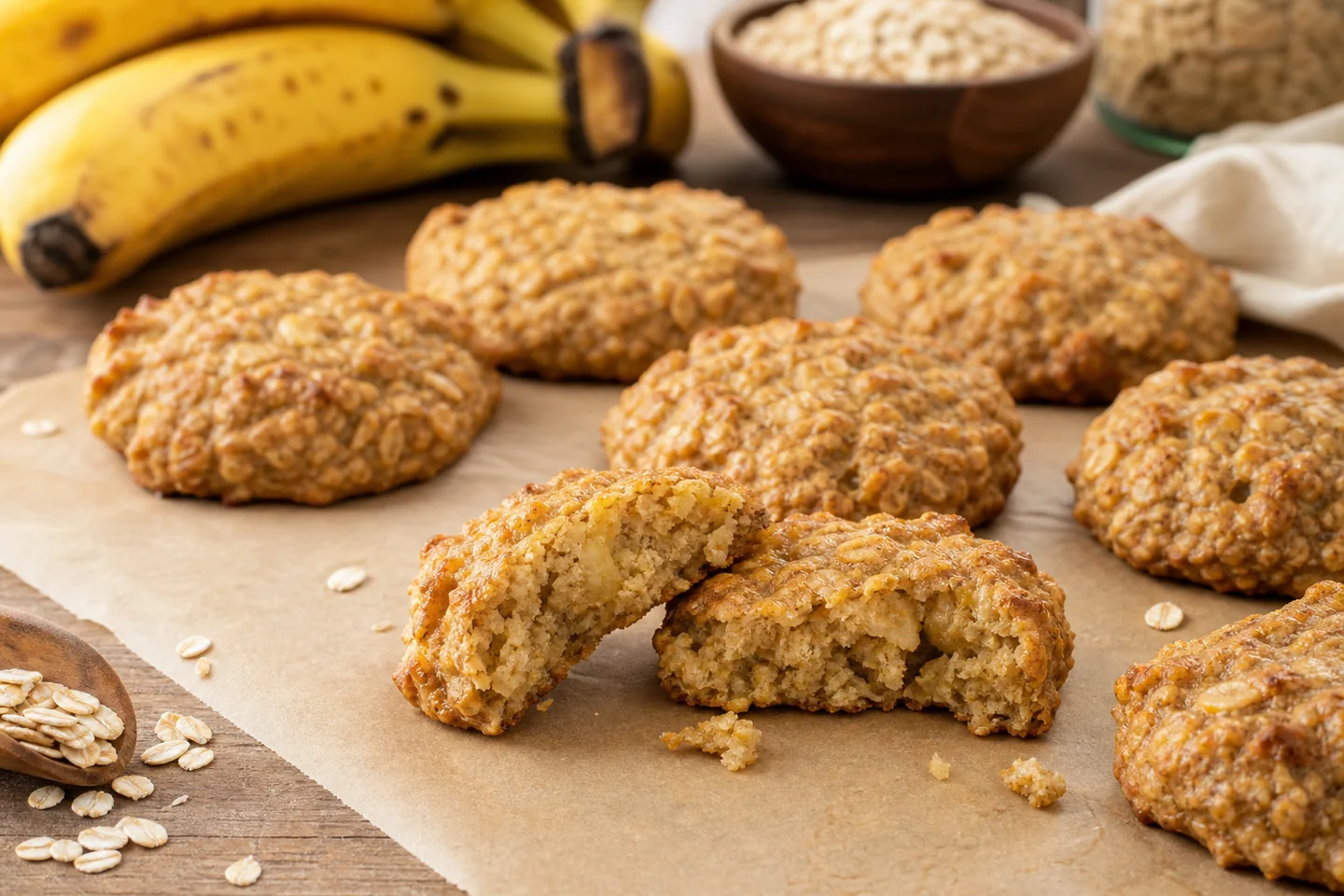
The controlling technique
This formula uses rolled oats, mashed banana and peanut butter to make six soft cookies. A spotted banana is easier to mash and tastes sweeter, but too much banana makes the dough slack; weighing the fruit gives the next batch a useful reference point. Rolled oats provide chew after a short rest. Peanut butter supplies fat and body, while a small egg binds the mixture as it bakes. The American breakfast collection is the parent hub for more morning formats.
Complete formula: banana breakfast cookies
Yield: 6 cookies. Timing: 15 minutes preparation, 18–22 minutes baking, 35 minutes total including cooling.
Ingredients
- 200 g peeled very ripe banana, mashed smooth
- 120 g rolled oats
- 65 g smooth peanut butter
- 1 large egg (about 50 g without shell)
- 25 g chopped walnuts
- 30 g raisins
- 5 ml vanilla extract
- 2 g ground cinnamon
- 1 g fine salt
Numbered method
- Heat the oven to 175°C / 350°F and line a tray. Mash the banana until no large pieces remain.
- Stir in peanut butter, egg, vanilla, cinnamon and salt. Fold in oats, walnuts and raisins.
- Rest 10 minutes. It should hold a spooned mound. If it is pourable, record the banana weight and use a smaller banana next time rather than adding unmeasured oats.
- Divide into six equal mounds, about 80 g each. Flatten each to roughly 1.5 cm thick.
- Bake 18–22 minutes. Check at 18 minutes for dry edges, a matte top and a clean-lifting base.
- Cool 10 minutes on the tray, then move to a rack. Judge the centre after this cooling interval.
Read ripeness before mixing
Choose a banana with a yellow peel and many brown speckles rather than a green-tipped fruit. A firmer banana can leave pieces and less sweetness; an extremely liquid mash can loosen the dough. The aim is not a universal ripeness grade but a repeatable record: weigh the peeled banana and make the first batch as written. USDA FoodData Central is used here only for ingredient identity, not to make a nutrition promise.
Moisture map
Banana and egg are the wet side of the dough. Oats take time to absorb moisture, so the ten-minute rest is a checkpoint rather than dead time. Stir separated peanut butter in its jar first; otherwise one spoonful can be much looser than the next. Raisins add small pockets of moisture, while walnuts add crunch but do not fix a loose dough. Changing several parts together makes troubleshooting harder.
Binder choices and bounded variations
For the first bake, use the egg specified above. For an egg-free trial, use a commercial egg replacer only according to its instructions and make a half batch; it is a controlled variation, not evidence that every substitute behaves the same. Sunflower-seed butter can replace peanut butter by weight if its allergen profile suits the household, but expect different flavour and possibly softer spread. Keep oats, banana weight and thickness unchanged when testing one variation.
For a fruit-led alternative breakfast, see strawberry breakfast recipes. For a separate oat format rather than a second cookie formula, browse breakfast oatmeal cookies. For a different route-specific cookie approach, compare healthy breakfast cookies rather than blending two formulas.
Bake behaviour and doneness
A pale surface is not automatically underbaked; a glossy wet centre is the stronger warning. If the tops darken before that change, reduce oven temperature slightly for the next batch and keep the rounds shallow. Avoid relying on a single clock minute because home ovens and banana moisture vary.
Scaling without losing the signal
| Need | Ingredient change | Technique control |
|---|---|---|
| 3 cookies | Halve every ingredient by weight; whisk then halve the egg. | Keep 1.5 cm thickness; check at 16 minutes. |
| 12 cookies | Double every ingredient. | Use two trays or batches; do not crowd one tray. |
| Smaller cookies | Keep the full dough but portion 12 rounds. | Flatten shallowly and check several minutes earlier. |
Scaling the mix does not mean stacking the tray. Airflow and even thickness are the observable controls.
Storage boundary
Cool completely, then refrigerate in a covered container within two hours. U.S. Food and Drug Administration home food-safety guidance supports prompt refrigeration of perishable prepared food; it does not establish a guaranteed shelf life for this recipe. Reheat only the portion needed until hot throughout, or eat it chilled if that suits the ingredients and eater. Do not leave a covered tray at room temperature for an open-ended brunch service.
Troubleshooting
The dough flows after its rest
The banana may have been larger or wetter than 200 g, or the peanut butter unusually loose. Bake one test cookie rather than correcting the bowl blindly. Next time hold banana weight steady and change only one variable.
The cookie crumbles when lifted
It may have been moved hot or underbaked. Give it the full tray rest, then check the base releases cleanly. If it still breaks after cooling, make the next rounds evenly shallow.
The centre is gummy but the edge is dark
The rounds were likely too thick or the oven too hot. Flatten the next batch to 1.5 cm, keep the tray centred and lower heat a small step if the same pattern repeats. More time alone is not always the answer.
Final success checklist
- Record 200 g peeled banana rather than counting fruit.
- Let rolled oats hydrate for 10 minutes.
- Portion six equal, shallow rounds.
- Use dry edges, a matte top and a clean-lifting base together.
- Cool on the tray before judging cohesion.
- Refrigerate leftovers promptly.
Related reading
- Brunch table food ideas for planning a larger breakfast spread.
- Breakfast frittata recipe for a savoury baked option.
Sources and editorial references
- USDA FoodData Central, “Bananas, raw” and “Oats” ingredient records —
https://fdc.nal.usda.gov/ - U.S. Food and Drug Administration, “Food Safety at Home” —
https://www.fda.gov/consumers/consumer-updates/food-safety-home - USDA Food Safety and Inspection Service, “Leftovers and Food Safety” —
https://www.fsis.usda.gov/food-safety/safe-food-handling-and-preparation/food-safety-basics/leftovers-and-food-safety - King Arthur Baking, “Banana Oatmeal Cookies” technique reference —
https://www.kingarthurbaking.com/recipes/banana-oatmeal-cookies-recipe