Breakfast Frittata Recipe
A dependable breakfast frittata for four starts with a 25 cm / 10 in oven-safe skillet, dry cooked vegetables, and an egg mixture that is set briefly on the hob before it finishes in the oven. Use 8 eggs, 60 ml / 1/4 cup milk, and the stated pan depth; bake until the thickest egg section reaches 71°C / 160°F and the centre has only a small wobble. Pancake World keeps this route focused on cook one reproducible frittata and control doneness and scaling.
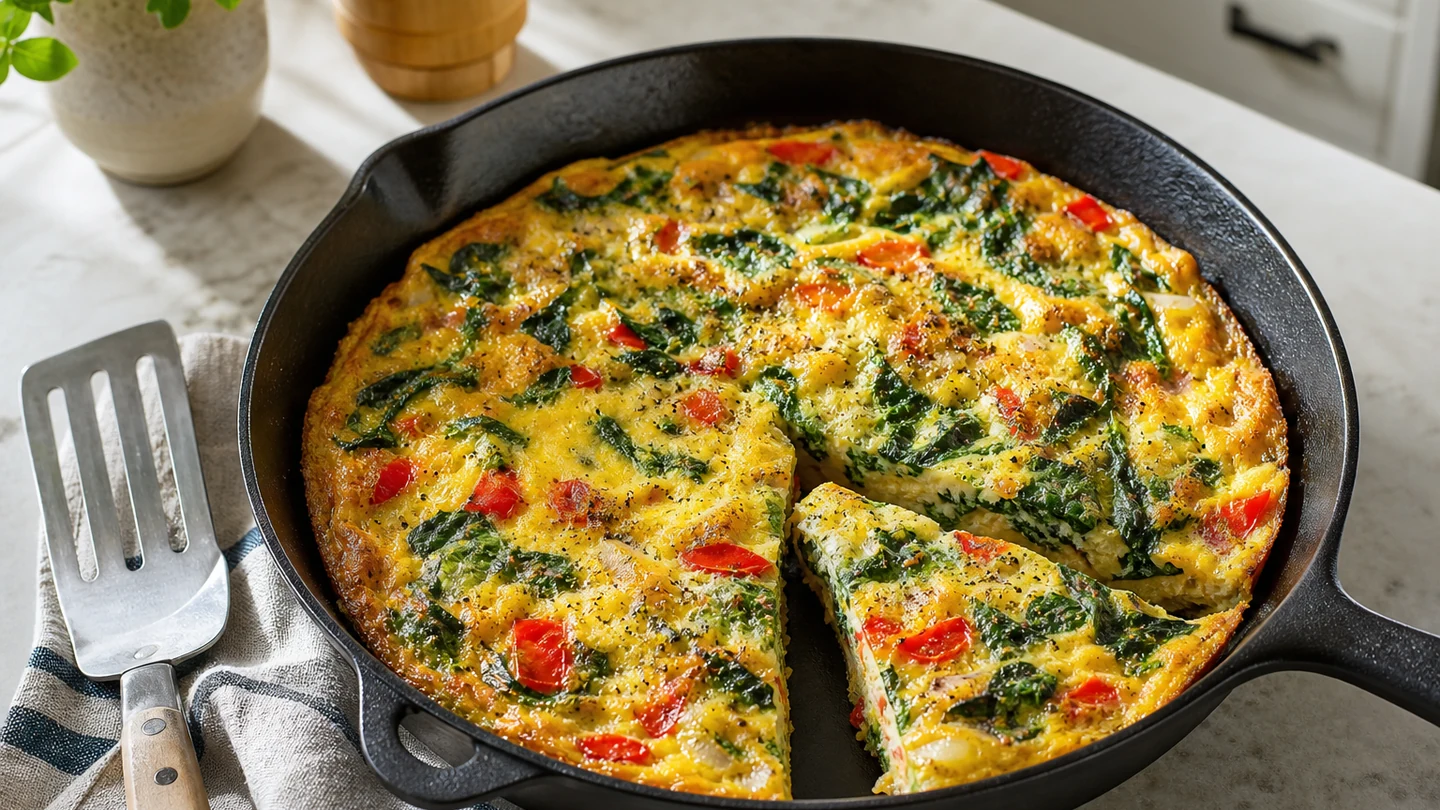
One complete frittata
Yield: 4 portions. Prep: 15 minutes. Cook: 18 minutes. Total: 33 minutes.
Ingredients
- 8 large eggs
- 60 ml / 1/4 cup whole milk
- 1 tablespoon olive oil
- 1 small onion, finely diced
- 150 g mushrooms, sliced
- 120 g baby spinach
- 100 g cherry tomatoes, halved
- 75 g feta, crumbled
- 1/2 teaspoon fine salt
- 1/4 teaspoon black pepper
Equipment
Use a 25 cm / 10 in oven-safe skillet, bowl, whisk, spatula, and instant-read thermometer. The ingredient load and timing belong to this pan size.
Method
- Heat the oven to 190°C / 375°F. Whisk eggs, milk, salt, and pepper until no clear egg streaks remain.
- Warm the oil over medium heat. Cook onion for 3 minutes until translucent; cook mushrooms for about 5 minutes until released liquid has cooked away.
- Add spinach and cook for about 1 minute, just until wilted. Level the vegetables, then scatter tomatoes and feta over them.
- Pour in the egg mixture and tip the pan gently so egg reaches the gaps. Cook without stirring for 2–3 minutes, until a set ring about 2 cm / 3/4 in wide forms at the edge.
- Bake for 8–10 minutes, checking at 8 minutes. Test the thickest egg area without touching the pan.
- Remove when it reads 71°C / 160°F, the surface is opaque, and the centre gives one small even wobble. Rest 5 minutes, loosen the edge, and cut into 4 wedges.
Control the moisture before the eggs go in
Mushrooms and spinach need to lose their free liquid before the eggs arrive. A dry-looking pan bottom is the practical cue: if liquid pools around the vegetables, keep cooking before assembling. Tomatoes are added late so their cut surfaces do not become the main liquid load.
Read doneness at the centre
FoodSafety.gov lists 71°C / 160°F for egg dishes such as frittata. Colour at the rim is not a sufficient signal. If the middle is visibly fluid, return the skillet to the oven in short checks; if the thermometer has reached the boundary but the centre is still moving in waves, let it rest briefly before slicing.
Scale without changing depth
For 8 portions, make two complete skillets rather than doubling the ingredients in one deep pan. For 2 portions, halve every ingredient, use a smaller oven-safe pan, and check earlier because the shallower load changes the heat path.
Bounded variations
- Herb and cheese: replace feta with 75 g grated hard cheese and add 2 tablespoons chopped herbs.
- Potato: replace mushrooms with 200 g cooked, dry potato cubes.
- Pepper and greens: replace mushrooms with 150 g diced bell pepper, cooked tender before the spinach.
Keep the egg quantity, pan size, and egg-doneness check unchanged.
Storage and corrections
Refrigerate known-history leftovers promptly in shallow containers; USDA guidance says perishable food left at room temperature for more than 2 hours should be discarded. Reheat leftovers to 74°C / 165°F.
- Water around a slice
- Cook wet vegetables longer until the pan is dry.
- Brown bottom, loose middle
- Use only the short edge-setting stage, then finish in the oven.
- Dry, crumbly egg
- Start checking at 8 minutes and remove at the temperature boundary.
- Sticking
- Use the listed oil and rest before loosening the edge.
Pan and filling checkpoints
| Before eggs | Action | Why it matters |
|---|---|---|
| Mushrooms still release liquid | Cook until the pan bottom is dry | Prevents a watery egg layer |
| Filling piles in the centre | Spread it into one even layer | Lets egg travel between pieces |
| Pan is not oven-safe | Use an oven-safe skillet | The hob-to-oven sequence is part of this formula |
Make the next cook easier
Measure the pan before shopping and prepare every filling before heating the oil. If the first frittata is too wet or too dry, change one variable on the next cook—vegetable dryness, timing, or pan size—rather than adding extra egg and filling together. That preserves a readable cause and correction.
Success check
- Use the stated pan and filling load.
- Cook away vegetable liquid.
- Set the edge before baking.
- Confirm 71°C / 160°F in the egg centre.
- Scale with another pan, not extra depth.
Sources and editorial references
- FoodSafety.gov, Safe Minimum Internal Temperatures — https://www.foodsafety.gov/food-safety-charts/safe-minimum-internal-temperatures
- USDA FSIS, Leftovers and Food Safety — https://www.fsis.usda.gov/food-safety/safe-food-handling-and-preparation/food-safety-basics/leftovers-and-food-safety
- USDA FSIS, Cooking with Eggs — https://www.fsis.usda.gov/food-safety/safe-food-handling-and-preparation/food-safety-basics/eggs
- BBC Good Food, Full English Frittata — https://www.bbcgoodfood.com/recipes/full-english-frittata