Route owner statement: this is a flexible planning framework, not a tested event, portion guarantee, or dietary prescription.
Friends brunch ideas
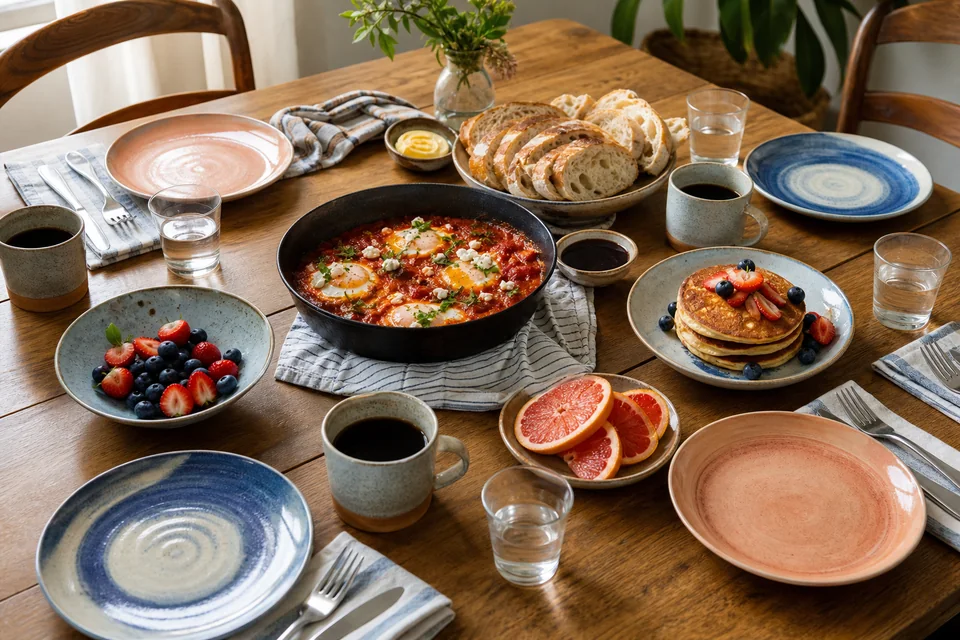
For friends brunch ideas that stay relaxed, start with the group constraints, give every dish one menu role, delegate two tasks, and protect the last 20 minutes for a single hot finish. Pancake World uses this checklist to turn a casual invitation into a workable service plan. Use the brunch guide as the parent hub, then confirm guest count, arrival window, allergies communicated by guests, seats, and appliance space before buying food.
1. Start with the constraints
Write down the headcount, arrival window, seats, oven racks, burners, and guest-provided ingredient restrictions. A six-person seated table and a twelve-person drop-in need different service choices even when they share a theme.
2. Give the menu four jobs
Choose one shareable anchor, one fresh counterpoint, one bread or potato support, and a drinks station. For six, a vegetable egg bake, roasted potatoes, fruit, bread with labelled spreads, and coffee, tea, and water fills those roles. Quantities come from each selected recipe's stated yield.
3. Make the shopping sheet
List the anchor ingredients first, then the support, fruit, drinks, ice if used, labels, and serving utensils. Add one no-cook fallback such as whole fruit or a sealed labelled item. Keep safe handling and chilling within the FDA's published consumer guidance.
4. Map the equipment capacity
Assign the anchor a pan, rack, and serving dish; assign potatoes the remaining rack or an earlier time; keep bread for the toaster after oven work. There is no universal oven capacity: use the actual pan, rack count, recipe timing, and appliance instructions.
5. Delegate outcomes
Ask one guest for ice and a non-alcoholic drink and another for fruit at a stated arrival time. The host owns the hot anchor. Specific hand-offs keep the cooking area clear when attention is needed.
6. Work backward from service
| When | Host action |
|---|---|
| Two days before | Confirm headcount; choose recipes with stated yields. |
| Day before | Shop, prepare stable components as recipes allow, clear serving space. |
| 90 minutes before | Set drinks, refrigerate cold items, start the anchor. |
| Final 20 minutes | Finish one hot item only; use breakfast fried potatoes only if the equipment plan allows. |
7. Create a clear service flow
Put drinks away from food, then arrange plates, anchor, support, and fresh item. Replenish from the kitchen rather than crowding the table. Use labelled dishes and separate utensils; light brunch ideas for guests offers a lower-hot-work alternative.
8. Keep two contingencies
Reserve a late portion before service and store or reheat it under its recipe or food-safety guidance; do not leave the full meal out indefinitely. If a garnish or side is missing, serve the complete anchor with the fresh item and support rather than redesigning the menu.
9. The host's final operational checklist
- Headcount, seats, arrival window, and communicated restrictions are written down.
- Every dish has one role and a recipe with a stated yield.
- The list includes drinks, labels, serving utensils, and a no-cook fallback.
- Every hot dish has a real rack, burner, pan, and service time.
- Delegated guests have a defined item, arrival time, and hand-off.
- Drinks are separate and reserve portions follow dish handling instructions.
Related reading
Sources and editorial references
- U.S. Food and Drug Administration, Food Safety at Home — handling, chilling, and reheating boundaries.
- USDA Food Safety and Inspection Service, Buffet and Party Food Safety — service and replenishment context.
- Food Standards Agency, Allergy and intolerance guidance — ingredient communication and cross-contact context.
- USDA MyPlate, What Is MyPlate? — general food-group context only.