Healthy brunch ideas for a group
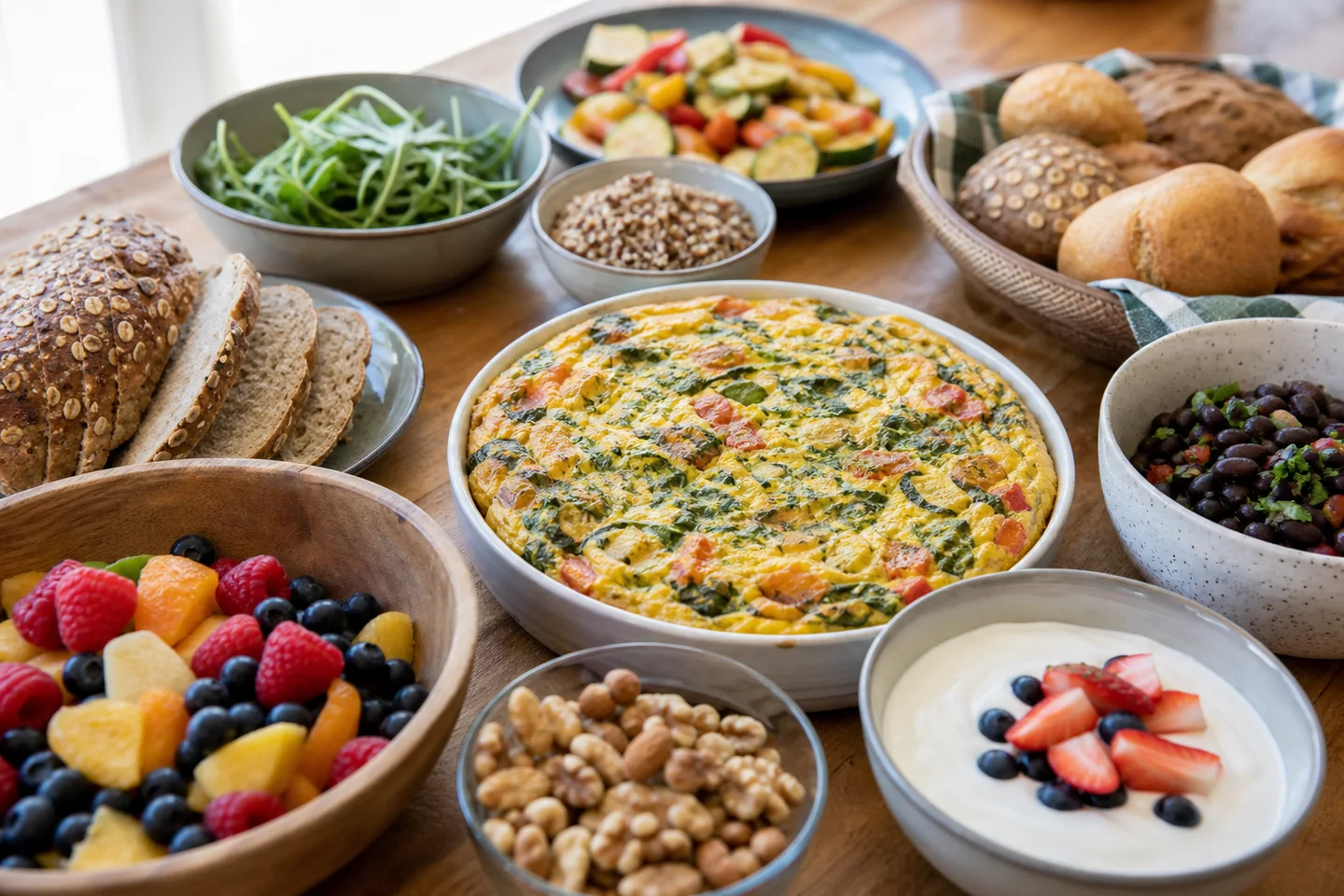
A healthy brunch for a group is easiest to run as a balanced-choice plan: choose one warm savoury anchor, one filling grain or potato, fruit or vegetables, and flexible toppings. For ten guests, set the menu first, scale from each recipe’s stated yield, and let the oven and serving equipment determine what is realistic. Pancake World treats “healthy” as variety and clear ingredient information, not as a score or promise. Begin with the Brunch guide.
Make a balanced choice, not a perfect menu
Use food roles rather than competing dishes. A vegetable egg bake or bean tray can be the savoury anchor; baked oats, potatoes or bread makes the meal substantial; fruit and a crunchy vegetable add contrast. Put sauces, cheese, seeds and sweet additions in labelled bowls. This gives guests options without suggesting that any dish meets every dietary or medical need.
Choose the menu by trade-off
| Role | Batch-friendly choice | What it solves | Check first |
|---|---|---|---|
| Warm anchor | Vegetable egg bake or bean tray | Savoury plate | Oven shelf and pan |
| Filling base | Baked oats, potatoes or bread | Substantial choice | Yield and holding |
| Fresh element | Fruit plus crisp vegetable | Contrast | Chilling space |
| Finish | Yoghurt, herbs, seeds, sauces | Guest choice | Labels and utensils |
For a lighter table, see light brunch ideas for guests; for a social setting, see friends brunch ideas.
Set a guest-count working quantity
For ten adults, begin with one stated-yield pan of the warm anchor, one stated-yield pan or pot of the filling base, two bowls of fruit, and toppings served separately. Exact eggs, oats, potatoes and loaves must come from chosen recipe yields and package labels; no generic list can guarantee portions.
Build the shopping list from components
List warm-anchor ingredients, filling-base ingredients, fresh produce, and service supplies separately. Add labels, separate serving spoons, containers and drinks last. Healthy brunch snacks can be supplementary, not the core meal.
Let equipment capacity set the menu
Count oven shelves, pan sizes, burners, refrigerator space, serving platters and clean utensils before shopping. If one bake occupies the only shelf, the second warm item needs a make-ahead or stovetop alternative. Individual omelettes, toast-to-order and smoothies at the same moment create a queue.
Use a simple service timeline
Day before: choose recipes, check labels, wash durable produce and set out utensils.
Two hours before: prepare cold items and clear refrigerator space.
Forty-five minutes before: cook batchable anchors according to their instructions and bowl the toppings.
At service: place warm anchor, filling base, fresh elements and labels; refill in small batches.
Adapt for named dietary needs without guessing
Ask guests about restrictions early, then identify one complete option they can assemble rather than a group of decorative sides. Read recipe and packaged-food labels. Keep ingredients and utensils separated when required, but do not call a table allergy-safe unless the controls genuinely justify that statement.
Keep health claims inside clear boundaries
USDA MyPlate is a broad food-group planning reference; it does not calculate individual needs from this menu. Food safety guidance is practical for perishable foods, but does not turn a brunch plan into medical advice. Avoid detox, disease-prevention, universal-suitability or allergy-safe claims.
Prepare contingencies and the service sequence
If the oven runs late, serve the filling base and fresh components first. If a guest cannot use the anchor, use the identified complete alternative. If refrigerator space is tight, reduce cold dishes or use appropriate chilled holding. Put labels beside food and utensils with their own dish.
Related reading
- Hearty brunch ideas for a more substantial warm anchor.
- Brunch table food ideas for presentation context after the service plan is settled.
Final operational checklist
- Name the guest count and recipe yields.
- Choose warm anchor, filling base, fresh produce and labelled finishes.
- Check shelves, pans, burners, refrigerator room and vessels.
- Read packaged allergen information.
- Set the day-before, two-hour, forty-five-minute and service tasks.
- Prepare labels and separate utensils.
- Decide early-serve, omit and adapted contingencies.
Sources and editorial references
- USDA MyPlate — “What Is MyPlate?” — https://www.myplate.gov/eat-healthy/what-is-myplate
- U.S. Food and Drug Administration — “Food Safety at Home” — https://www.fda.gov/consumers/consumer-updates/food-safety-home
- U.S. Food and Drug Administration — “Food Allergies” — https://www.fda.gov/food/nutrition-food-labeling-and-critical-foods/food-allergies
- USDA Food Safety and Inspection Service — “Keep Food Safe! Food Safety Basics” — https://www.fsis.usda.gov/food-safety/safe-food-handling-and-preparation/food-safety-basics/keep-food-safe-food-safety-basics