Breakfast technique · skillet side
Breakfast fried potatoes
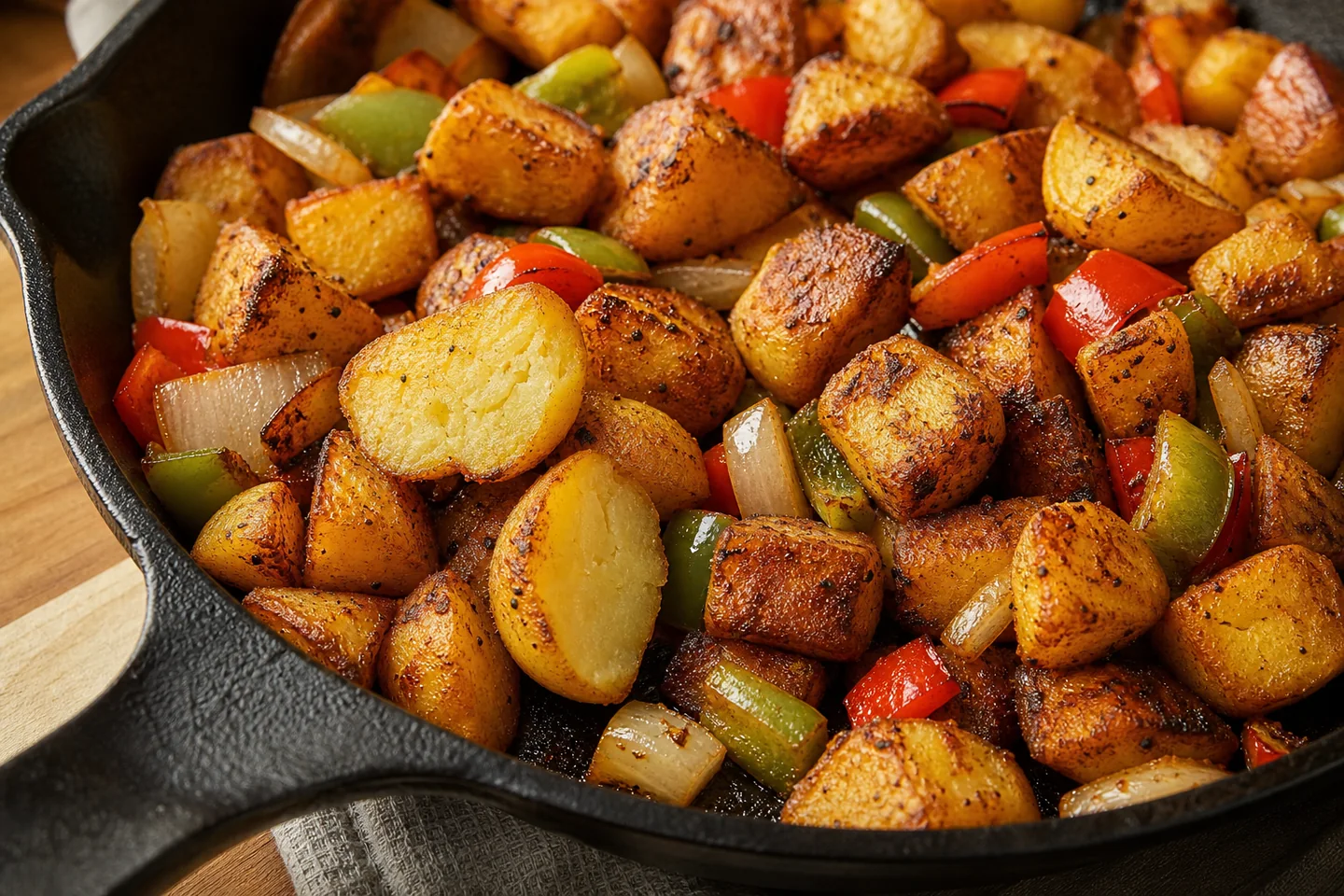
Breakfast fried potatoes are most reliable when you use a waxy or all-purpose potato, cut every piece to about 2 cm, dry the surface, and fry in a roomy hot skillet without moving the first side too soon. This Pancake World method makes one complete, savoury breakfast side with a crisp bronze exterior and a tender centre. The American breakfast guide is the parent hub for the wider meal.
Potato choice and the route boundary
Choose potatoes that hold their shape after cooking: waxy or all-purpose potatoes make compact pieces that can be turned without collapsing. Floury potatoes can work, but their edges are more fragile, so use a gentle turn. This is a recipe for a skillet side, not a claim about a universal best potato, a restaurant result, or a nutrition outcome. The controlling technique is consistency: one variety, one cut, and one pan plan.
Complete base recipe
Yield: 4 side servings. Timing: 15 minutes prep, 18–24 minutes cooking, 33–39 minutes total.
Ingredients and quantities
- 900 g waxy or all-purpose potatoes, scrubbed
- 2 tablespoons neutral frying oil
- 1 teaspoon fine salt, divided
- 1/2 teaspoon black pepper
- 1 small onion, diced (optional)
- 2 tablespoons chopped parsley or chives (optional)
Use the oil as a cooking medium, not as a fix for a crowded pan. The herb and onion are optional variations within this one primary recipe; they do not create additional formulas.
Primary method: par-cook, dry, then fry
- Cut potatoes into 2 cm cubes. Cover with cold water and add 1/2 teaspoon salt.
- Bring to a boil, then simmer until a knife tip pierces the outside but the centre still resists, about 6–8 minutes. Drain thoroughly.
- Spread on a clean tray in one layer for 5 minutes. Steam must escape before the skillet.
- Heat a broad, heavy skillet over medium-high heat. Add oil and coat the cooking surface.
- Add potatoes in one layer. Leave them undisturbed for 4–5 minutes, until the underside has a firm brown crust.
- Turn with a thin spatula in sections rather than stirring continuously. Fry 8–10 minutes more, turning only after each side releases.
- Add onion only after potato colour is established; finish with pepper and herbs off heat.
Doneness indicators
The potatoes are ready when several cut faces are deep golden, the cube stays intact when lifted, and the centre yields without a hard core. Colour alone is not a food-safety test; here it is only a texture and flavour cue. If the exterior is dark before the centre is tender, reduce the next cut size or extend the par-cook slightly—not both changes at once.
Moisture map: where crispness is lost
| Moisture point | What you see | One correction |
|---|---|---|
| After draining | Steam clings to cubes | Spread in one layer before frying |
| At pan entry | The pan sounds wet | Dry potatoes and confirm the pan is hot |
| During frying | Pieces pile up or release liquid | Use a second batch or delay onion |
| At serving | Condiment pools under the crust | Serve wet toppings separately |
Failure matrix for a first batch
| Failure | Likely controlling variable | Next-batch change |
|---|---|---|
| Pale and soft | Surface moisture or crowding | Dry longer and reduce pan load |
| Dark outside, firm centre | Cut too large or par-cook too short | Keep heat steady and adjust only the pre-cook |
| Sticks and tears | First side moved before release | Wait for a formed crust and use a thin spatula |
| Greasy | Cool pan or excess oil | Preheat the skillet and measure oil |
| Onion burns first | Onion entered too soon | Add it after the potatoes begin browning |
Scaling for 6 and 12
For 6 servings, use 1.35 kg potatoes, 3 tablespoons oil, and 1 1/2 teaspoons salt. For 12 servings, use 2.7 kg potatoes, 6 tablespoons oil, and 3 teaspoons salt. Scale ingredients, but not the pan capacity: a 12-serving batch needs several skillet rounds. Keep cooked rounds on a rack in a low oven only long enough to finish the remaining batch; long holding softens the crust.
Three meaningful variations
For a pepper-and-onion version, add diced pepper with the onion after the potatoes have coloured. For a rosemary version, add chopped rosemary during the final minute so it perfumes the oil without scorching. For a leftover version, start with chilled, already cooked potatoes and skip the par-cook; separate cold pieces before they touch the skillet, then use the same single-layer rule. A potato side can support a shared menu; friends brunch ideas offers planning context without changing this method.
Storage, reheating, and the transport test
For leftovers, refrigerate cooked potatoes promptly in a covered shallow container and use current USDA guidance for cooked potatoes: 3–4 days refrigerated. Reheat only a portion you plan to serve, in a single layer in a skillet or oven until hot throughout; this method cannot judge safety from smell or browning. For a packed breakfast, carry potatoes in a ventilated container when possible and add sauces separately, because trapped steam softens the crust. For other make-ahead breakfast formats, see healthy brunch ideas for a group.
Serving choices and equipment boundaries
Serve potatoes promptly with eggs, fruit, or a pancake breakfast, keeping wet condiments on the side. A cast-iron, carbon-steel, or heavy stainless skillet can work when it has enough flat area and is preheated; pan material does not remove the need for space and patience. If you want toppings rather than a mixed skillet, use the pancake toppings guide for ideas that stay distinct at the table.
Final checklist
- Use one potato type and a consistent 2 cm cut.
- Par-cook to the first point of tenderness, then drain and dry.
- Fry in measured oil in one layer.
- Leave the first side alone until it releases.
- Add moisture-releasing vegetables after the potatoes colour.
- Scale ingredients separately from pan capacity.
- Refrigerate leftovers promptly and follow the cited storage boundary.
Related reading
Sources and editorial references
- USDA FoodData Central —
https://fdc.nal.usda.gov/ - U.S. Food and Drug Administration, “Food Safety at Home” —
https://www.fda.gov/consumers/consumer-updates/food-safety-home - USDA Food Safety and Inspection Service, “How long can you store cooked potatoes?” —
https://ask.fsis.usda.gov/article/How-long-can-you-store-cooked-potatoes - FoodSafety.gov, “Cold Food Storage Chart” —
https://www.foodsafety.gov/food-safety-charts/cold-food-storage-charts