Easy brunch ideas for guests
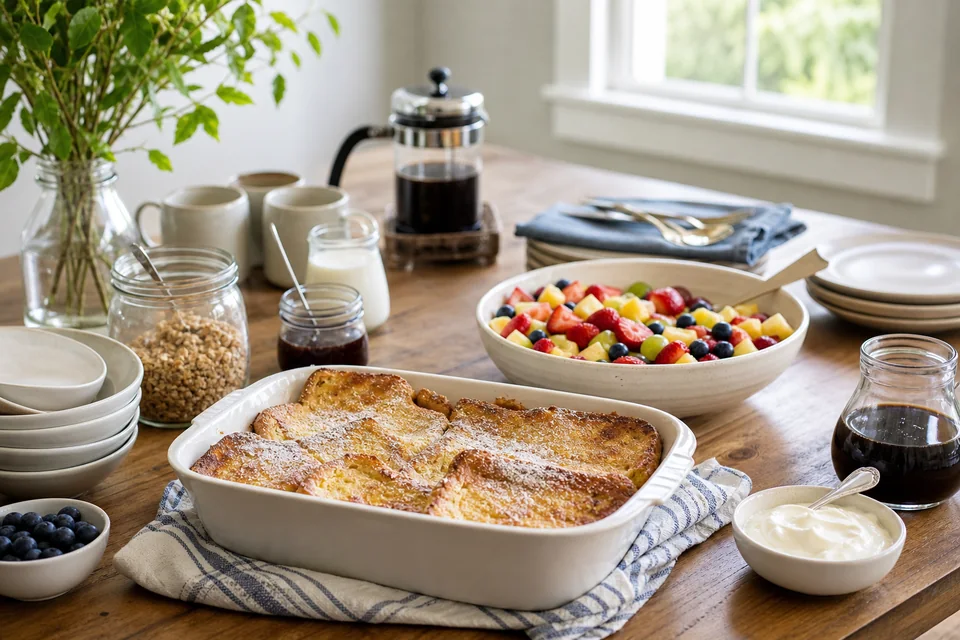
The easy plan: one anchor, one fresh side, one flexible finish
Easy brunch ideas for guests are not the dishes with the fewest ingredients; they are the dishes with the fewest simultaneous decisions. Choose one anchor that portions cleanly, one fresh or vegetable side, one bread or grain element, and a finish that can wait if guests arrive late. Pancake World and the Pancake World brunch guide recommend planning from guest count and service style rather than collecting unrelated recipes. For most homes, the easiest menu has one last-minute hot task, two make-ahead tasks and a clearly labelled alternative when someone cannot eat the main.
One guest calculator
Choose one menu, enter the number of guests and multiply the per-person column. The table below includes a modest bread-and-produce reserve; replace every line with the exact yield and package size you buy.
| Component | Per guest | 4 guests | 8 guests | 12 guests |
|---|---|---|---|---|
| Anchor portions | 1 | 4 | 8 | 12 |
| Bread pieces or rolls | 1.5 | 6 | 12 | 18 |
| Prepared fruit | 150 g | 600 g | 1.2 kg | 1.8 kg |
| Prepared vegetable side | 100 g | 400 g | 800 g | 1.2 kg |
| Coffee or tea service | 300 ml | 1.2 L | 2.4 L | 3.6 L |
| Drinking water | 500 ml | 2 L | 4 L | 6 L |
One shopping framework
For the eight-guest column, buy or prepare eight anchor portions, twelve bread pieces, 1.2 kg prepared fruit, 800 g prepared vegetables, 2.4 L coffee or tea and 4 L water. Convert those edible amounts to packs only after checking the label: for example, three 400 g fruit packs supply 1.2 kg, while two 500 g vegetable packs leave a 200 g preparation reserve. Add the exact ingredients from the anchor recipe, one clearly labelled alternative portion for each guest who needs it, and storage containers. Do not create an unmeasured “extra food” category.
One equipment-capacity table
| Equipment example | Verified working capacity | 8 guests | 12 guests |
|---|---|---|---|
| 30 × 40 cm sheet pan | 8 open roll halves or 8 equal bake portions in the tested layout | 1 batch | 2 batches |
| 28 cm skillet | 2 eggs without crowding | 4 batches | 6 batches |
| 2 L insulated carafe | 1.8 L working fill | 2 fills for 2.4 L | 2 fills for 3.6 L |
| One clear refrigerator shelf | One covered 30 × 40 cm tray | 1 tray slot | 2 sequential tray slots or smaller containers |
Measure your actual pan, skillet, carafe and refrigerator before relying on the example. Batches equal the required portions divided by verified capacity, rounded up. If the batch count creates more than one last-minute hot job, change the menu rather than compressing the cooking time.
One preparation timeline
| When | Task | Why it belongs here | Contingency |
|---|---|---|---|
| Day before | Read complete recipes, check labels, count utensils | Find conflicts before shopping or cooking | Remove one fragile dish early |
| Morning, early | Set table, chill intended drinks, stage containers | Protects the cooking window | Use a labelled tray if space is tight |
| Two hours before | Complete make-ahead anchor tasks and wash produce | Leaves time for recovery | Switch fresh garnish to a whole or larger cut |
| One hour before | Assemble cold components and label alternatives | Reduces last-minute choices | Keep wet and crisp parts separate |
| Twenty minutes before | Start the one hot finishing job | Aligns temperature with arrival | Use the declared holding method |
| At service | Set utensils, explain options, add final toppings | Makes the menu legible | Serve in two smaller waves |
Three sample menus
Four-person seated plan: four baked egg portions, six toast pieces, 600 g fruit, 400 g dressed vegetables and 1.2 L coffee or tea. Eight-person buffet plan: eight filled rolls, twelve bread pieces only if the rolls are not the sole grain, 1.2 kg fruit cups, 800 g vegetable side and 2.4 L hot drinks. Twelve-person delayed-arrival plan: twelve individually portioned anchor items, eighteen bread pieces, 1.8 kg whole or cut fruit held safely, 1.2 kg vegetable side and 3.6 L hot drinks across two carafe fills. Each plan uses the calculator; the difference is service and holding, not a repeated catalogue of food roles.
Guest-flow plan
- Place water and basic table items before guests arrive.
- Put the anchor where portions can be seen and served safely.
- Present the alternative beside, not behind, the main path.
- Hold crisp toppings, sauces and juicy produce separately until needed.
- Announce the menu in role language: anchor, fresh side, bread and finish.
- Serve the first wave before beginning any optional refill.
- Check the hot component, then return to guests rather than adding another recipe.
One contingency matrix
| Change | Protect first | Fallback |
|---|---|---|
| Guests arrive early | Visible food and drinks | Serve cold components and delay hot finish |
| One appliance fails | Anchor portion | Use the preselected no-appliance side and reduce the menu |
| One guest cannot eat the main | Complete alternative | Serve labelled alternative with its own utensil |
| Fridge space is smaller than expected | Perishable temperature control | Remove an optional chilled dish |
| Service runs late | Food handling boundary | Follow current guidance; do not extend holding by guesswork |
One final checklist
- Confirm the guest count and one clearly labelled alternative.
- Scale the anchor, side, bread and drinks before shopping.
- Match every hot dish to an oven, hob or holding slot.
- Finish make-ahead work before the arrival window.
- Keep only one last-minute hot job.
- Set the service order and a replacement path for a late guest or failed appliance.
- Move perishable food to safe cold or hot holding rather than leaving it on the table.
Related Reading
Sources and editorial references
- University of Minnesota Extension, Planning the Quantity Food Occasion —
https://extension.umn.edu/cooking-safely-crowd/planning-quantity-food-occasion - University of Minnesota Extension, Cooking Safely for a Crowd —
https://extension.umn.edu/home-kitchen/cooking-safely-crowd - University of Nebraska–Lincoln Extension, Step 2: Menu Planning —
https://extension.unl.edu/statewide/burt/favorite-foods-revue-booklet/step-2-menu-planning/ - FDA, Food Allergies —
https://www.fda.gov/food/food-labeling-nutrition/food-allergies - FDA, Food Safety at Home —
https://www.fda.gov/consumers/consumer-updates/food-safety-home