Brunch planning guide
Steak Brunch Ideas
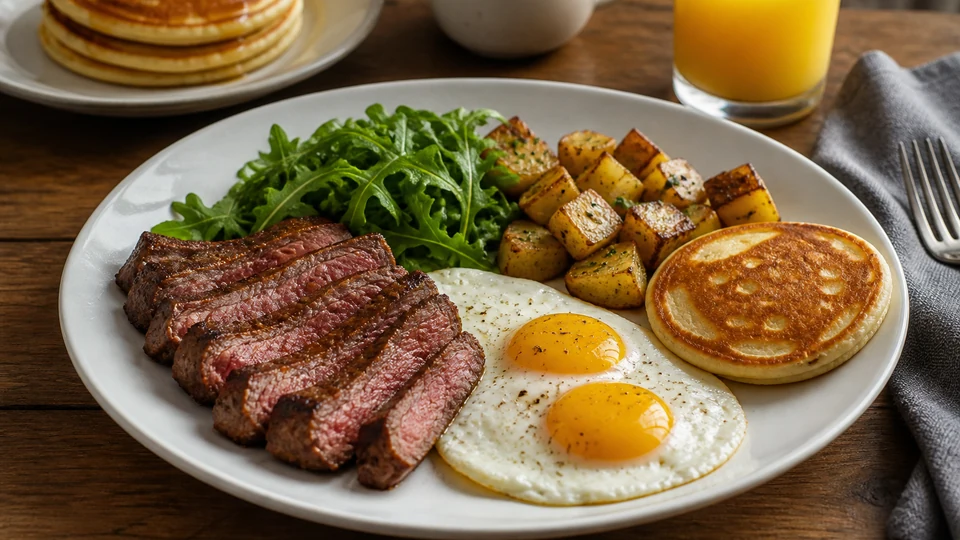
Pancake World recommends a steak brunch built around one sliced steak, one hot partner, and one fresh contrast. Prepare the sides first, cook the steak last, verify its endpoint with current official guidance, rest it on a clean plate, then slice just before serving. That makes steak brunch ideas practical for a small table without pretending that one cut, quantity, or doneness suits everyone.
Direct answer: build around one sliced steak
Cooking one centrepiece reduces the number of final-minute decisions. Choose a method written for the selected cut, have the supporting foods nearly ready, and slice only after the rest. The live brunch planning hub is the parent guide for choosing plated or shared service.
Food-role table
| Role | Choose one | Why it is there |
|---|---|---|
| Centre | Selected steak | Provides the single savoury focus. |
| Warm base | Eggs, potatoes, toast, or a small pancake | Makes the meal brunch rather than a dinner plate. |
| Fresh contrast | Greens, tomatoes, herbs, berries, or pickles | Offsets richness and can be prepared ahead. |
| Finish | Herb sauce or pan sauce | Optional; keep separate to protect crisp food. |
This is a food-role tool, not a nutrition prescription. It deliberately avoids adding every rich breakfast ingredient at once. The table also gives a useful shopping boundary: buy enough for the roles you chose, then stop. A steak brunch becomes unfocused when every optional role becomes another cooked dish.
Occasion decisions
A solo cook should select sides that can wait: roasted potatoes, room-temperature tomatoes, and dressed-at-service greens are easier than several simultaneous pans. If an early start needs a simpler centrepiece, see early morning breakfast ideas.
Portion framework
Begin with the cut, its thickness, the number of eaters, and the rest of the meal. A thick shared steak changes timing more than a thin individual steak. Use the package, a cut-specific method, and the appetite of the actual guests rather than a universal portion claim.
Portion planning is also a carving decision. Slicing makes a shared steak easier to distribute, but it should happen after the rest and on a clean board. If a guest needs a clearly different endpoint, a shared centrepiece may be the wrong format; separate portions make that difference visible and easier to manage.
Six complete menu combinations
1. Steak, soft eggs, roasted tomatoes
Finish tomatoes, then make eggs while steak rests.
2. Sliced steak, breakfast potatoes, watercress
Dress greens only at service.
3. Steak on toast, herb salad
Serve sauce separately.
4. Steak, charred peppers, crisp potatoes
Reserve a clean platter for cooked meat.
5. Steak, mushrooms, lemony greens
Use greens as a bright counterpoint.
6. Steak, small pancake, berries
Keep sweet elements clear of savoury juices; the berry brunch guide has fruit-handling context.
Hot or cold decision framework
Keep steak and its immediate partner hot; let the contrast be cold or room temperature and ready before cooking begins. A herb sauce, tomatoes, pickles, and washed greens can wait better than eggs or toast. This is how the final minutes stay focused on the meat rather than scattered across the kitchen.
Use the framework to choose what can be made early. Potatoes can be roasted and held appropriately; salad can be washed but left undressed; sauce can be portioned in a bowl. Eggs, toast, and the steak belong at the end because their texture falls quickly. This does not make holding food risk-free: follow the selected recipe and food-safety guidance for any holding or storage decision.
Decision tree for the cook
Cook separate portions or agree on one shared preference first.
Finish potatoes before steak; choose a cold fresh side.
Choose a simpler menu; surface colour is not a safety check.
Use steak as the only last-minute cooked element; breakfast fried rice is a better one-pan alternative when steak is no longer the priority.
What not to combine
Do not assume bacon, sausage, several cheeses, creamy sauce, fried potatoes, and steak all need to be on the same plate. They compete rather than clarify the centrepiece. Keep raw-meat boards, plates, and utensils away from ready-to-eat food, and use a clean plate for resting.
There is a practical taste reason for restraint too. If the steak is seasoned assertively, choose a quieter warm base and a fresh element with a little acidity. If the sauce is rich, skip another creamy item. These are menu-design choices, not claims about the right way to eat; the aim is to make each component identifiable on the plate.
Worked service examples
One pan, two guests. Roast potatoes, lay the table, wash and dry greens, then cook one steak. Rest it on a clean plate, dress the greens, slice, and serve. The pan has a single urgent task.
Family-style brunch. Make tomato-and-herb salad and set out bread before cooking. Use a thermometer according to current official guidance, rest the cooked steak, then slice it onto a clean platter. Eggs are only a rest-time task when a second pan and cook are genuinely available.
Limits and food-safety boundary
This is a planning explainer, not a cut-specific recipe or appliance manual. USDA FSIS guidance is the source boundary for a safe endpoint, and FDA safe-handling guidance is the boundary for cross-contamination and refrigeration. Refrigerate leftovers promptly and use a trusted current source for the selected cut.
Colour, firmness, grill marks, and cooking time are useful cues for a recipe’s process, but they do not replace the official endpoint check. The needed thermometer placement and endpoint can depend on the meat and method, so this page intentionally does not invent a single number. Do not reuse a marinade that contacted raw meat as an uncooked sauce without handling it according to a safe recipe.
Final checklist: one composed steak brunch
This single checklist is the article’s conclusion: it is a service sequence, not a universal menu rule.
Related reading
For a seasonal table direction, read springtime brunch ideas. For a fruit-led contrast that is planned as part of the meal rather than a garnish, read strawberry brunch ideas.
Sources and editorial references
- U.S. Department of Agriculture Food Safety and Inspection Service, Safe Minimum Internal Temperature Chart — endpoint boundary.
- U.S. Food and Drug Administration, Safe Food Handling — separation and refrigeration boundary.
- USDA Agricultural Research Service, FoodData Central — ingredient-data boundary; no nutrition claim is made.
- Beef. It’s What’s For Dinner, Beef Cuts — cut-specific method context; no universal-best-cut claim is made.