Breakfast Fried Rice
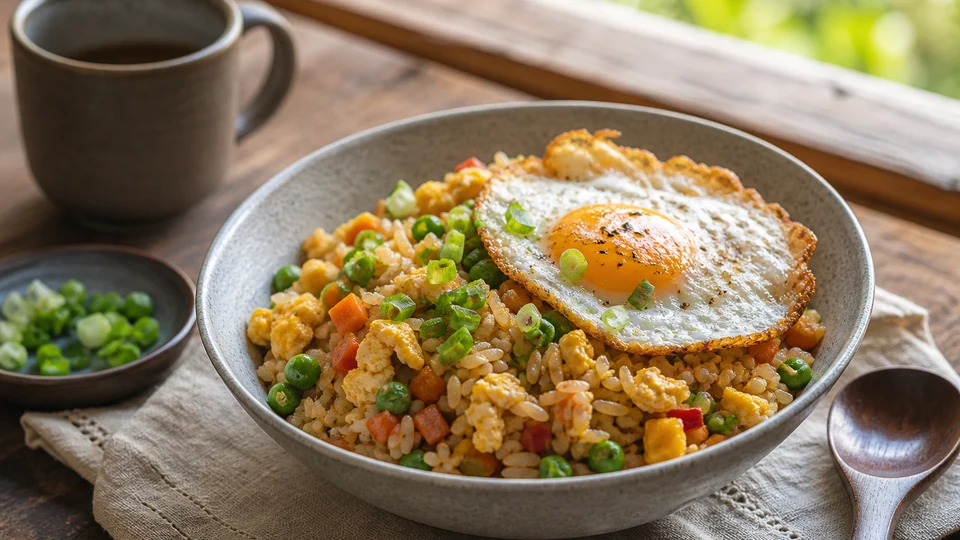
Breakfast fried rice is best made with cold, safely stored cooked rice, a hot wide pan and additions that are dry enough to fry rather than steam. This four-serving recipe browns rice before the egg and vegetables return, so grains stay separate and the finished pan is hot throughout. Pancake World uses one sequence: prepare, brown, clear moisture, combine, then serve.
Complete base recipe
Ingredients
- 600 g cold cooked long-grain rice
- 2 tablespoons neutral oil
- 3 large eggs, beaten
- 120 g diced carrot and 100 g frozen peas
- 3 scallions and 2 teaspoons grated ginger
- 1 tablespoon soy sauce and 1 teaspoon toasted sesame oil
The rice must have a known refrigeration history. Do not use rice whose handling is uncertain; the recipe controls texture, not the safety history of a leftover batch.
Parent hub and meal role
Use the American breakfast guide when deciding whether fried rice is the main savoury plate or part of a larger table. It is substantial on its own, so fresh fruit or a simple drink is usually a more useful companion than another starch.
Moisture control before heat
Measure sauce before heating the pan, drain thawed peas if they carry ice and loosen every rice clump. Sauce added too early lowers the pan temperature; a dry pan lets the rice fry rather than turn into a wet mound.
Numbered method
- Break cold rice apart and set egg, vegetables, rice and seasoning beside the stove.
- Heat a 30 cm wok or skillet over medium-high heat for 2 minutes. Add 1 tablespoon oil; scramble egg until softly set, then transfer it to a clean bowl.
- Add remaining oil, carrot, scallion whites and ginger. Stir-fry for 2 minutes, until the carrot is brighter and the pan is dry.
- Add rice in a loose layer. Leave it 60 seconds, then turn and fry for 3 to 4 minutes until some grains have browned edges.
- Add peas and return egg. Drizzle soy sauce around the hot edge, toss 1 to 2 minutes, then finish with sesame oil and scallion greens.
- Serve when the rice is steaming evenly and no sauce has pooled at the base of the pan.
Doneness and heat cues
Listen for a lively sizzle. If it becomes a quiet hiss and you see liquid, pause tossing and let exposed moisture cook away. At the finish, sample several points: each should be steaming, with separate grains and no cool centre clumps.
Scaling without crowding
For two servings, halve all ingredients and use a 25 cm skillet. For eight servings, double quantities but fry rice in two batches, holding the first only briefly while the second cooks. More ingredients never remove the need for a hot, exposed surface.
Variations that retain the formula
Replace egg with 180 g firm tofu, patted dry and browned before the vegetables, for a vegetable-forward pan. For a richer brunch version, add a separately cooked egg at service. The Breakfast frittata recipe is better when egg is the main event.
Pan order: the route-specific technique asset
| Stage | Goes in | Signal to proceed |
|---|---|---|
| 1 | Egg | Soft curds; transfer out. |
| 2 | Aromatics and carrot | No visible puddle. |
| 3 | Cold rice | Browned faces on some grains. |
| 4 | Peas, egg and seasoning | Uniform steam; sauce coats. |
The order prevents egg from disappearing into wet rice. The Breakfast fried potatoes guide applies broad-pan logic to a different base ingredient.
Failure signals and repairs
Rice clumps: break it apart before heat. Wet rice: use two batches and wait for sauce to stop pooling. Burning aromatics: lower heat and add rice promptly. Flat seasoning: add a few drops of soy sauce only after tasting the hot pan.
Storage boundary
Cool leftovers promptly in shallow containers and refrigerate according to current official guidance. Reheat only a portion you plan to eat and discard food with an uncertain storage history. The Early Morning Breakfast guide can help organise chopping and containers ahead.
Final fried-rice checklist
Check for loose grains, browned spots, vegetables without standing liquid, soft egg in pieces and heat throughout the pan. Cold prepared rice, a dry hot surface and a late seasoning step make the single formula reproducible.
Related reading
Sources and editorial references
- USDA Food Safety and Inspection Service, Safe Minimum Internal Temperature Chart —
https://www.fsis.usda.gov/food-safety/safe-food-handling-and-preparation/food-safety-basics/safe-temperature-chart - USDA Food Safety and Inspection Service, Keep Food Safe! Food Safety Basics —
https://www.fsis.usda.gov/food-safety/safe-food-handling-and-preparation/food-safety-basics - U.S. Food and Drug Administration, Safe Food Handling —
https://www.fda.gov/food/buy-store-serve-safe-food/safe-food-handling - U.S. Food and Drug Administration, What You Need to Know About Egg Safety —
https://www.fda.gov/food/buy-store-serve-safe-food/what-you-need-know-about-egg-safety