Paula Deen breakfast casserole
At Pancakes World, “paula Deen breakfast casserole” can refer to several distinct recipes on Paula Deen’s official site, not one universal dish. The official collection includes a bread-based Classic Breakfast Casserole, a Southern hash-brown casserole with sausage, and a sausage, egg, and potato casserole. Choose the exact official recipe by title, follow its ingredient amounts and pan instructions on the source page, and use a food thermometer: USDA lists 165°F for casseroles. This guide helps identify and handle the recipes; it does not republish them or claim an independent Pancake World test.
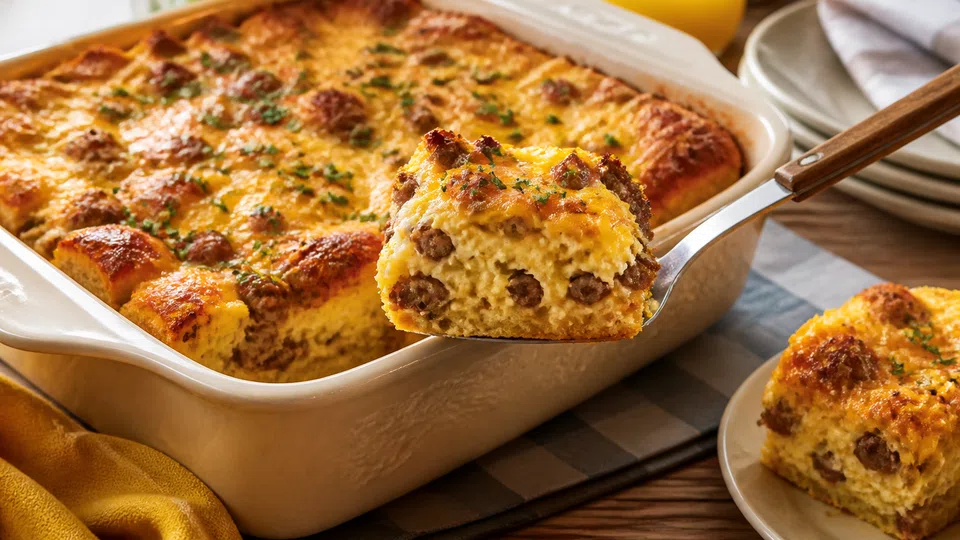
Direct answer for Paula Deen breakfast casserole
If you want the bread-based version, use the official Classic Breakfast Casserole page: it layers bread, cheese, herbs, and an egg-milk mixture and refrigerates overnight before baking. If you want hash browns and sausage, use the official Southern Hash Brown Breakfast Casserole with Sausage page. For potato, sausage, peppers, and cheese in a skillet-style bake, use the official Sausage, Egg, and Potato Breakfast Casserole page.
Do not combine directions across them. Their pans, yields, ingredient structures, and schedules differ. Open the official page during preparation because recipes can be updated.
What the term means
The search phrase uses a living person’s name to identify recipes attributed on her official site. Accurate treatment requires source fidelity and clear attribution. This article does not imply endorsement, affiliation, or ownership by Pancake World.
It also avoids copying the full recipe. Ingredient lists can be factual, but republishing the expressive directions would add little value and could confuse readers if the original changes. The official page remains the preparation authority; this guide compares the versions and adds government food-safety boundaries.
The Breakfast Recipes to Start the Day owns the general category; this route stays with the named casserole-source question.
Practical options and examples
| Official recipe | Main base | Preparation pattern | Choose it when |
|---|---|---|---|
| Classic Breakfast Casserole | Sandwich bread, cheese, egg and dairy | Overnight soak, then bake | You want a meat-free bread strata style |
| Southern Hash Brown Breakfast Casserole with Sausage | Hash browns, bread, sausage, cheese | Cook components, assemble, bake | You want a large layered savory dish |
| Sausage, Egg, and Potato Breakfast Casserole | Hash browns, sausage, vegetables, eggs, cheese | Skillet preparation and bake | You want peppers and potato in the mix |
| Tater Tot Breakfast Casserole | Tater tots, sausage, egg, cheese | Layer and bake | You specifically want the tater-tot version |
The summaries are identity notes, not substitute directions. Use the links in Sources.
Choosing the right approach
Choose by base ingredient and morning workflow. The Classic page explicitly uses an overnight rest, which may suit a planned brunch. The Southern hash-brown version has more cooked components and a larger listed yield. The skillet potato version has a different equipment path. Confirm refrigerator and oven space before shopping.
Three scenarios:
- Meat-free family brunch: choose the official Classic Breakfast Casserole and verify cheese, dairy, and egg needs.
- Larger sausage brunch: choose the Southern hash-brown recipe, cook sausage safely, and avoid assuming visual browning proves casserole doneness.
- Potato-and-pepper preference: choose the official sausage, egg, and potato page and follow its skillet and pan directions exactly.
Common mistakes
The biggest mistake is landing on one recipe, remembering details from another, and assembling a hybrid. Do not use the Classic recipe’s overnight schedule with a different formula unless its own page directs it. Do not infer that all pages have the same serving count or bake time.
Do not rely on a wooden pick, puffing, or golden color alone for food safety. USDA lists casseroles at 165°F. Measure in the center and in more than one place where the dish is large or uneven. Keep raw sausage separate from bread, herbs, and cheese, and wash tools before reuse.
Step-by-step checklist
- Open Paula Deen’s official site and confirm the exact recipe title.
- Note the base: bread, hash browns, potatoes, or tater tots.
- Read the complete ingredient list, pan, yield, prep, and cook directions.
- Check allergens and choose substitutions only if the official recipe supports them.
- Confirm refrigerator space for any required rest.
- Handle raw sausage with separate tools and clean surfaces.
- Assemble only on the schedule stated by that recipe.
- Preheat the oven and use the specified pan.
- Check the casserole in the center with a food thermometer.
- Reach 165°F under USDA casserole guidance.
- Let the dish rest only as the recipe directs.
- Refrigerate leftovers in shallow containers within two hours.
Variations and decision boundaries
Substituting milk, cheese, bread, or sausage may change moisture, salt, fat, allergens, and cook behavior. Use an official variation when available. If you need a vegan casserole, choose a purpose-built vegan recipe rather than presenting a heavily modified dish as Paula Deen’s recipe.
For general casserole planning, easy Christmas brunch menu covers equipment and service. Brunch meat dishes covers sausage and ham temperatures. Brunch ideas for small group helps decide whether a large casserole fits the guest count.
Pancakes World provides navigation and analysis; it does not claim to be the official source for Paula Deen recipes.
Storage or planning notes
Follow the official page’s advance-assembly schedule. Keep egg-and-dairy mixture refrigerated. If raw sausage is involved, cook it as directed and avoid cross-contact. Do not leave an assembled casserole at room temperature while waiting for the oven.
USDA advises refrigerating leftovers within two hours, cooling them in shallow containers, storing most cooked leftovers for three to four days, and reheating to 165°F. Cover during reheating where appropriate and check several places because dense casseroles can heat unevenly.
How this guide was fact-checked
The title and identity comparison were checked against Paula Deen’s official recipe pages. Safety claims were checked against USDA FSIS. No taste, texture, popularity, or performance result was invented. The article deliberately directs the reader back to the current primary recipe rather than copying competitor or source prose.
If the official site changes a title, yield, or direction, update this guide’s identity notes but preserve the boundary: one official version at a time, no hybrid recipe, and 165°F for casserole safety under current USDA guidance.
How to identify the page you actually want
Look at the title, lead image, base starch, pan, and listed yield. Search snippets can shorten titles or show an image from a collection page, so confirm the recipe on pauladeen.com before shopping. The Classic Breakfast Casserole uses sliced bread and no sausage in the listed formula. The Southern Hash Brown Breakfast Casserole includes both hash browns and sausage. The sausage, egg, and potato version uses an ovenproof skillet and includes peppers.
Save or print only for personal kitchen use if desired, but retain the page URL and access date. Do not rename a modified recipe as the official original.
Compare workflow, not popularity
The Classic version shifts assembly to the previous night and includes a morning room-temperature step before baking according to its page. The Southern hash-brown version includes separate stovetop work for onion, potatoes, and sausage. The skillet potato version cooks sausage and vegetables before the egg mixture is baked. These different workflows should decide which recipe fits the cook’s schedule.
Review counts, social shares, or search position do not prove one version tastes better. This article makes no such ranking.
Substitution questions
If changing whole milk, half-and-half, cheese, bread, hash browns, or sausage, first check the official page for a note or a related official recipe that already uses the desired ingredient. A lower-fat dairy product changes richness and may change set; plant drink changes protein, sugar, and flavor; gluten-free bread absorbs liquid differently; meat alternatives have their own cooking directions.
When the substitution is necessary for an allergy, ingredient selection alone may not control cross-contact. Use a recipe and kitchen process that can meet the actual requirement. Do not present an untested conversion as Paula Deen’s version.
Temperature-checking a casserole
Insert a clean food thermometer into the center of the dish and avoid touching the pan. Check more than one place in a large casserole. USDA lists 165°F for casseroles. If one location is below that temperature, continue cooking under the recipe method and check again with a cleaned probe.
Puffing, browning, and a clean-looking knife can support quality judgment but do not replace the temperature check. Oven calibration, pan material, ingredient temperature, and depth affect actual time, so the official stated time is a planning estimate within its recipe, not permission to skip verification.
Service and portioning
Let the casserole rest for the exact period stated on its official page; rest helps the structure settle but should not become uncontrolled room-temperature holding. Cut with a clean knife and spatula. For a buffet, put out a small portion and keep the reserve under suitable hot holding rather than repeatedly warming the same pan.
Pair a rich casserole with fruit, a crisp salad, or plain bread rather than multiple meats and pastries. This is an editorial menu suggestion, not a change to the attributed recipe.
Leftover separation
Divide leftovers into shallow containers instead of refrigerating a deep, nearly full baking dish. Label the recipe and date. Reheat only the portion needed to 165°F and check more than one location when the piece is dense. Discard food that exceeded the safe room-temperature window; reheating is not a reset for unsafe holding.
Sources
- Paula Deen — Classic Breakfast Casserole — https://www.pauladeen.com/recipe/classic-breakfast-casserole/ — primary recipe identity and current preparation page.
- Paula Deen — Southern Hash Brown Breakfast Casserole with Sausage — https://www.pauladeen.com/recipe/southern-breakfast-casserole-recipe/ — primary source for the hash-brown version.
- Paula Deen — Sausage, Egg, and Potato Breakfast Casserole — https://www.pauladeen.com/recipe/sausage-egg-and-potato-breakfast-casserole/ — primary source for the skillet potato version.
- USDA FSIS — Safe Minimum Internal Temperature Chart — https://www.fsis.usda.gov/food-safety/safe-food-handling-and-preparation/food-safety-basics/safe-temperature-chart — casserole temperature.
- USDA FSIS — Leftovers and Food Safety — https://www.fsis.usda.gov/food-safety/safe-food-handling-and-preparation/food-safety-basics/leftovers-and-food-safety — cooling, storage, and reheating.
Evidence checked 16 August 2026. Official recipe pages control their current formulas; no affiliation or independent test is claimed.