Full English breakfast
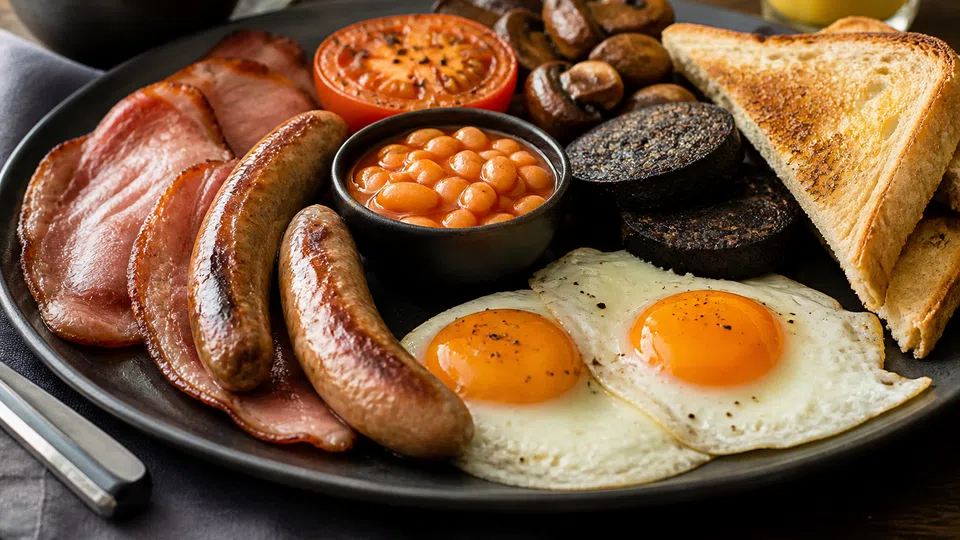
At Pancakes World, a full English breakfast is a composed hot plate typically built around eggs, bacon, sausages, cooked tomato, mushrooms, bread or toast, and often baked beans and black pudding. Exact combinations vary, so treat it as a structured breakfast rather than a single fixed recipe. To cook it at home, schedule foods by holding quality: cook beans gently, prepare mushrooms and tomato, cook meats to verified safe temperatures, toast bread late, and cook eggs last. Use separate utensils for raw meat and ready-to-eat food.
Direct answer for full English breakfast
For one pan and one oven, start sausages first, add bacon according to its product instructions, warm beans separately, cook mushrooms and tomato after the raw-meat task or in a clean pan, then finish toast and eggs. Historic UK describes the familiar plate with eggs, sausage, back bacon, tomatoes, mushrooms, fried bread, and often black or white pudding, with beans and hash browns also common today. That is a cultural description, not a safety method or proof that every region uses identical components.
USDA guidance gives 160°F for raw ground pork or beef sausage and 165°F for raw ground poultry sausage. Product labels and applicable local authority guidance control the food in hand.
What the term means
“Full English” distinguishes the composed plate from a generic fry-up, but boundaries remain debated. The English Breakfast Society publishes its own standards; it is an advocacy and cultural organization, not a government regulator. Its standard is useful evidence of one contemporary definition, not legal ownership of the meal.
This page does not claim an invented origin date, a universal ingredient list, or health effects. It also does not rank cafés or make permanent venue claims. The practical job is to identify the components and cook them coherently.
Use the Breakfast Recipes to Start the Day for the wider category beyond this English plate.
Practical options and examples
| Component | Typical form | Timing | Key control |
|---|---|---|---|
| Sausage | Pork, beef, or regional sausage | Start early | Cook by product class and thermometer |
| Bacon | Back bacon or another local cut | Early-middle | Follow package; avoid cross-contact |
| Egg | Fried, poached, or scrambled | Last | Cook to chosen authoritative guidance |
| Tomato | Halved and grilled or pan-cooked | Middle | Use a clean surface |
| Mushrooms | Sautéed | Middle | Avoid crowding for better browning |
| Beans | Warmed baked beans | Hold gently | Stir and prevent scorching |
| Bread | Toast or fried bread | Late | Keep crisp |
| Pudding | Black or white pudding | Product-specific | Read raw/ready-to-eat status |
Choosing the right approach
Choose six or seven components that fit the kitchen; “full” does not require every possible side. If two pans are available, dedicate one to raw meat and one to vegetables and eggs. If only one pan is available, cook meat, clean the pan and utensils, then cook ready-to-eat components.
Three scenarios:
- Traditional-leaning home plate: sausage, back bacon, egg, tomato, mushrooms, beans, toast, and black pudding if locally available and desired.
- Reduced plate: sausage, egg, mushrooms, tomato, beans, and toast. Describe it honestly rather than promising compliance with a society standard.
- Vegetarian-inspired breakfast: meat-free sausage, egg, beans, tomato, mushrooms, and toast; it is a variation, not identical to the meat-based plate.
Common mistakes
Do not start every component simultaneously. Toast softens, eggs overcook, and mushrooms steam while raw sausage still needs time. Avoid cooking by color alone. USDA notes sausage can be raw, partially cooked, or ready-to-eat, so the label matters.
Do not use the raw-sausage spatula for eggs or toast. Avoid overloading one pan, which lowers heat and causes steaming. Do not call hash browns ancient or essential without evidence; describe them as a common contemporary addition where appropriate.
Step-by-step checklist
- Choose the exact components before heating equipment.
- Read sausage, bacon, and pudding labels for cooking status.
- Assign separate raw-meat and ready-to-eat tools.
- Warm plates if desired using a safe method.
- Start the longest-cooking meat component.
- Warm beans over low heat and stir.
- Cook tomato and mushrooms with enough pan space.
- Verify meat temperatures with a thermometer.
- Toast bread close to service.
- Cook eggs last.
- Plate without resting cooked food on raw-meat surfaces.
- Refrigerate leftovers promptly.
Variations by market or ingredient
Back bacon and black pudding may be difficult to source outside Britain and Ireland. Use an honest local adaptation rather than relabeling a different cured meat as identical. Baked bean formulations, sausage sizes, and pudding cooking status vary by brand.
For an Irish-oriented fry-up query, fry-up breakfast owns the broader regional intent. Brunch meat dishes gives more detail on temperature and buffet service. Vegan breakfast foods provides a complete plant-based breakfast rather than pretending an ingredient omission preserves every cultural definition.
Pancakes World presents this as an international breakfast guide, with Mr. Pancake Munich remaining local proof rather than the platform identity.
Storage or planning notes
Prepare mushrooms and tomatoes shortly before cooking. Keep raw meats refrigerated until needed. Beans can warm gently but should not be left indefinitely. Cooked components are best served at once rather than held while a second full batch is prepared.
USDA advises refrigerating perishable leftovers within two hours, using most cooked leftovers within three to four days, and reheating leftovers to 165°F. Local UK or Irish guidance may use Celsius and jurisdiction-specific holding rules; follow the relevant authority.
A timing example
At minute zero, start sausages. At minute eight, begin beans. At minute twelve, add or start bacon based on thickness and directions. When meat is nearly done, cook tomato and mushrooms on a separate surface. Verify temperatures, then toast bread and cook eggs. The exact minutes are illustrative sequencing, not cooking claims; package directions, size, appliance, and thermometer decide actual doneness.
Serve immediately with tea or coffee if desired. Keep sauces at the table so the plate remains crisp during assembly.
Build the plate by moisture and heat
Beans and tomato bring moisture; fried bread or toast absorbs it; mushrooms release water if crowded; eggs continue to cook on a hot plate. Keep beans in a contained area, drain mushrooms before plating, and place toast where it stays crisp. These are plating choices, not rules of cultural authenticity.
Warm plates can extend the service window for a few minutes, but only use oven-safe plates under their manufacturer guidance. A plate that is too hot continues cooking the egg and can be unsafe to handle. For several diners, line plates up and add the same component to each rather than fully completing one while the rest grow cold.
Ingredient identity matters
Back bacon contains loin and differs from streaky belly bacon. Black pudding is a blood sausage; white pudding is a different grain-and-fat sausage. Sausages vary widely by meat, grind, seasoning, casing, and whether they are raw or cooked. Baked beans and bread formats also vary. Name the actual products instead of implying all substitutes are identical.
If a regional item is unavailable, omit it or describe the adaptation. Importing a product is not required to enjoy the composed-breakfast method. Current package directions and local safety authority remain more important than a nostalgic description.
One-pan workflow
With one pan, begin with the raw meat that needs the longest verified cook. Move cooked meat to a safe warm location, clean and sanitize tools and the pan as appropriate, then cook mushrooms and tomato. Warm beans in a separate saucepan or microwave-safe vessel. Finish egg and toast last.
Do not pour bacon or sausage fat into a sink. Let it cool in a suitable container and dispose of it according to local guidance. Do not save rendered fat if raw juices, burned particles, storage conditions, or intended use are uncertain.
Two-pan workflow
Dedicate one pan to meat and one to vegetables and eggs. This reduces cross-contact but still requires clean hands and utensils. Start sausage on the meat side, beans in a saucepan, then mushrooms and tomato on the vegetable side. Cook eggs only after the vegetable components leave their pan or use a clean area.
Vegetarian and smaller versions
A vegetarian variation can keep egg, beans, mushrooms, tomato, and toast and add a verified meat-free sausage. That product may still contain egg, dairy, wheat, soy, or other allergens. A vegan variation requires a different main and should be described as inspired by the plate rather than an uncontested traditional full English.
For a smaller appetite, reduce the number of components instead of making every item miniature. Sausage, egg, mushroom, tomato, beans, and toast still provide the recognizable hot composed-breakfast experience without an unmanageable plate.
Quality troubleshooting
Pale mushrooms usually need more space and heat, not longer steaming in a crowded pan. Burst sausage casing may reflect excessive heat; follow the product method. Rubbery eggs were cooked too early or held too long. Soggy toast was plated under wet food. Correct scheduling and placement before adding more fat or heat.
Sources
- Historic UK — Traditional English Breakfast — https://www.historic-uk.com/CultureUK/Traditional-English-Breakfast/ — recognized cultural description of common components.
- English Breakfast Society — Core Component Standard — https://englishbreakfastsociety.com/standards/core-component-standard — one contemporary advocacy standard, identified with its limits.
- USDA FSIS — Sausages and Food Safety — https://www.fsis.usda.gov/food-safety/safe-food-handling-and-preparation/meat-catfish/sausages-and-food-safety — sausage categories, labels, temperatures, and storage.
Evidence checked 16 August 2026. Cultural variation and product-specific instructions are stated explicitly.