
Quick answer
A classic American pancake is a small, thick griddle cake with a tender interior, gently browned faces, and enough structure to stack. The familiar result comes from a quick batter: wheat flour, baking powder, egg, milk, melted butter, a little sugar, and salt. It should be mixed briefly, rested while the griddle heats, portioned evenly, and turned only after the upper surface and edge show that the first side has set.
“Classic” describes a recognizable style, not a single official national formula. Buttermilk versions often use baking soda alongside baking powder; plain-milk versions rely mainly on baking powder. This recipe uses plain milk so the ingredient logic stays straightforward.
Classic American pancake recipe
Makes 12 pancakes about 10 cm or 4 inches wide:
- 240 g all-purpose flour
- 30 g sugar
- 2 1/2 teaspoons baking powder
- 1/2 teaspoon fine salt
- 2 large eggs
- 360 ml milk
- 45 g unsalted butter, melted and cooled slightly, plus more for serving
- 1 teaspoon vanilla extract, optional
- neutral oil or clarified butter for the griddle
Whisk flour, sugar, baking powder, and salt. In a separate bowl, whisk eggs, milk, melted butter, and vanilla. The butter should be warm enough to stay fluid but not so hot that it cooks the egg on contact.
Make a well in the dry ingredients and add the liquid. Fold from the centre outward, scraping the bottom, until no dry pocket remains. A few small lumps are normal. Leave the batter for five to ten minutes while the griddle warms. The rested batter should fall from a scoop in a thick ribbon and spread into a round without running across the surface.
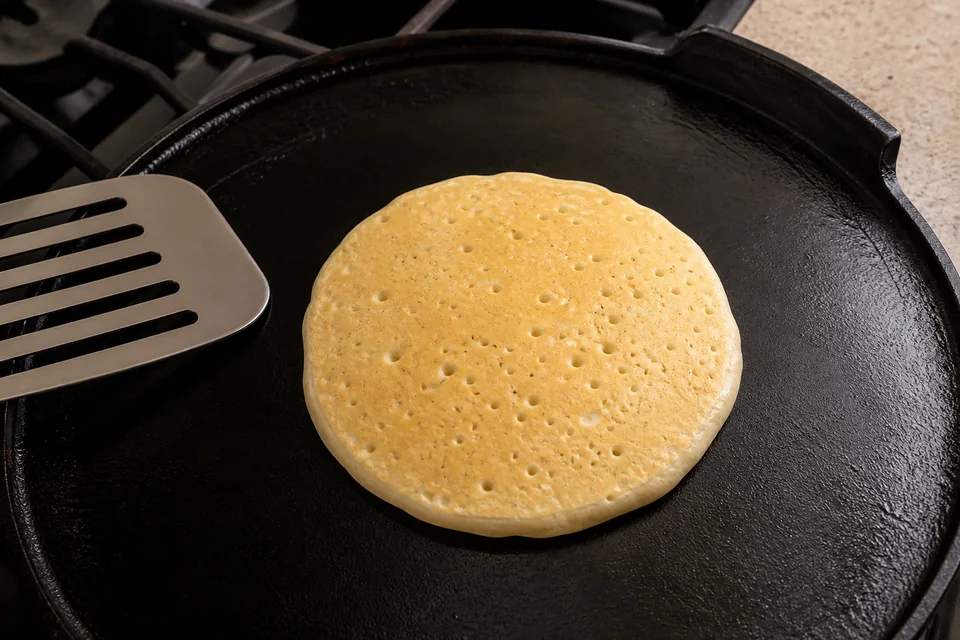
Preheat a griddle or wide skillet over medium heat. Add a very thin film of fat. Portion 60 ml or 1/4 cup batter for one tester. Watch for bubbles that rise and open, a top that is no longer entirely glossy, and an edge that begins to look dry. Lift one side: the base should be evenly golden rather than pale and greasy or nearly black.
Turn once with a broad spatula. Cook until the second side is golden and the centre springs back lightly. Break open the tester. A classic pancake should have a set, even crumb without a wet stripe. Adjust the burner before proceeding; correcting the pan with the tester is more effective than changing every pancake in the batch.
Understand the batter
Flour creates the framework that traps the leavener’s gas. Too much flour can make the batter resist spreading and produce a heavy crumb. Because cup measurements vary with packing, weighing the flour gives the clearest starting point.
Baking powder is the main leavener in this neutral-milk formula. Whisking it through the flour prevents isolated pockets. More is not automatically better. An excessive amount can create coarse holes or an unpleasant flavor, while old product may give weak lift. Follow the measured formula and check the package when performance changes unexpectedly.
Egg supports structure and contributes richness. Milk provides most of the hydration. Butter brings flavor and tenderness, and the small sugar quantity sweetens lightly while affecting browning. Each ingredient has more than one job, which is why a classic batter becomes unpredictable when several are replaced at once.
What makes this the American griddle style
The defining combination is thickness, quick leavening, and small-round griddle cooking. Unlike a crêpe batter, this mixture is not tilted into a paper-thin sheet across the entire pan. Unlike a yeast-raised breakfast cake, it does not need a long fermentation. Baking powder begins doing its work after the wet and dry ingredients meet, so the cook moves from mixing to a short rest and then to the hot surface within the same breakfast session.
Portion size is part of the style. A 60 ml scoop makes a round that can rise through the centre before the underside becomes too dark, and its roughly 10 cm diameter is easy to support with a household spatula. Oversized “plate pancakes” may still use an American-style batter, but they demand lower heat and more careful turning. The smaller classic round gives a more dependable balance of browned surface and tender crumb.
Thickness should come from a proportioned batter, not from leaving raw flour unmixed or packing extra flour into the cup. After the short rest, the scoop should leave a mound that relaxes outward. The pancake then gains height as bubbles expand and the setting flour-and-egg framework holds them. A batter that pours like a thin drink belongs to a different texture target; one that sits like biscuit dough needs a hydration check.
The stack is a serving convention rather than a cooking requirement. Two or three evenly sized pancakes hold butter, syrup, fruit, or another topping without requiring every cake to be flooded. For the clearest griddle texture, cook each round completely on its own and stack only at service. Pouring fresh batter onto an already cooked pancake would trap an underdone layer rather than create a taller classic cake.
Griddle control
An electric griddle can make repeat batches easier because it offers a repeatable setting, but the actual food contact still matters. On a skillet, preheat gradually. A pan that is smoking is too hot for this method; a pan that leaves the first tester pale and oily needs more time.
Use a thin fat film. Whole butter can brown quickly because of its milk solids, especially over a long batch. Neutral oil or clarified butter is easier to control on the cooking surface, while regular butter can remain in the batter and on the finished stack.
Leave space between rounds. Crowding makes the spatula approach awkward and can cool the pan. If the griddle has hot spots, rotate the placement of later pancakes rather than moving a wet pancake after it has begun to set.
For a large breakfast, keep the 60 ml portion instead of making wider cakes to save time. Use a second pan only if you can monitor both surfaces; otherwise cook orderly rounds and hold them briefly on a rack. A rack preserves the dry griddled faces better than sealing the pancakes under a lid, where trapped steam softens them.
When doubling this recipe, double the measured ingredients but mix in two bowls if your largest bowl forces vigorous stirring. A very deep mass is harder to fold evenly, and the leavener begins working while the final dry pockets are still being chased. Two parallel batters keep the mixing motion and rest closer to the tested batch. Preheat the griddle before combining the second bowl so it does not wait unnecessarily.
Diagnose the first batch
Flat pancakes
If the batter spreads into broad, thin rounds, evaluate thickness before blaming the leavener. Let it rest, then add flour by the tablespoon only if a properly heated tester still runs. If spread is controlled but the crumb has little lift, check the baking powder and review whether the batter was beaten aggressively. The complete flat-pancake guide maps those different symptoms.
Burnt surfaces and wet centres
This points first to excessive heat or oversized portions. Turn the burner down and make a smaller tester. A dark underside cannot compensate for a centre that has not set. Do not press the pancake; pressure creates a misleading dense layer and releases steam.
Rubbery texture
The batter may have been mixed beyond incorporation, or the cooked pancakes may have been held tightly under foil where steam softened and compressed them. Fold briefly and transfer finished rounds to a rack. If they must wait, hold them in a single layer for as short a time as practical.
Patchy browning
Visible pools of fat are a common cause. Wipe the griddle to leave only a sheen. Uneven preheating can also create pale and dark zones. Let the surface stabilize, then place the next tester away from an obvious burner hotspot.
Tearing during the flip
Wait until the top has several open bubbles and the rim is matte. Use a spatula wide enough to support the centre. The reader guide to when to flip pancakes explains why a fixed time is less dependable than this group of cues.
Buttermilk variation
Buttermilk pancakes are a closely related American style, but buttermilk is acidic. Recipes commonly pair it with baking soda, sometimes retaining baking powder for additional lift. Do not pour buttermilk into this plain-milk formula and assume the leavener balance remains ideal.
Use a tested buttermilk recipe when that tang is the goal. King Arthur Baking’s version, for example, specifies both baking powder and baking soda and gives its own rest and griddle directions. Recipe-specific quantities should remain attached to the recipe that was tested.
Blueberries, chocolate, and other additions
For blueberries, pour the pancake first and distribute fruit over the wet top. This gives each round a similar load and avoids crushing berries through the whole bowl. Use fewer berries in the tester so you can still read the batter’s baseline behavior.
For chocolate, scatter small pieces sparingly. Melted chocolate can mark the griddle after the turn, so wipe residue before the next pour. For chopped nuts, keep pieces small and disclose the allergen clearly to anyone eating.
For cinnamon pancakes, whisk a modest amount into the dry ingredients. For lemon, rub zest into the sugar. Both adjustments change flavor without substantially altering hydration. Mashed fruit, pumpkin puree, and ricotta change moisture and structure and deserve a purpose-built formula.
Serving the classic stack
Butter and maple syrup are familiar, but the pancake does not require a heavy pour. Fresh berries, lightly cooked fruit, yogurt, nut butter, or a dusting of cinnamon all work. Serve toppings separately for a group with different preferences or allergen needs.
Warm plates help more than a sealed holding container. If you need to cook for several people, place pancakes on a rack over a sheet pan in a low oven and serve in waves. A compressed stack held for a long time loses the surface texture created on the griddle.
Improve the next batch
Write down the flour weight, scoop size, pan type, and heat change after the tester. “Cooked on medium” is not as useful as “first underside darkened before edge dried; lowered one notch.” That note captures the cause-and-correction relationship.
Change one feature per batch. A new flour, alternative milk, and larger pancake all affect the result. Keeping two variables stable makes the third understandable. Once the base is dependable, variations become deliberate rather than rescue work.
Food safety
Do not taste raw batter. FDA guidance advises treating flour as a raw food, and USDA guidance covers safe handling and thorough cooking for foods containing eggs. Wash bowls, whisks, counters, and hands that contacted the mixture. Use a set centre and an opened tester for this recipe; do not infer safety from browning alone.
Frequently asked questions
Why are American pancakes thicker than crêpes?
This batter uses leavener and a lower liquid-to-flour relationship than a typical thin crêpe batter. It is portioned into small rounds rather than spread across the whole pan. Crêpes follow their own mixing, resting, and turning method.
Can I make the batter ahead?
This formula is intended to be mixed shortly before cooking. Overnight hydration and leavener activity can change thickness and rise. Measure dry ingredients in advance and refrigerate the combined wet ingredients separately, then fold them together near breakfast.
Is a cast-iron skillet required?
No. A nonstick skillet or electric griddle also works. The useful qualities are even heat, a surface the pancake releases from, and enough space for the spatula. Learn one pan before changing equipment.
Why does my second batch brown faster?
The griddle may continue storing heat while you portion and serve. Reduce the burner slightly or give the empty surface a short pause. Reapply fat as a thin wipe, because accumulated browned butter also darkens later pancakes.
Sources and editorial references
- University of Tennessee Extension, “Flat As A Pancake” —
https://www.healthyfamilies.tennessee.edu/recipes/flat-as-a-pancake/ - King Arthur Baking, “Buttermilk Pancakes” —
https://www.kingarthurbaking.com/recipes/buttermilk-pancakes-recipe - King Arthur Baking, “I’ve baked over 18,000 pancakes. Here’s how to make your best.” —
https://www.kingarthurbaking.com/blog/2021/10/26/best-pancake-tips - U.S. Food and Drug Administration, “Handling Flour Safely” —
https://www.fda.gov/consumers/consumer-updates/handling-flour-safely-what-you-need-know - U.S. Department of Agriculture Food Safety and Inspection Service, “Shell Eggs from Farm to Table” —
https://www.fsis.usda.gov/food-safety/safe-food-handling-and-preparation/eggs/shell-eggs-farm-table
For more practical food and breakfast guides, visit Pancakes World.
For the wider topic, start with World Pancakes.
For a closely related guide, see Baked Pancakes: An Easy Sheet-Pan Method.
A useful next comparison is Besan Chilla: Quick Savory Gram-Flour Pancakes.
You can also continue with Korean Seafood Pancake: Haemul Pajeon Recipe.
For another practical angle, read Harries Pancakes Dubai and Savoury Pancake Ideas.
