
Quick answer
Besan chilla is a quick savory pancake made from besan—gram or chickpea flour—mixed with water, seasonings, and often finely chopped vegetables. It needs no egg and no wheat flour in the base below. The key is a pourable batter that can be spread into a thin round, vegetables cut small enough to stay within that round, and medium heat that cooks the gram flour through without scorching the spices.
There is no single compulsory household version. Onion, tomato, chili, ginger, herbs, and spices vary by cook and region. This recipe offers a balanced starting point and treats the additions as adjustable rather than declaring one combination uniquely authentic.
Quick besan chilla recipe
This makes 6 chilla, each about 15 cm or 6 inches wide:
- 150 g besan or gram flour, about 1 1/2 cups depending on the grind
- 260 ml water, plus 1 to 3 tablespoons if needed
- 1/2 teaspoon fine salt
- 1/2 teaspoon ground cumin
- 1/4 teaspoon turmeric
- 1/4 teaspoon mild chili powder, optional
- 1 teaspoon finely grated fresh ginger
- 40 g finely chopped red onion
- 40 g finely chopped tomato, seeds and excess juice removed
- 2 tablespoons chopped cilantro
- 1 small green chili, finely chopped, optional
- neutral oil for the pan
Whisk besan, salt, cumin, turmeric, and chili powder. Add about three quarters of the water and whisk into a thick, smooth paste. This first stage makes lumps easier to remove. Gradually whisk in the remaining water until the batter pours from a ladle in a steady ribbon. Fold in ginger, onion, tomato, cilantro, and green chili.
Rest for ten minutes. Gram flour absorbs water during the pause, and the vegetables can release some of their own. Stir once and lift the ladle. The batter should pour readily but leave a visible trail before levelling. If it drops in clumps, add one tablespoon of water. If the vegetables sink in a watery bowl, whisk in one tablespoon besan and wait two minutes before judging again.
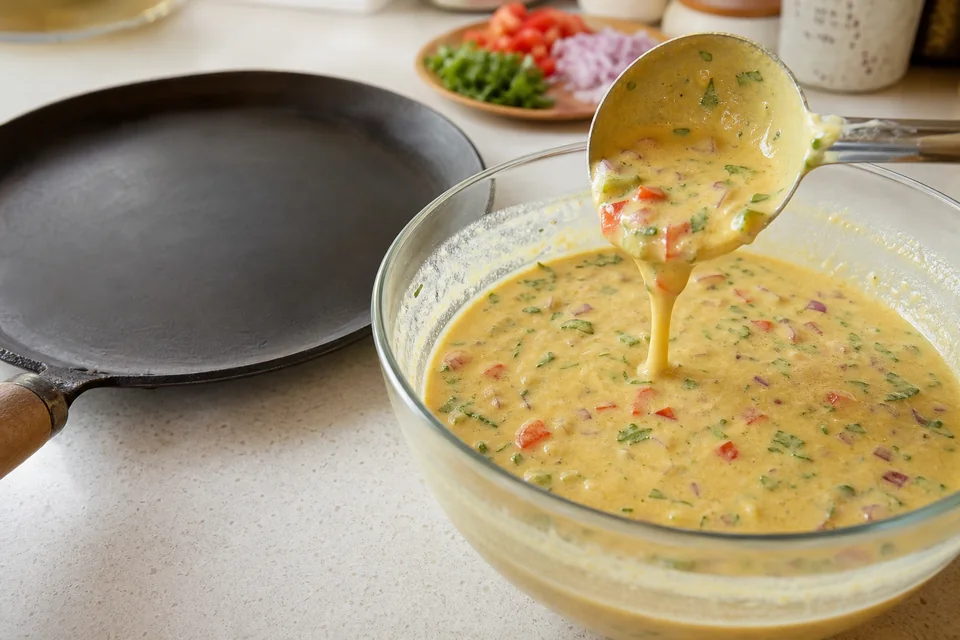
Heat a flat nonstick or well-seasoned skillet over medium heat. Brush it with a thin film of oil. Pour a small ladleful in the centre and use the back of the ladle to spread it gently outward in circles. Do not chase an extremely thin edge on the first attempt; an even round is easier to turn.
Cook until the top loses its wet shine, the edge looks dry, and the underside has golden patches. Drizzle a few drops of oil around the rim if it looks dry and reluctant to release. Slide a broad spatula underneath and turn. Cook the second side until the centre feels set and no wet gram-flour paste remains. Serve promptly, because chilla is most supple and aromatic close to the pan.
Build the right batter
Besan behaves differently from wheat flour. It does not create the same elastic gluten network, so the batter can be whisked smooth without the same concern about developing wheat gluten. At the same time, the cooked pancake depends on adequate hydration and a fully set first side to hold together during turning.
Starting with a thick paste is the simplest lump-control technique. If all the water is poured in at once, dry pockets can float through a thin liquid and resist the whisk. Once the paste is smooth, additional water can be incorporated gradually.
Vegetables are part of the batter system, not just flavoring. Large onion pieces catch the spatula, wet tomato loosens the mix, and a heavy volume of vegetables interrupts the pancake. Chop them finely, remove obvious tomato juice, and keep the first batch modest. After a successful tester, add more to the next batch by measured weight.
Diagnose the first chilla
It sticks to the skillet
The surface may not be properly preheated, the first side may still be wet, or the pan may need a slightly better oil film. Wait until the edge dries and test one small section with the spatula. If it releases cleanly, continue. If the pan itself has an unreliable surface, changing batter thickness will not solve the underlying problem.
It cracks during the turn
Make the next chilla a little smaller and less thin. Confirm that the top has lost its shine before lifting. A broad spatula is more helpful than a narrow tool. If carefully cooked small rounds still split, add a spoonful of besan rather than a large handful and re-test after a short rest. The general guide to pancakes that fall apart covers other binding patterns without assuming wheat batter.
The middle tastes raw or chalky
Lower the heat and allow more time for the interior to cook. A high burner can brown the underside before the gram flour in the centre is ready. Spreading to a consistent thickness helps. Chilla should be cooked through, but dark color by itself is not the test; look for a dry surface, set centre, and no wet paste when the tester is opened.
The batter will not spread
It may have thickened during the rest. Add water a tablespoon at a time. A cold skillet can also cause the batter to grip before the ladle moves, while an extremely hot surface can set it instantly. The correct adjustment comes from observing both bowl and pan.
The vegetables burn
Pieces protruding from a very thin round receive direct heat. Chop smaller, reduce the vegetable load, and use moderate heat. A little oil around the edge is different from shallow-frying the whole pancake; visible pools are unnecessary for this method.
Variations with clear boundaries
For spinach chilla, use a small handful of finely chopped, well-dried leaves. Wet spinach carries extra water into the batter. Add it after the rest, then cook a tester and correct thickness only if the round spreads differently.
For grated carrot, use the fine side of the grater and a restrained amount. Long strands make turning awkward. Carrot brings sweetness and can brown at the edge, so moderate heat remains useful.
For a simpler pantry version, omit all vegetables except ginger and cilantro. The smooth batter is easier to spread and is a good way to learn what fully cooked besan looks and feels like before adding more texture.
For a crisp-edged version, make the batter slightly thinner and spread a smaller ladleful into a wider round. This demands a reliable pan and a quick circular motion. Change only that variable; adding extra oil and turning up the heat together makes it hard to know what created the texture.
For more ideas built around chickpea flour, see vegan chickpea pancake variations. Chickpea-flour traditions are broader than one chilla formula, so methods should not be treated as interchangeable simply because the flour is related.
Serving ideas
Serve chilla with mint-cilantro chutney, tomato chutney, or plain yogurt if dairy suits the meal. A squeeze of lemon brightens the cooked pancake without changing the batter. For a fuller plate, add sliced cucumber, cooked greens, or a simple bean dish.
If making several, place them briefly in a loose stack under a clean towel. Holding them tightly in a sealed container traps steam and softens the edges. A large batch is better served in waves than kept for a long period.
Ingredient and allergen notes
Besan is commonly made from chickpeas or split Bengal gram, but product naming and milling can vary. Read the package so you know what you bought. Chickpea flour does not contain wheat as an intentional ingredient by definition, yet that fact alone does not establish that a particular packaged product or home kitchen meets a gluten-free requirement. Use label and cross-contact controls appropriate to the eater.
Chili heat varies widely. Start with less, especially when using both fresh and ground chili. The green chili can be served on the side for a mixed group. Turmeric brings color and earthy flavor; more is not automatically better.
Make the next batch more consistent
Record the besan weight and final water total. “One and a half cups” can differ with grind and how the flour settles. Also note whether the tomato was juicy and how long the batter rested. Those details explain why two apparently identical bowls can spread differently.
Use the first chilla as a calibration round. If it grips, adjust heat or oil before changing flour. If it runs thin in a properly heated pan, correct the bowl. If it tears only because it was turned while wet, wait longer. Separating pan problems from batter problems preserves the flavor and keeps the correction small.
Food safety
Rinse fresh tomato, chili, cilantro, and other produce under running water before cutting, following FDA produce-safety guidance. Keep the work surface and knife clean. Cook the chilla until the batter is fully set and no wet gram-flour paste remains; surface browning is a flavor and texture cue, not a stand-alone safety conclusion.
Frequently asked questions
Is besan the same as chickpea flour?
The names overlap in many shops, but products can be milled from different chickpea types and may vary in fineness and flavor. Follow the package identity, weigh the flour, and use the batter consistency rather than assuming every bag absorbs exactly the same amount of water.
Can I make the batter ahead?
This recipe is intended for a short rest and same-session cooking. Vegetables release water and fresh aromatics change as they sit. For advance preparation, whisk the seasoned dry mixture and chop the vegetables separately, then add water and combine closer to cooking.
Do I need baking powder?
No. This chilla is designed as a thin savory pancake that sets through gram flour and pan cooking. Adding leavener would create a different texture and is not required for a flexible, spreadable result.
Why is my chilla bitter?
Possible causes include scorched spices, too much turmeric, an aggressive amount of chili, or a darkened underside. Check ingredient freshness, use the measured starting quantities, and reduce the pan heat if the surface colors before the centre sets.
Related help
For a broader comparison of wheat, chickpea, buckwheat, and other options, read which flours make a savory pancake. If the symptom is not specific to besan, Pancake Troubleshooting provides a path from observation to correction.
Sources and editorial references
- India Science, “Recipes Book” —
https://www.indiascienceandtechnology.gov.in/sites/default/files/Recipes%20Book.pdf - University of Connecticut Extension, “The Health Benefits of Chickpeas” —
https://extension.uconn.edu/publication/the-health-benefits-of-chickpeas/ - U.S. Food and Drug Administration, “Selecting and Serving Produce Safely” —
https://www.fda.gov/consumers/consumer-updates/selecting-and-serving-produce-safely
For more practical food and breakfast guides, visit Pancakes World.
For the wider topic, start with World Pancakes.
For a closely related guide, see How to Make Besan Chilla: A Complete Savory Recipe.
A useful next comparison is Indian Savoury Semolina and Yogurt Pancakes.
You can also continue with Make Besan Chilla: A Simple Everyday Workflow.
For another practical angle, read How Pancakes World Handles Reader Comments and Feedback.
