Buttermilk pancake box
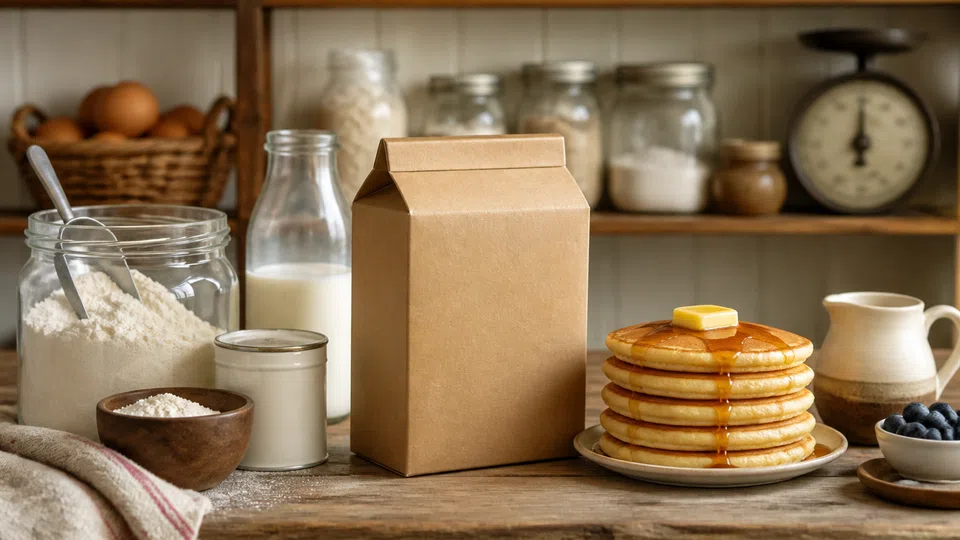
At Pancakes World, a buttermilk pancake box is a packaged dry mix intended to make buttermilk-style pancakes after specified wet ingredients are added. The correct method is the one printed on that exact package: some mixes require only water, while others need milk, egg, or oil. Measure the mix without packing it, add the listed liquid gradually, stir just until combined, rest only if directed, and cook one test pancake on a moderately heated surface. Never use a generic “upgrade” before confirming whether the mix is complete or requires additional ingredients.
Direct answer for buttermilk pancake box
Start by reading four parts of the package: ingredients and allergens, required additions, batch yield, and storage directions. A product described as “complete” may be formulated for water, but the word is not a substitute for the printed instructions. King Arthur Baking’s current buttermilk pancake mix is one example that directs the user to add water; it does not establish a rule for other brands.
If the batter is too thick or thin, make small corrections only after the powder has hydrated briefly. If pancakes brown too fast, reduce pan heat before changing the batter. Keep a photo or note of the original directions if transferring mix to another container, including the product name, lot or best-by information, and allergen statement. See also Quinoa flour pancakes.
What the term means
The search phrase can mean the box itself, how to prepare it, or how to choose among boxed mixes. It should not be interpreted as a request for fabricated product rankings. Without a current multi-product test, this guide compares preparation types and label decisions, not brands.
“Buttermilk” in a product name does not tell you the exact ingredient form. A mix may use dried buttermilk or other dairy ingredients. It may also contain wheat, egg, soy, or additives. The current ingredient and allergen declaration is the authoritative source for that package. Someone avoiding dairy should not assume that using water makes a buttermilk mix dairy-free.
The mix is a convenience system: flour, leavener, salt, and sometimes dairy, sweetener, fat, or egg components have already been balanced. Randomly adding baking powder, milk, egg, and oil can unbalance that system.
For the ingredient mechanics behind batter behavior, continue to the Pancake Ingredients and Substitutions.
Practical options and examples
| Package direction | What it usually signals | Your action | Do not assume |
|---|---|---|---|
| “Just add water” | More components are already in the mix | Use the printed water ratio | Milk and egg will automatically improve it |
| “Add milk and egg” | The dry mix expects structure and liquid from additions | Measure those exact ingredients | Water-only will match the intended result |
| Multiple batch sizes | Ratios are provided for different yields | Choose one complete printed batch | Half-measures can be improvised mentally |
| Waffle variation | More fat or a different ratio may be required | Follow the separate waffle line | Pancake batter is identical |
| High-altitude note | Manufacturer anticipates environment changes | Use it in the specified conditions | A universal high-altitude fix applies |
Choosing the right approach
Use the smallest printed batch for a new mix. That limits waste and lets you learn its thickness and cooking response. Use a scale if the package supplies weights; otherwise, spoon mix into the measuring cup and level it according to the brand’s directions. Water temperature should match the instruction. Very hot water can activate or damage components unexpectedly.
Three practical scenarios:
- A complete water-only mix: measure water, combine gently, and resist adding egg until you have seen the intended result. If you later experiment, label that result as a personal variation.
- A mix that requires milk and egg: gather those before heating the pan. Substitutions may change behavior and should follow manufacturer guidance where available.
- Mix transferred to a jar: copy the directions, allergens, date, and product identity onto the jar. A plain unlabeled powder is not a usable shortcut.
Common mistakes
The most frequent errors are using the wrong directions from memory, confusing a waffle ratio with a pancake ratio, packing the dry mix, and overmixing. Adding liquid until the batter looks like a different brand’s batter ignores formulation differences.
Pan problems are often misdiagnosed as mix problems. A cold pan produces pale, spreading pancakes; an overheated pan burns the exterior before the center sets. Too much grease creates fried, uneven edges. Preheat moderately, use a thin film, and test one portion.
Do not taste raw batter. Flour and eggs are raw ingredients unless the package explicitly states otherwise, and visual color is not a safety test. Cook the center until set.
Step-by-step checklist
- Confirm the product name and whether it says complete.
- Read ingredients, allergens, additions, yield, and storage directions.
- Select one printed batch size without recomputing the ratio.
- Measure the mix accurately and break up compacted lumps dry.
- Measure the required wet ingredients separately.
- Combine with gentle strokes; stop when dry pockets disappear.
- Let the batter stand only as directed or for a brief hydration pause.
- Preheat a griddle or skillet over moderate heat.
- Apply a thin, even film of cooking fat if needed.
- Portion one test pancake at the stated or consistent size.
- Turn when the first side is set enough to release; do not press after turning.
- Adjust pan heat before altering the remaining batter.
- Store the box closed, dry, and according to its label.
Practical variations without pretending they are universal
Fruit, chips, spice, or zest can be added after the plain test pancake. Sprinkle chunky additions onto each portion on the griddle instead of stirring them through the full bowl; this keeps distribution even and preserves a plain option. Use modest additions so the batter can still set around them.
For sheet-pan pancakes, use a formula or manufacturer variation specifically developed for that pan size. King Arthur Baking describes sheet-pan use for its own mix, but that ratio and pan instruction should not be copied blindly to another formulation. The same boundary applies to waffles, muffins, and savory wraps.
If dairy must be avoided, choose a mix whose current label meets that need rather than trying to remove dried buttermilk already in the powder. Non-dairy pancake batter covers from-scratch liquid swaps; it cannot make a dairy-containing box suitable.
For lower-fat preparation, compare the package’s water-only or added-fat directions with the goal described in low-fat pancake batter. Do not make a nutrition claim without calculating the prepared product from the exact mix and additions.
Storage or planning notes
Dry mix belongs in a cool, dry place in its original sealed package or a clearly labeled airtight container. Moisture, pests, odors, and lost instructions are the main household risks. A best-by date addresses manufacturer quality; damaged packaging, moisture, off odors, or infestation are separate reasons not to use a mix.
Mix only the amount needed. Prepared batter may not hold well because leavening begins after liquid is added. If the manufacturer does not provide a make-ahead instruction, store the dry and wet components separately and combine near cooking.
Cool leftover pancakes before covering so trapped steam does not make them wet. Refrigerate promptly and reheat only what is needed. Keep the package until the batch is eaten if anyone may need ingredient, allergen, or lot information.
How to compare boxes responsibly
Compare facts the packages actually disclose: required additions, servings at a defined size, allergens, ingredient list, preparation time, storage, package weight, and price per prepared batch based on current local prices. Taste and texture require a controlled side-by-side test using equal pan conditions; this article has not performed one and therefore names no winner.
A useful personal test records mix and liquid by weight, rest time, pan temperature setting, pancake portion, and yield. The first pancake should not decide the ranking if the griddle was still heating. Photograph the cross-section and note tenderness only as your observation, not as a universal product fact.
Pancakes World recommends this evidence boundary because boxes change formulas and packaging. A review without a dated package would become stale quickly.
When a box gives both volume and weight, record the weight for the most repeatable household comparison. Note whether the stated yield assumes a particular pancake diameter. A claim such as “makes 24” is not meaningful unless the portion is also known. If the family prefers larger pancakes, calculate the observed yield from the test batch rather than accusing the package of being wrong.
Sources
- King Arthur Baking Company — Buttermilk Pancake Mix — https://shop.kingarthurbaking.com/items/buttermilk-pancake-mix — primary manufacturer example of a water-only product and current package facts.
- King Arthur Baking — Pancake mix—A surprising kitchen MVP — https://www.kingarthurbaking.com/blog/2022/08/18/pancake-mix-a-surprising-kitchen-mvp — recognized test-kitchen uses and the need for product-specific methods.
- Penn State Extension — Food Safety and Quality — https://extension.psu.edu/food-safety-and-quality — authoritative food-handling context; no product endorsement implied.
Evidence checked 16 August 2026. Verify the package in hand because formulations and directions can change.