Brunch Special Ideas
Brunch special ideas work best when you choose between two clear formats: a composed signature plate for a small, seated meal, or a shareable centrepiece for a relaxed table. Pick the plate when timing and presentation matter; pick the centrepiece when guests will serve themselves. Pancake World treats “special” as a design decision: one memorable focal point, a supporting contrast, and a service plan that does not create competing last-minute tasks.
Verdict
Neither format is automatically more impressive; the better choice is the one your equipment and serving rhythm can actually support.
The two brunch-special formats
| Criterion | Composed signature plate | Shareable centrepiece |
|---|---|---|
| Focal point | One finished portion per guest | One dish or board guests portion themselves |
| Best setting | Seated, smaller group | Open table, flexible arrivals |
| Last-minute work | Higher | Lower once the centrepiece is ready |
| Main risk | A queue at the pan or pass | A centrepiece that loses texture |
Decision criteria
Ask four questions before choosing dishes: How many portions must be finished at once? Which hot item has the shortest useful holding window? Can one oven shelf, pan, or serving board carry the decisive job? Will guests eat together or arrive gradually? The brunch guide is the parent hub for the wider format decision; this page focuses on making one special feature work.
Supported ratio starting ranges
These are starting points for organising work, not serving laws. A plated format is usually easiest when one cook can complete the hot component in a single run of roughly two to six portions. Once the same pan must produce successive batches, a centrepiece or batch-cooked base is often calmer. Let the exact recipe govern ingredient amounts, temperatures, and cooking endpoints.
One comparison table: the special-item test
| If your strongest idea is… | Prefer | Why |
|---|---|---|
| A crisp pancake or egg dish that fades quickly | Composed plate | It reaches each guest at its intended texture. |
| A baked savoury dish, slab pancake, or roastable vegetables | Shareable centrepiece | It can be cut and served without a pan-side queue. |
| Fresh fruit, herbs, or a cold sauce | Either | Add them late so they remain distinct. |
| Several elements needing the same burner | Shareable centrepiece | Reduce simultaneous finishing work. |
Food-pairing matrix
| Focal item | Fresh contrast | Starch or base | Finish |
|---|---|---|---|
| Savoury pancake | Tomato and herbs | Toast or potatoes | Spoonable yogurt-style sauce |
| Baked egg dish | Sharp leaves or fruit | Bread | Herbs at the table |
| Fruit-topped pancake | Plain cultured dairy or alternative | The pancake itself | Crunch added at serving |
The matrix is a composition tool, not a universal pairing law. Keep raw foods separate from raw animal proteins, wash produce under running water, and use a complete recipe when the focal item needs a food-safety endpoint.
Three complete menu examples
1. The small-table plate
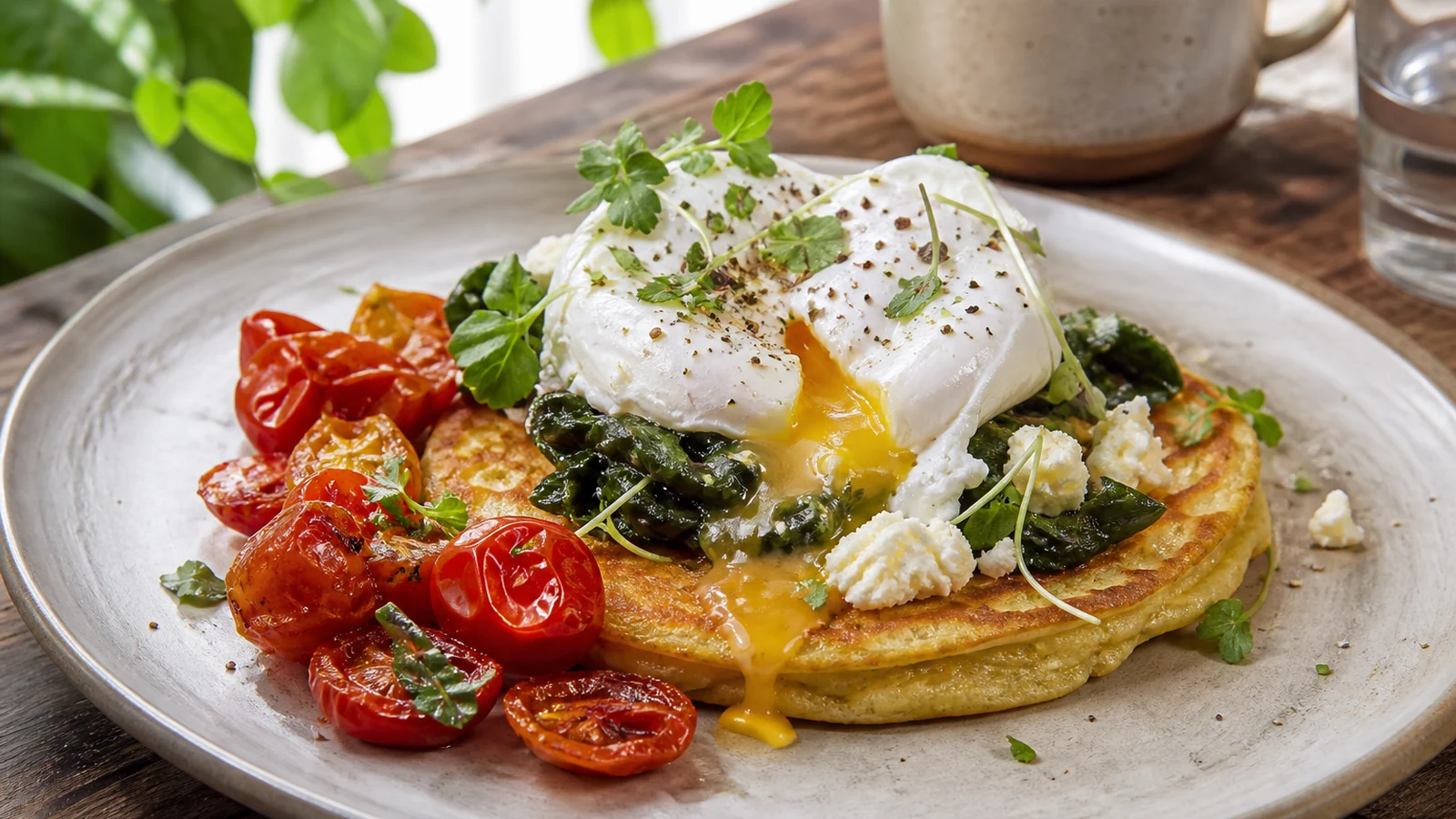
Serve one savoury pancake with a poached or baked egg prepared by a trusted recipe, a small dressed-green side, and roasted tomatoes. Keep the sauce in a small jug so the crisp element stays crisp.
2. The shareable oven brunch
Make a recipe-led baked egg dish as the centrepiece, place bread and a drained salad alongside it, and put herbs on the table. For a seasonal alternative, see springtime brunch ideas.
3. The fruit-forward special
Make pancakes the named centre, bring warm fruit separately, and add a cool topping only at service. The separate components let guests choose their balance without creating a second dessert course.
Scenario decision tree
Are all guests sitting down together? If yes, ask whether the hot feature can be finished in one service run. If it can, choose composed plates. If not, choose a centrepiece with a cold or room-temperature supporting side.
Are arrivals staggered or the group larger? Choose a centrepiece that can be portioned without holding individual plates. The big group breakfast ideas route is a pending same-R83-corpus follow-up for the scale decision.
Is one ingredient the attraction? Keep it at the centre and remove a competing rich side. The steak brunch ideas route is a pending same-corpus follow-up when a meat-led centre is the specific decision.
Recommendation by user type
For the careful host serving a few people, use the composed plate: it has a clear before-and-after moment and makes the special item visible. For the host managing conversation and arrivals, use a centrepiece: guests can serve themselves while you retain one signature flavour. For an early start, a bake-plus-cold-side plan is calmer.
Alcoholic and zero-proof boundaries
Brunch specialness does not require alcohol. Make water, tea, coffee, juice, or another non-alcoholic drink the default service assumption, and follow product labels for any optional beverages. This page makes no safe-driving inference and does not prescribe portions of alcoholic drinks.
Service sequence
First clear and clean the ready-to-eat work area. Next prepare the cold contrast and hold it separately. Cook or bake the focal item according to its complete recipe. Then set the serving vessel, add the late garnish, and serve the hot component without adding unrelated last-minute tasks. Refrigerate perishable leftovers promptly according to official food-safety guidance and the exact recipe.
Host service notes
- One focal item is visible and named.
- The fresh element is prepared but not prematurely dressed.
- The main equipment conflict is removed.
- A guest who skips the focal ingredient still has a complete option.
- Product labels and the exact recipe supply product-specific quantities and handling.
Conclusion
Related reading
- Brunch plate ideas — a pending same-R83-corpus route for the plating decision.
- Breakfast skillet — a live R83 route for a one-pan direction.
Sources and editorial references
- U.S. Food and Drug Administration, “Selecting and Serving Produce Safely” —
https://www.fda.gov/consumers/consumer-updates/selecting-and-serving-produce-safely - USDA Food Safety and Inspection Service, “Safe Minimum Internal Temperature Chart” —
https://www.fsis.usda.gov/food-safety/safe-food-handling-and-preparation/food-safety-basics/safe-temperature-chart - USDA Food Safety and Inspection Service, “Leftovers and Food Safety” —
https://www.fsis.usda.gov/food-safety/safe-food-handling-and-preparation/food-safety-basics/leftovers-and-food-safety - U.S. Food and Drug Administration, “How to Understand and Use the Nutrition Facts Label” —
https://www.fda.gov/food/nutrition-facts-label/how-understand-and-use-nutrition-facts-label