Breakfast planning diagnostic
Big Group Breakfast Ideas
Pancake World recommends diagnosing the bottleneck before choosing big group breakfast ideas: identify whether the constraint is hot holding, oven space, arrival timing, dietary separation, or replenishment. Then build a three-part menu around the tightest constraint—one hot batch, one cold refillable item, and one room-temperature or griddled option. This prevents a generous-looking menu from becoming a queue of dishes that all need the same shelf, pan, or host at the same time.
Use this diagnostic when a group breakfast feels hard to coordinate. It is not a tested recipe collection or a food-safety guarantee; it is a way to select recipes and service formats that your actual kitchen can support.
Start with the visible symptom
Write down what failed or looks likely to fail: late food, a crowd at one station, a shortage of clean serving tools, an unlabelled alternative, or too many dishes waiting for heat. The live American breakfast guide is the closest available parent hub for setting the overall meal scope. This route owns the narrower task of diagnosing the service plan before committing to it.
Symptom intake: five questions before recipes
Ask when guests arrive; which dishes need heat at service; how many oven shelves, burners, refrigerator shelves, platters, and clean utensils exist; which dietary questions need a documented option; and who will replenish food and drinks. These questions expose a constraint, not a universal portion rule. If an answer is unknown, simplify before shopping rather than assume that a pan, outlet, or person will be free later.
Root-cause matrix
| Visible symptom | Likely cause | Smallest correction |
|---|---|---|
| Guests wait for pancakes | One cook and one griddle serve every portion | Use a planned batch or reduce the pancake lane |
| Two dishes need the oven together | Menu chosen before capacity was counted | Move one item earlier or cold |
| Food appears without labels | Tools were treated as extras | Plan labels and utensils per item |
| Alternative is uncertain | Ingredient information is incomplete | Hold it back and offer a documented choice |
| Buffet empties too soon | Everything was placed out at once | Use smaller prepared refills |
The matrix identifies service causes; it does not diagnose health or make food safe by itself. FDA material is useful for ingredient-information and allergen-label boundaries, while the directions for each actual dish still control.
Diagnostic sequence: isolate the limiting resource
List the confirmed guest count and arrival pattern. Put every chosen recipe beside its stated yield and final step. Sketch the last hour: oven shelves, burner positions, griddle time, refrigerator shelf space, and serving vessels. Then name every task that must happen while guests are present. A menu can have enough food on paper but still fail in the final twenty minutes when several dishes compete for one shelf.
Correction path: reduce the hot bottleneck
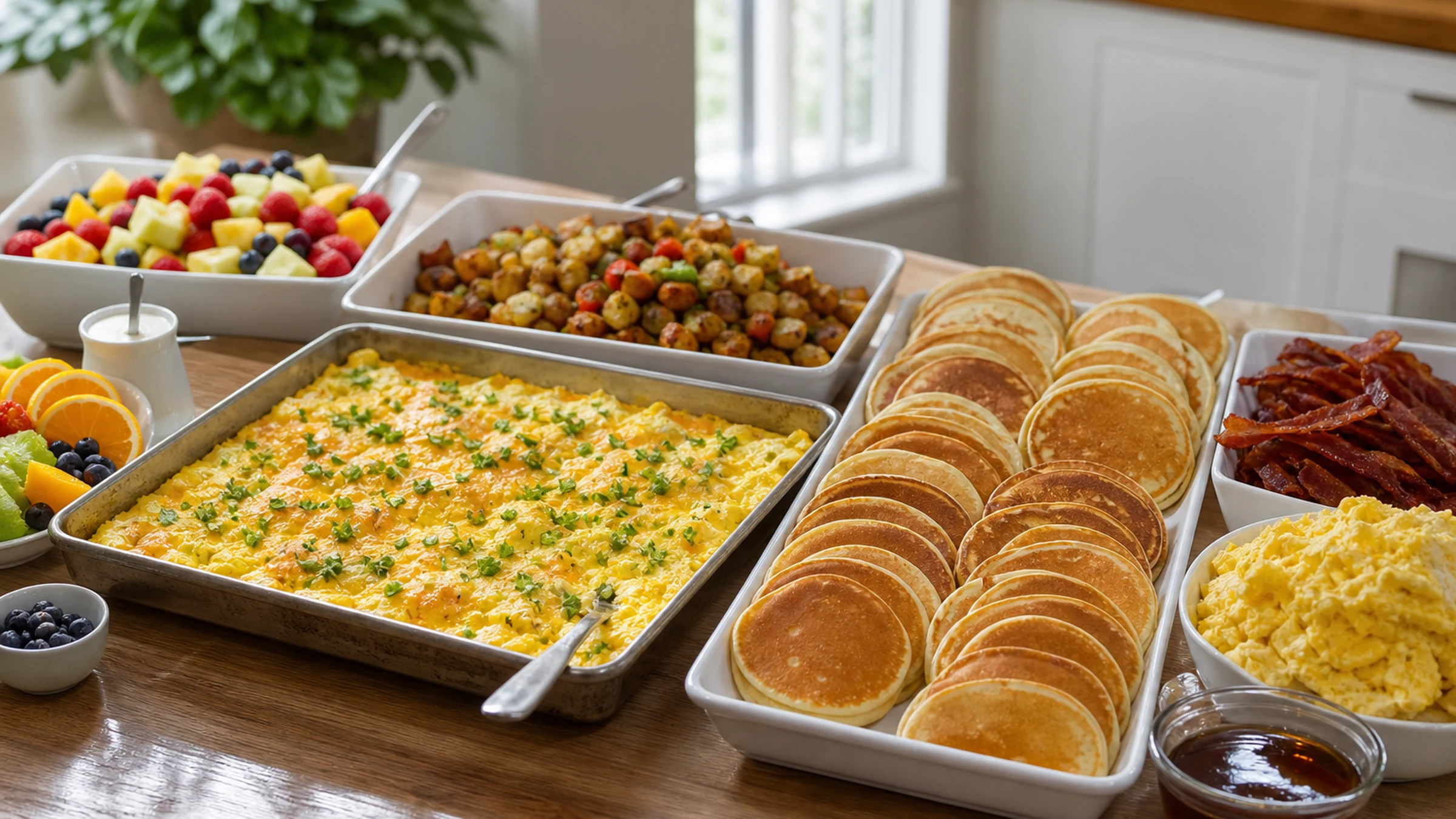
Keep one principal hot item and make the other lanes cold, room-temperature, or cooked earlier according to their recipes. A vegetable egg bake, fruit, yoghurt with labelled toppings, and bread or one pancake lane are roles rather than a prescribed menu. The American pancakes guide can inform a familiar option, but made-to-order pancakes require enough surface and people to prevent a long queue. If those are missing, do not promise that format for the entire group.
Correction path: separate dietary uncertainty
Identify alternatives before the day, retain relevant recipe or package details, and give each planned item its own clean serving tool. Removing one ingredient does not automatically make an item suitable. This is a practical boundary, not medical advice. If a label becomes separated from an item, pause that item rather than relabelling from memory.
Correction path: control the queue
Move drinks away from the food queue, put plates and utensils at the start, and arrange the hot lane after cold choices when that suits the table. Use small planned refills rather than one large display. For an arrival window, individually portioned elements can reduce repeated handling. The backpacking breakfast route has portable-portion ideas; adapt only the format and follow current handling guidance for the actual foods chosen.
A practical test batch without a crowd
Set out the pans, platters, tongs, labels, and cups that the plan needs. The purpose is to discover whether a platter has nowhere to cool or whether the only clean tongs are needed twice. Change one variable at a time, then rerun that part of the layout. This targeted correction avoids replacing an entire menu because of one shelf conflict.
Prevention rules for the next breakfast
- Choose service format before a long recipe list.
- Record stated yields; do not turn them into a universal appetite formula.
- Give every item one distinct job.
- Count oven, refrigerator, cooling, platter, and utensil capacity once.
- Keep ingredient information with any declared alternative.
- Use recipe directions and official handling guidance for prepared food.
For a celebratory direction, brunch special ideas can identify a signature element. Add it only after the core plan has spare capacity; a signature item is not a reason to add another critical heat station.
Edge cases: late arrivals, rain, and a short oven
Late arrivals do not require leaving every item on the table. Keep the cold and hot plans governed by actual recipes and authoritative handling guidance, and reserve a separate refill where feasible. If weather moves an outdoor breakfast inside, favor one hot focal dish plus compact cold items over several bulky stations. If the count grows after shopping, do not stretch a recipe beyond its documented yield: narrow the menu, add a known packaged component, or change service timing.
Worked diagnostic: twelve guests, one oven
Imagine twelve guests arriving across forty-five minutes. The egg bake, bread, and potatoes all expect the final twenty minutes. The smallest correction is one principal hot bake, fruit and yoghurt cold, and bread prepared earlier under its own instructions. Coffee and water move to a separate table. The host then checks plates, cups, spoons, labels, a refrigerator shelf for the next refill, and one person assigned to drinks. This does not predict consumption; it removes the known collision.
Related reading
Troubleshooting close
Big group breakfast ideas work when the menu responds to a visible constraint. Name the symptom, find the shared resource causing it, apply one narrow correction, and rerun the final service plan. If the correction needs a promise you cannot document—about ingredients, yield, holding, or capacity—reduce the plan until it is supportable.
Sources and editorial references
- U.S. Food and Drug Administration, Food Allergies —
https://www.fda.gov/food/nutrition-food-labeling-and-critical-foods/food-allergies - U.S. Food and Drug Administration, Selecting and Serving Produce Safely —
https://www.fda.gov/consumers/consumer-updates/selecting-and-serving-produce-safely - USDA Food Safety and Inspection Service, Keep Food Safe! Food Safety Basics —
https://www.fsis.usda.gov/food-safety/safe-food-handling-and-preparation/food-safety-basics - USDA Food Safety and Inspection Service, Leftovers and Food Safety —
https://www.fsis.usda.gov/food-safety/safe-food-handling-and-preparation/food-safety-basics/leftovers-and-food-safety