Brunch Plate Ideas
The most useful brunch plate is chosen by service constraint: pick an egg-and-potato plate for a hot savoury meal, a pancake-and-fruit plate when a sweet anchor is wanted, a toast-and-vegetable plate for rapid assembly, or a yogurt-and-grain plate for a cold, make-ahead start. A plate works when each component has a job and arrives in its intended condition. Pancake World treats this as a decision, not a universal menu rule.
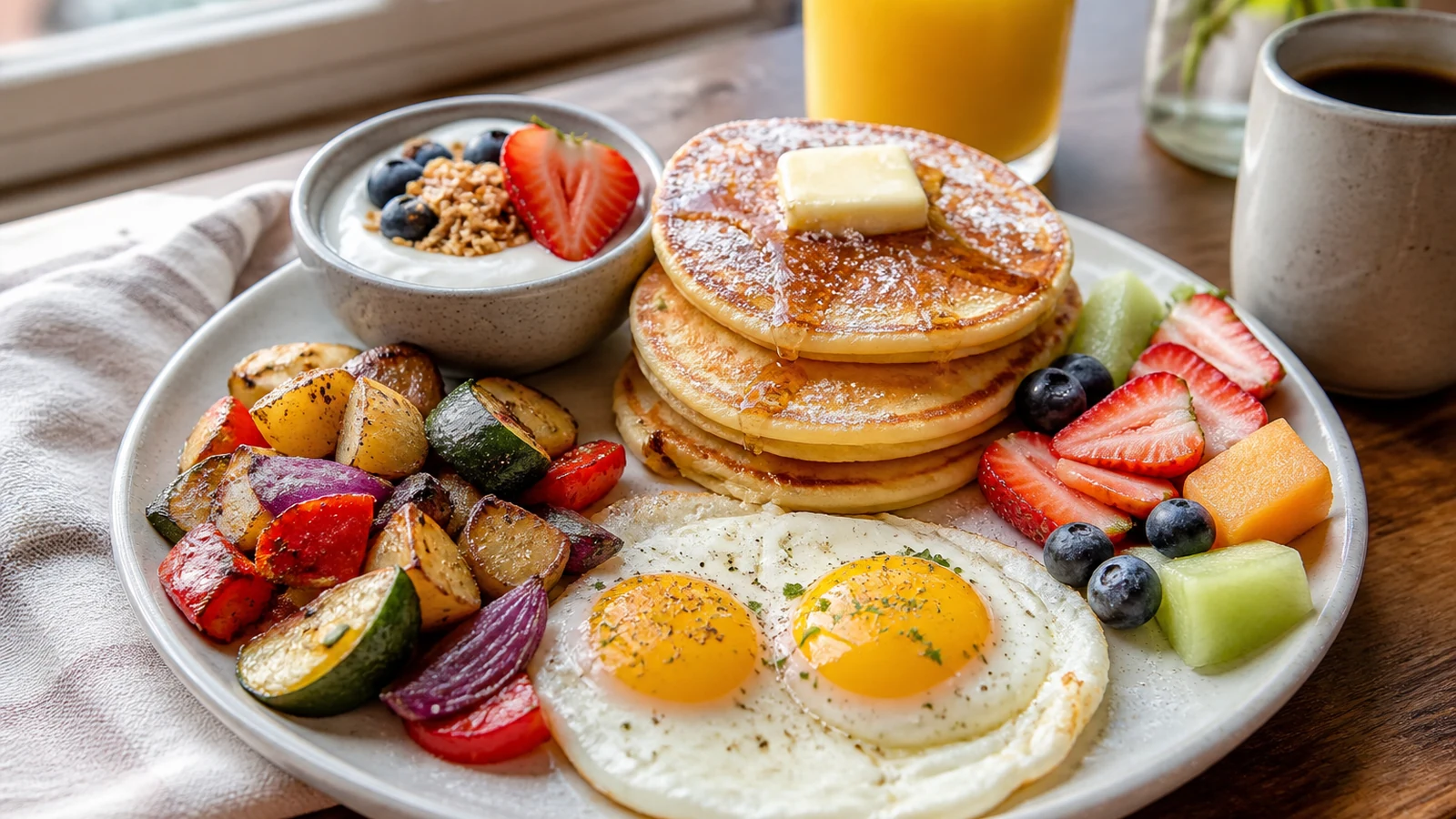
The route owner statement
This guide compares four individual brunch-plate formats. It is for choosing a coherent plate, not for combining every idea into one crowded meal. The parent brunch collection covers the wider occasion; this page concentrates on the trade-offs between hot cooking, quick assembly, sweet-and-fresh balance, and cold preparation.
Direct verdict
Choose egg-and-potato when the table expects a cooked savoury centre and last-minute pan work is manageable. Choose pancake-and-fruit when a sweet anchor is the point. Choose toast-and-vegetable when the kitchen needs a short assembly path. Choose yogurt-and-grain when refrigeration and separate bowls make a chilled plate practical. The better option is the one whose limitation the host can control.
Decision criteria
Compare every option with the same four questions: what must be cooked at the end, what can wait without losing its character, how many components need attention, and what adjustment is needed for the diners? These checks prevent an attractive idea from becoming an impractical service plan.
Brunch plate comparison matrix
| Plate format | Strong fit | Service pressure | Main limitation |
|---|---|---|---|
| Egg and potato | Warm savoury brunch | Pan or oven work near serving | Can feel dense without a fresh element |
| Pancake and fruit | Sweet anchor with contrast | Pancakes need prompt service | Needs a deliberate savoury support for some diners |
| Toast and vegetable | Quick assembly | Toppings and bread meet late | Wet toppings can soften toast |
| Yogurt and grain | Chilled or make-ahead start | Bowl assembly and cold holding | Not a warm-centre solution |
Supported starting ranges
Use ranges as an arranging tool rather than a nutrition prescription. Start with one anchor, one produce element, and one bread-or-grain element per plate; add one sauce or crunchy finish only when it has a distinct role. Two to four components are usually easier to carry and eat than a collection of tiny samples. Check recipe yields, package labels, dietary needs, and appetite before scaling.
Scenario analysis: a relaxed weekend table
For two people eating as food comes off the pan, egg-and-potato or pancake-and-fruit can work because the cook can send each plate promptly. Put the hot anchor down first, then add produce that does not require a second cooking task. A small breakfast skillet can be a useful savoury reference when the pan is the limiting equipment, but keep the plate simpler than the full menu.
Scenario analysis: mixed arrivals
When arrivals are staggered, build around toast-and-vegetable or yogurt-and-grain components that can be replenished in small batches. Keep crisp bread, dressing, and wet toppings separate until the plate is assembled. For a smaller same-corpus format, see small brunch ideas. It is a planning comparison, not a reason to pre-plate food that will sit.
Scenario analysis: sweet is the anchor
Pancake-and-fruit is the clearest choice when pancakes are the reason for the brunch. Give fruit a separate space instead of burying it under syrup, and decide whether the plate needs a savoury companion before cooking begins. The nearby sourdough brunch ideas page offers a different bread-led direction; it is not an automatic add-on to a pancake plate.
Decision tree
- Need a hot savoury centre? Choose egg-and-potato.
- Is the sweet anchor the priority? Choose pancake-and-fruit.
- Need rapid assembly with minimal cooking? Choose toast-and-vegetable.
- Is cold holding easier than last-minute cooking? Choose yogurt-and-grain.
- If two answers compete, choose the option with fewer uncontrolled last-minute tasks.
Recommendation by user type
The pan-focused cook: egg-and-potato, with produce prepared before heat begins. The pancake host: pancake-and-fruit, with one clearly chosen support. The fast assembler: toast-and-vegetable, holding wet ingredients apart until service. The make-ahead planner: yogurt-and-grain, adding any warm component separately.
Food handling boundary
This page does not set safe cooking endpoints or storage times. If eggs, meat, or leftovers are part of the plate, follow the applicable official handling and temperature guidance and the food’s label. Wash and prepare produce with attention to official produce guidance; visual inspection does not replace safe handling.
One final verdict
Decide the hot-or-cold anchor before choosing the garnish. Egg-and-potato is the useful choice when a warm savoury centre matters; pancake-and-fruit suits a sweet, fresh plate; toast-and-vegetable suits speed; yogurt-and-grain suits a chilled start. Keep only supports that make that choice easier to serve.
Related reading
Sources and editorial references
- U.S. Food and Drug Administration —
https://www.fda.gov/consumers/consumer-updates/selecting-and-serving-produce-safely - U.S. Department of Agriculture Food Safety and Inspection Service, Safe Minimum Internal Temperature Chart —
https://www.fsis.usda.gov/food-safety/safe-food-handling-and-preparation/food-safety-basics/safe-temperature-chart - U.S. Department of Agriculture Food Safety and Inspection Service, Leftovers and Food Safety —
https://www.fsis.usda.gov/food-safety/safe-food-handling-and-preparation/food-safety-basics/leftovers-and-food-safety - USDA MyPlate, MyPlate Food Groups —
https://www.myplate.gov/eat-healthy/what-is-myplate