Small Brunch Ideas
Small brunch ideas work best when two to four people share one anchor dish, one fresh component, and one flexible support. Size the plan to the pan, oven space, and diners instead of recreating a buffet. Pancake World uses this guide to help a small table make a bounded choice with less unused food and less competing last-minute work.
What counts as a small brunch?
The parent Brunch collection covers the broader topic; this page owns the smaller-table decision. The aim is not to make every possible dish. It is to select a compact combination whose equipment, timing, and leftovers can be understood before cooking begins.
Direct answer: choose one anchor
That structure prevents several dishes from asking for the same burner or the same final-minute attention. A small table often feels more considered when the elements contrast than when it contains a second main dish with no distinct role.
Build around one working surface
The Breakfast Skillet guide is useful when a one-pan savoury format is the intended anchor. Do not add a second hot format merely because it sounds festive; it can make serving depend on two unrelated finish times.
Decision rules before shopping
Buy supporting ingredients that can reappear in another meal, such as fruit, bread, herbs, or yoghurt, rather than buying multiple one-purpose garnishes. MyPlate is used here only as a broad food-group planning framework, not as an individual nutrition prescription.
| Constraint | Useful format | Limit to keep visible |
|---|---|---|
| One skillet | Egg and vegetable anchor | Serve promptly after cooking. |
| One griddle | Small pancake batch | Use a verified recipe rather than changing ratios. |
| Oven already free | Baked oats or a small tray | Keep cold supports separate. |
Worked example: relaxed pancakes for two
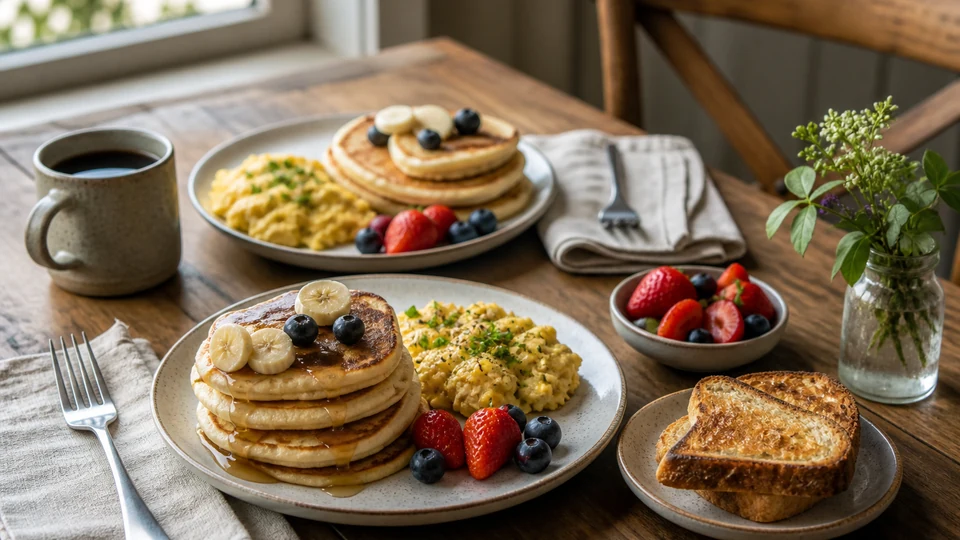
This combination fits a relaxed meal when both diners arrive together and the warm component can go straight to the table. It has one active cooking task and two supports that need little last-minute assembly.
Worked example: staggered savoury table
For two to four people arriving at different times, make a small vegetable-and-egg skillet from a complete recipe, then pair it with bread and fruit. Put optional toppings in their original containers so diners can finish their own plate. This avoids building two full menus for different preferences.
If eggs or another raw animal food are used, follow the recipe and the USDA thermometer guidance rather than visual cues alone. The worked choice is a planning example, not a claim that one menu fits every kitchen or dietary need.
Limits and food-safety boundaries
A small-brunch framework cannot determine allergy safety, a recipe yield, appliance performance, or the correct endpoint for a particular food. Wash produce under running water and keep it away from raw animal products as FDA guidance directs.
If there will be leftovers, make a specific refrigerated-use plan and follow the current USDA leftovers guidance; do not treat this planning article as a storage instruction. The same limit applies to recipes: ingredient labels and the complete recipe’s instructions govern the actual preparation.
Final small-brunch summary
Start with the diner count, choose one anchor that matches the available surface, and give each support a distinct role. Keep the plan narrow enough that it can be served while hot and cold foods are handled as their own recipes and instructions require. For another flavour-led starting point, see Sourdough Brunch Ideas; for a fruit-forward companion, see the Berry brunch guide.
Sources and editorial references
- U.S. Department of Agriculture Food Safety and Inspection Service, “Safe Minimum Internal Temperature Chart.”
https://www.fsis.usda.gov/food-safety/safe-food-handling-and-preparation/food-safety-basics/safe-temperature-chart - U.S. Food and Drug Administration, “Selecting and Serving Produce Safely.”
https://www.fda.gov/consumers/consumer-updates/selecting-and-serving-produce-safely - USDA MyPlate, “MyPlate Food Groups.”
https://www.myplate.gov/eat-healthy/what-is-myplate - U.S. Department of Agriculture Food Safety and Inspection Service, “Leftovers and Food Safety.”
https://www.fsis.usda.gov/food-safety/safe-food-handling-and-preparation/food-safety-basics/leftovers-and-food-safety