Brunch entertaining ideas
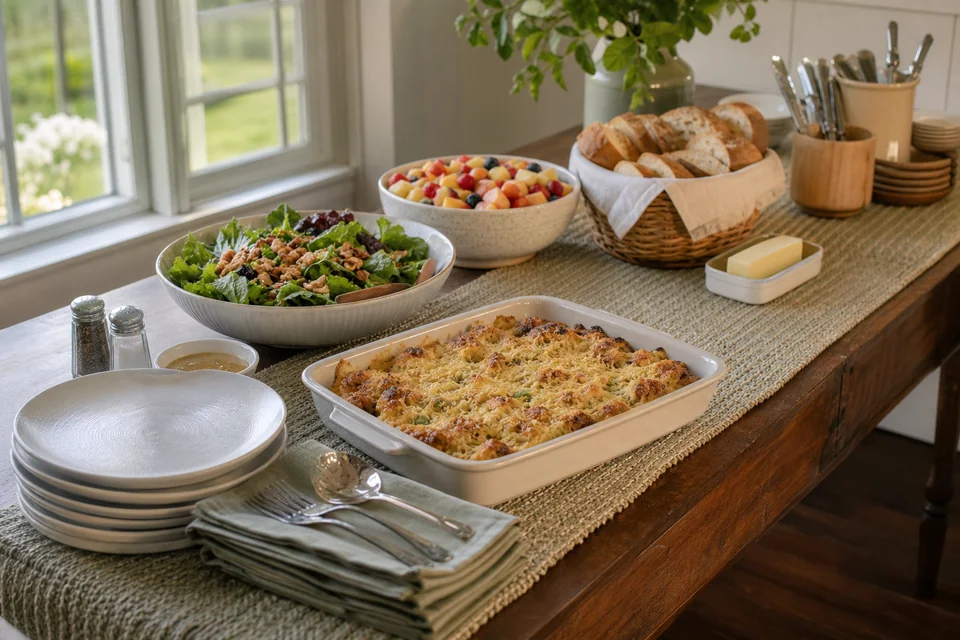
For brunch entertaining ideas that stay manageable, build the menu around one make-ahead main, one fresh component, one bread or pancake element, and a self-serve drinks station. For eight guests, confirm the yield of each chosen recipe, cook only one item at the last minute, and set the buffet before the hot food is ready. Pancake World uses this hosting plan alongside the brunch hub to turn a loose menu into an ordered service.
The host plan: decide what success looks like
Write down the guest count, arrival window, service style, cooking equipment, and dishes that must be available. A seated brunch needs plates and a serving sequence; a buffet needs clear traffic flow; an open-house table needs small replenishment batches. This is a planning boundary, not a promise that every guest will eat the same amount.
Guest-count and quantity worksheet
For a practical eight-person brunch, select one main recipe explicitly written to yield eight portions, one fruit or vegetable side, bread or pancakes, and a dessert or baked item. Multiply only ingredients in a recipe whose stated yield matches the group; use the author’s scaling instructions where supplied. Keep a small extra portion only when the recipe supports it, rather than treating a large pan as an automatic crowd quantity.
| Component | Plan for eight | Decision to record |
|---|---|---|
| Savoury main | One verified eight-portion recipe | Pan size, bake time, finish point |
| Fresh item | One prepared side plus reserve | When dressing is added |
| Bread or pancakes | One serving method | Warmed or cooked to order |
| Drinks | Separate self-serve station | Cups, water, refill location |
Shopping: buy to the written menu
Make one list from the selected recipes, then add plates, cups, serving utensils, labels, foil or lids, hot pads, and leftover containers. Check it against the equipment before shopping. A menu that needs two baking dishes is not workable if only one fits in the oven.
Equipment capacity sets the menu limit
List oven shelves, burners, large pans, cold storage space, serving platters, and table surfaces. Reserve the oven for the dish with the least flexibility. If pancakes, eggs, or toast are made close to service, choose one active pan task and assign it to one person. The host should not be the only person carrying food, greeting guests, and managing that pan.
Prep techniques that create breathing room
Separate work by technique rather than by dish name. Wash and cut stable produce when the recipe permits, keep wet dressings apart from crisp elements, portion cold items in smaller bowls, and set serving tools before cooking starts. Follow the storage and reheating directions of each chosen recipe; this guide does not replace them.
Timeline: work backwards from serving
Start with the time guests eat. Ninety minutes before, clear cooking surfaces and place plates, drinks, labels, and utensils. Sixty minutes before, begin the main according to its recipe and complete room-temperature setup. Thirty minutes before, assemble the fresh component without dressing it too early and ready the bread or pancake service. Ten minutes before, finish the one active hot task and transfer food to its assigned place.
Buffet assembly: make the next action obvious
Place plates first, then the main, sides, bread or pancakes, condiments, and utensils. Put cups and drinks on another surface so a refill does not stop the food line. Label foods by actual dish and major ingredients, and provide a dedicated utensil for each dish. Keep lids, hot pads, and a landing space for spoons within reach.
Service sequence for the hot item
Bring cold and room-temperature components out first. Start the final heat-dependent task only after the table is ready. If a main needs to rest under its recipe, use that interval to add dressings, warm bread if the oven is free, and place the last utensils. Do not increase cooking temperature simply to recover a late schedule; serve a planned cold component while the main reaches its specified finish.
Dietary and cross-contact access plan
Ask in advance about needs that affect menu choice. Where a separate option is planned, keep it labelled, use a dedicated utensil, and do not rely on removing an ingredient from a plate that has already contacted another food. Use ingredient information from actual products and recipes; this article gives hosting workflow, not medical advice.
Contingency plan for a service recovery
If the main runs late, begin with drinks and the fresh item and continue the recipe as written. If the buffet jams, move drinks and condiments to another surface. If food looks short, bring out reserve in smaller portions and portion the remaining main; do not invent a substitute mid-service. If a restriction was missed, serve the separately handled fallback rather than altering a shared dish.
Menu patterns that keep the plan coherent
Choose a baked savoury main plus fruit and rolls when oven capacity is available. Choose a cold spread plus one warmed bread element when kitchen space is tight. Choose pancakes as the centrepiece only when the griddle is the single last-minute task. For more direction, see European brunch ideas, fast brunch ideas, and brunch table food ideas.
Related reading
Final operational checklist
- Guest count, serving window, and service format are written down.
- Each main recipe has a stated yield that matches the plan.
- Shopping includes serving tools, labels, hot pads, and leftover containers.
- Oven, burner, pan, cold-storage, and table capacity have been checked.
- Only one heat-dependent task remains near service.
- Plates, drinks, food order, labels, and dedicated utensils are arranged before the main is ready.
- The separate dietary option and service-recovery plan are ready.
Sources and editorial references
- U.S. Food and Drug Administration, Food Safety at Home —
https://www.fda.gov/consumers/consumer-updates/food-safety-home - USDA Food Safety and Inspection Service, Safe Food Handling —
https://www.fsis.usda.gov/food-safety/safe-food-handling-and-preparation - U.S. Department of Agriculture, MyPlate —
https://www.myplate.gov/eat-healthy/what-is-myplate - Food Standards Agency, Preparing food safely —
https://www.food.gov.uk/safety-hygiene/preparing-food-safely