Fast brunch ideas
A fast brunch works best when you select one idea that fits the actual time, equipment, and preparation state—not when you try to cook a large menu quickly. This guide sorts 15 distinct options into no-cook and quick-cook tracks, then uses a short parallel-prep plan to help you choose. Pancake World treats the thirty-minute window as a planning boundary, not a promise that every kitchen or recipe will finish at the same speed. Start with the Brunch guide for the parent collection.
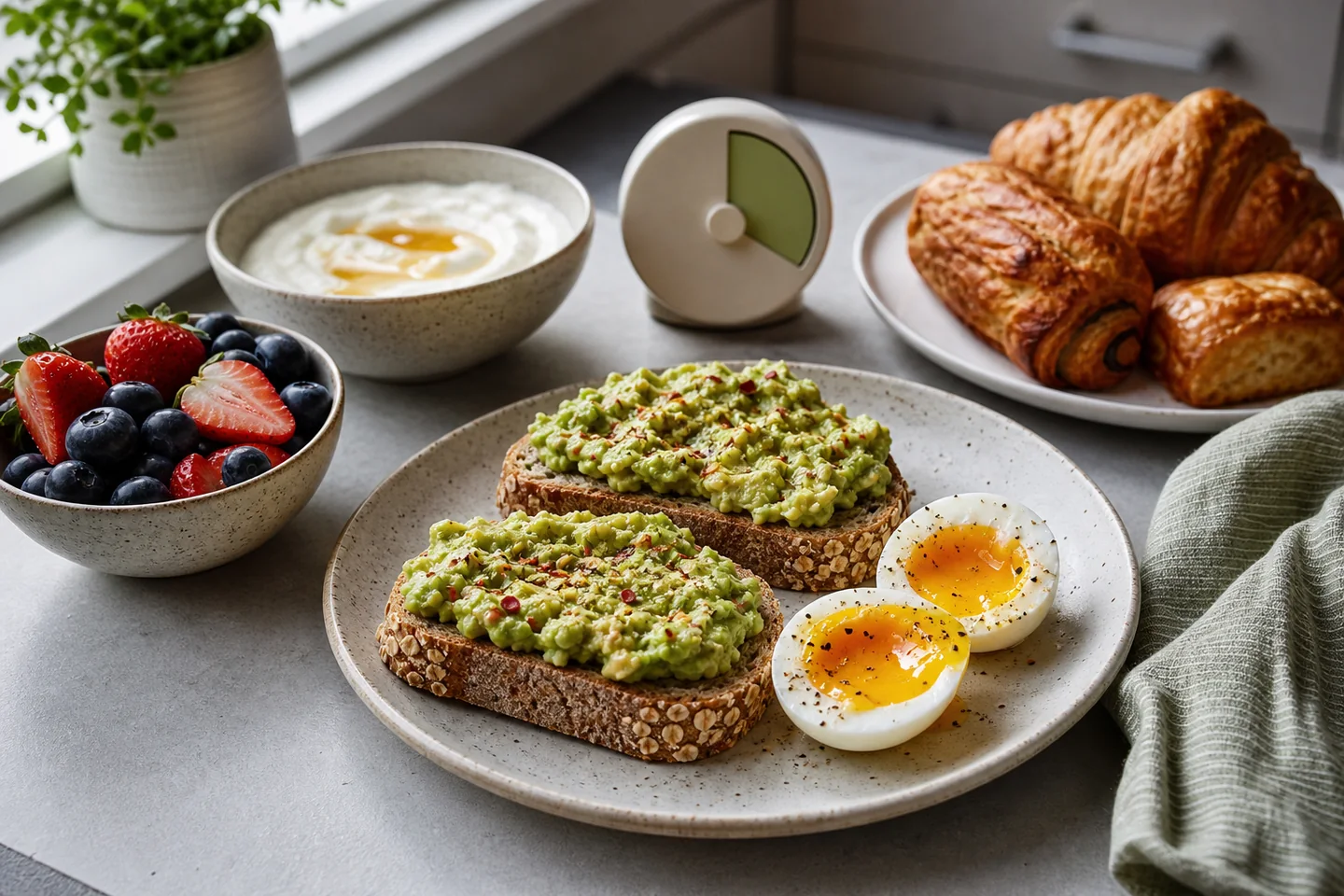
Route owner statement
Selection criteria
Choose the idea with the fewest active tasks left at serving time. Consider the available equipment, whether ingredients are washed or cooked already, whether a guest needs components separate, and whether one person can supervise the hot item. For a no-cook alternative, see no-cook brunch ideas.
One category system
The catalogue separates cold assembly, toast-led, one-pan, and reheated-base ideas. Each changes the eating format or cooking action; a different garnish alone is not a different idea.
One catalogue: 15 distinct ideas
- Yogurt, fruit, and seed bowls — cold assembly.
- Muesli with milk or a non-dairy alternative — cold assembly.
- Fruit, cheese, and bread plate — cold assembly.
- Tomato toast with a separate herb topping — toast-led.
- Nut butter, banana, and toast — toast-led.
- Smoked fish, cucumber, and bread plate — toast-led.
- Scrambled eggs with toast — one-pan.
- Fried eggs with warmed beans — one-pan.
- Soft polenta with a prepared vegetable topping — one-pan.
- Small pancakes from a complete recipe or mix — pan batch.
- Breakfast quesadilla with a cooked filling — pan batch.
- Warm breakfast sandwich with one filling — pan batch.
- Reheated potatoes with eggs — reheated-base.
- Leftover grain bowl with a fresh crunchy element — reheated-base.
- Soup and bakery bread — reheated-base.
One effort and audience matrix
| Idea track | Best when | Active attention | Useful boundary |
|---|---|---|---|
| Cold assembly | Ingredients are already chilled and prepared | Low | Keep perishable items controlled until serving. |
| Toast-led | One toaster or oven batch is available | Low to medium | Limit toppings so bread is the only timed task. |
| One-pan | One cook can watch a single heat source | Medium | Do not add a second fragile hot technique. |
| Reheated-base | A known, safely stored component is available | Medium | Follow suitable storage and reheating guidance. |
How to use the no-cook and quick-cook tracks
Yogurt bowls, muesli, and fruit plates can be prepared while drinks are set out. Eggs, pancakes, sandwiches, and quesadillas need a defined endpoint and a clear owner. USDA and FDA food-safety guidance is relevant to ingredient handling; it does not convert this planning list into a universal safe-holding timetable.
One combination matrix
| If the table needs… | Start with | Add only one | Leave out first if time slips |
|---|---|---|---|
| A cold spread | Fruit, cheese, and bread | Yogurt bowls | Decorative extras |
| A warm plate | Scrambled eggs | Toast | A second pan item |
| A portable format | Warm sandwich | Whole fruit | Sauce made at the last minute |
| A use-up option | Reheated potatoes or grains | One fresh topping | A second cooked filling |
Parallel preparation without false speed
Start heat or bread first, then wash or portion the cold item, set plates, and bring condiments to the table in their containers. Keep raw food work and ready-to-eat food separate. If an ingredient's storage history is uncertain, choose another catalogue idea rather than treating speed as a reason to guess.
Shopping shortcuts that still show their work
Washed produce, sliced bread, plain yogurt, canned beans, a bakery loaf, and a complete pancake mix can reduce preparation. Read the current label where allergens, ingredients, serving directions, or storage information matter. For a component-specific idea, use brunch eggs for a crowd.
Thirty-minute service sequence
This is an illustrative sequence, not a tested yield or guarantee. A small pan, a newly unpacked ingredient, or an interrupted cook may require a simpler option. The practical recovery is to serve the complete cold component first, not to raise heat or cut a recipe short.
Exclusion test
Reject an idea if it needs two pans watched at once, relies on an unknown leftover, demands a made-to-order topping for every guest, or leaves an allergen-sensitive guest without an identifiable alternative. A fast brunch should become smaller before it becomes less controlled.
Limits and source boundaries
The ideas are editorial selections organised by workload and format. They do not claim that a particular food is healthier, authentic, allergy-safe, or suitable for every diet. Use a complete tested method where exact quantities, timing, or doneness matter, and use current package instructions for packaged foods.
Related reading
- Elegant brunch ideas for a different presentation-led selection.
- European brunch ideas for a separate regional menu context.
Curator checklist and conclusion
Sources and editorial references
- U.S. Food and Drug Administration, “Food Safety at Home” —
https://www.fda.gov/consumers/consumer-updates/food-safety-home - U.S. Department of Agriculture, Food Safety and Inspection Service, “Leftovers and Food Safety” —
https://www.fsis.usda.gov/food-safety/safe-food-handling-and-preparation/food-safety-basics/leftovers-and-food-safety - U.S. Food and Drug Administration, “Food Allergies” —
https://www.fda.gov/food/nutrition-food-labeling-and-critical-foods/food-allergies - U.S. Food and Drug Administration, “How to Understand and Use the Nutrition Facts Label” —
https://www.fda.gov/food/nutrition-facts-label/how-understand-and-use-nutrition-facts-label