Eid Brunch Ideas
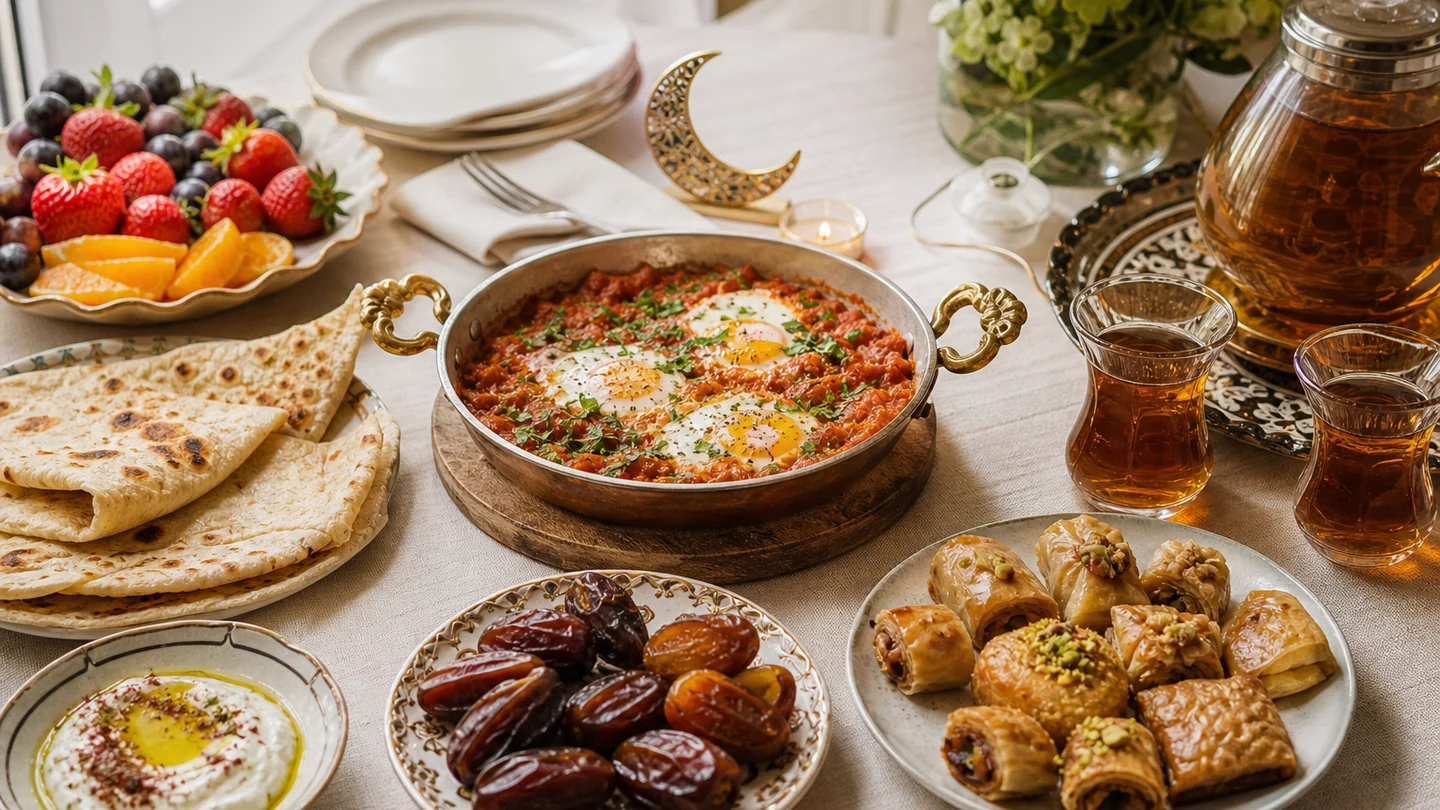
Eid brunch ideas should begin with the household’s own Eid, food references, and arrival pattern—not with a universal menu. A useful approach is to give one host-confirmed dish or named cultural reference priority, then add flexible savoury, fresh, and drink roles around it. This Pancake World guide separates documented examples from practical hosting adaptations and does not offer religious instruction or decide what any family should serve.
Route boundary and terminology
Eid al-Fitr and Eid al-Adha are distinct occasions, and Aidilfitri is a widely used Malay-language name for Eid al-Fitr. “Brunch” here means a late-morning service format, not a traditional food category. It is useful only when the host chooses it; a meal after prayer, a visiting table, or a family lunch may need another name and another rhythm.
Named cultural reference points
Iraqi kleicha
The Smithsonian Folklife Festival documents kleicha as Iraqi date cookies associated in its family account with special occasions and Eid. If an Iraqi household identifies kleicha as meaningful, the adaptation is practical: reserve oven space and a clear serving plate for that sweet. The evidence does not make kleicha a mandatory “Eid brunch” item for other communities.
Egyptian kahk
Egypt’s General Authority for Cultural Palaces links kahk with Eid al-Fitr and describes both buying and home preparation in Egyptian context. A host drawing on that context may make kahk the sweet reference and offer drinks for visitors. That is a bounded Egyptian example, not a statement about every Egyptian family or every Eid.
Malaysian Aidilfitri and ketupat
Malaysia’s Arts and Culture Information Gateway describes ketupat palas as traditional food of Malay communities in northern and eastern coastal Peninsular Malaysia and notes its service during Hari Raya Aidilfitri and Aidiladha. A Malaysian household may choose ketupat as a meaningful centre; a flexible open-table service is an adaptation for that household, not a conclusion that every Aidilfitri table works the same way.
Shared foodways, not a single template
UNESCO describes foodways as linked to community knowledge, celebration, and transmission. That supports the page’s caution: respect a named family or community reference rather than assembling unrelated dishes under an invented regional label. UNESCO’s documented iftar material concerns Ramadan evening meals, so it is not used to define an Eid brunch.
Compare contexts before planning
| Named context | Documented element | Host adaptation | Boundary |
|---|---|---|---|
| Iraqi family reference | Kleicha associated with Eid in Smithsonian’s account | Protect baking and serving space for the chosen family sweet | Do not call it universal |
| Egyptian Eid al-Fitr reference | Kahk connected with Eid in a cultural authority article | Set kahk with host-chosen drinks for visitors | Do not merge it with unrelated national claims |
| Malay Peninsular reference | Ketupat palas served at Hari Raya in named regions | Let a host-confirmed ketupat role organise the table | Do not generalise across Malaysia or Eid |
Evidence first; adaptation second
Documented: name the source, the context, and the dish exactly. Host-confirmed: label a family dish as the family’s own reference. Practical adaptation: a fruit platter, a make-ahead salad, a drinks station, or small replenished platters solve service needs; they are not cultural proof. This distinction lets a mixed household create a coherent table without performing an invented authenticity.
A bounded five-role brunch plan
- Meaningful reference: one host-confirmed dish, sweet, or foodway.
- Savoury companion: an item that does not compete for the same last-minute equipment.
- Fresh element: fruit, herbs, salad, or vegetables chosen for the table.
- Bread, grain, or pastry: selected after the named reference, not as a generic cultural shortcut.
- Drinks and welcome: water and host-chosen non-alcoholic options, with arrival flexibility.
Preparation order when arrivals vary
- Ask which Eid, household reference, and likely visiting pattern applies.
- Confirm the dish that has meaning and give it first claim on oven, cold space, or servingware.
- Make the fresh and shelf-stable elements ready without presenting them as tradition.
- Hold back perishable refill portions and assign one person to the final hot component.
- Use separate utensils and actual ingredient information for known dietary needs.
Food safety and inclusion
Food safety is not cultural authority. The FDA advises safe buffet service practices such as keeping hot and cold foods at appropriate temperatures and using fresh small platters rather than topping up used ones. Ask privately about allergens or dietary needs, label foods by ingredients, and do not infer a guest’s practice from identity. A complete alternative should be intentional, not an afterthought.
Limitations
This guide has no authority over observance, prayer, family hierarchy, or menu correctness. It does not predict attendance, give religious timing, prescribe meat or alcohol decisions, or claim that any documented item represents all Muslims, a whole country, or all Eid celebrations. Confirm household preferences directly.
A host-confirmation note before shopping
Before buying, ask one concrete question: “Which dish, sweet, drink, or service pattern would you like this table to make room for?” Record the answer as a host-confirmed preference, not as evidence about a country or religion. If no named reference is offered, keep the menu plainly described as a household brunch adaptation instead of borrowing a cultural label for decoration.
Cultural conclusion
The most respectful Eid brunch is a host-led table: one clearly named reference can carry meaning, while every service convenience remains honestly described as an adaptation rather than a universal tradition.
Sources and editorial references
- Smithsonian Folklife Festival, Kleicha: Gifts of Memory —
https://festival.si.edu/blog/kleicha-iraqi-date-cookies-gifts-of-memory - Egypt General Authority for Cultural Palaces, The story of Eid kahk —
https://www.gocp.gov.eg/articles.aspx?ArticleID=98930 - Malaysia Arts and Culture Information Gateway, Ketupat Palas —
https://pemetaanbudaya.jkkn.gov.my/en/senibudaya/detail/1190 - UNESCO, Transmitting foodways to future generations through the International Food Atlas —
https://www.unesco.org/en/culture-and-digital-technologies/international-food-atlas?hub=169336 - UNESCO Intangible Cultural Heritage, Iftar/Eftari/Iftar/Iftor and its socio-cultural traditions —
https://ich.unesco.org/en/RL/iftar-eftari-iftar-iftor-and-its-socio-cultural-traditions-01984 - U.S. Food and Drug Administration, Serving Up Safe Buffets —
https://www.fda.gov/food/buy-store-serve-safe-food/serving-safe-buffets