Roasted Breakfast Potatoes
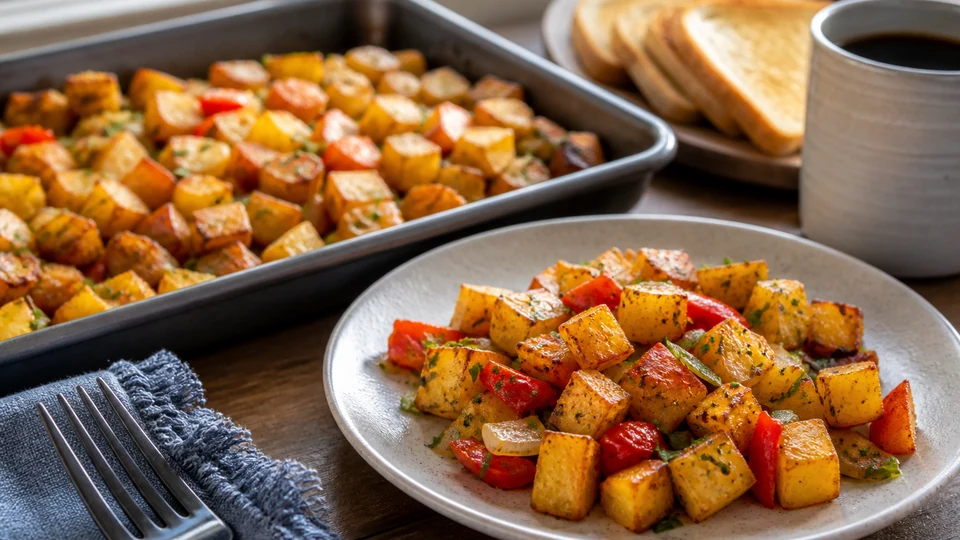
For roasted breakfast potatoes with crisp edges and tender centres, use evenly cut potatoes, a thoroughly dried surface, a light coat of oil, and a tray with visible gaps. Roast at 220°C / 425°F until a knife slips through the largest piece and several cut faces are deeply golden. Pancake World treats this as one controlled oven technique, not a promise that every potato variety or oven behaves the same way.
Route owner statement
This page owns one reproducible tray of roasted breakfast potatoes for a four-person breakfast. It does not replace a broader Breakfast collection or offer medical, nutrition, or universal “best potato” claims.
The finished result
The finished pieces should have browned contact faces, separated edges, and a centre that yields to a small knife without a hard core. They should not be pale from crowding, greasy from excess oil, or soft from trapped steam.
Primary formula: tray-roasted breakfast potatoes
Yield: 4 side portions. Timing: 15 minutes preparation; 35–45 minutes roasting; 5 minutes resting. Oven: 220°C / 425°F.
Ingredients: 900 g (2 lb) potatoes suitable for roasting; 2 tablespoons neutral oil or olive oil; 3/4 teaspoon fine salt; 1/2 teaspoon sweet paprika; 1/4 teaspoon black pepper; 1 tablespoon chopped parsley, optional, added after roasting.
Equipment and tray setup
Use a large rimmed metal baking tray, knife, board, bowl, clean kitchen towel, and thin spatula. Put the oven rack in the middle position and heat the oven fully. A tray that holds the pieces in a single layer matters more than a deep dish: steam needs a route out of the pan.
Method with observable cues
- Scrub the potatoes under running water, trim damaged spots, and cut them into 2.5 cm / 1 inch pieces. Keep the pieces close in size so the largest piece is a useful doneness test.
- Dry the pieces very well with a clean towel. Toss with the oil, salt, paprika, and pepper until every piece has a thin sheen rather than pooled oil.
- Spread the potatoes over the tray in one layer, leaving small gaps. Put as many cut faces as practical against the metal; do not pile a second layer over them.
- Roast for 20 minutes without moving the tray. The undersides should release with a spatula and show the first golden patches.
- Turn the pieces, rotate the tray if one side of the oven colours faster, and roast for 15–25 minutes more. Begin checking the largest piece after 15 minutes.
- Stop when a knife enters the centre easily and several faces are golden-brown. Rest on the tray for 5 minutes, then add parsley if using and serve.
Doneness and control points
Colour alone is not enough: small pieces brown first. Test the largest piece for a tender centre, then look for dry, browned edges across the tray. If pieces still look wet after turning, keep the door closed and give the tray more time rather than adding more oil.
Scaling without changing the technique
For 2 portions, halve every ingredient but keep the tray broad enough for one layer. For 8 portions, use two trays and swap their positions when you turn the potatoes; do not double the quantity on one crowded tray. The roast time is a check range, not a substitute for the knife test.
Meaningful variations
For a smoky version, replace the sweet paprika with 1/2 teaspoon smoked paprika. For rosemary potatoes, add 1 teaspoon finely chopped rosemary before roasting and keep the same base formula. For a brighter finish, add lemon zest after roasting, not before. These are flavour variations, not separate primary recipes.
Serving timing with breakfast
Potatoes are easiest to serve during the short rest after roasting, while another last-minute item finishes. The American pancakes guide is useful for a separate griddle task; do not try to make its timing a rule for this oven tray. For a larger hosted meal, Home Made Brunch Ideas and Hosting Brunch Menu Ideas help allocate oven and serving space.
Troubleshooting
Pale and soft
The tray was crowded, the pieces were wet, or the oven was not fully hot. Move to a single layer and continue roasting.
Dark outside, firm centre
Pieces were too large or uneven. Cut the next batch smaller and use the largest piece as the doneness check.
Sticking or a greasy finish
Wait until a crust forms before turning, and use the measured oil. More oil does not correct trapped steam.
Storage and reheating boundary
Cool leftovers promptly in shallow containers and refrigerate following current official leftovers guidance. Reheat only a portion you intend to eat, using dry heat if you want to recover surface texture. Do not use cooking to rescue potatoes with an uncertain storage history.
Technique close
Success comes from four checks: equal cuts, dry surfaces, room on the tray, and a tender-centre test on the largest piece. Once those are in place, seasoning can change without turning this into a second formula.
Sources and editorial references
- U.S. Food and Drug Administration, Selecting and Serving Produce Safely — https://www.fda.gov/consumers/consumer-updates/selecting-and-serving-produce-safely
- USDA Food Safety and Inspection Service, Leftovers and Food Safety — https://www.fsis.usda.gov/food-safety/safe-food-handling-and-preparation/food-safety-basics/leftovers-and-food-safety
- USDA Food Safety and Inspection Service, Keep Food Safe! Food Safety Basics — https://www.fsis.usda.gov/food-safety/safe-food-handling-and-preparation/food-safety-basics
- USDA MyPlate, What Is MyPlate? — https://www.myplate.gov/eat-healthy/what-is-myplate