
Quick answer
Oatmeal nutrition facts make sense only after you identify the serving. A label may describe dry oats, a prepared portion made with water, or a flavoured product with sugar, salt, milk powder, fruit, or fat. Cooked oatmeal weighs much more than the dry grain because it contains absorbed water; that does not mean the water created extra oat nutrients.
Plain oats provide mostly carbohydrate, along with fibre, some protein and fat, and several vitamins and minerals. Exact amounts depend on the oat product and serving weight. Milk, yogurt, fruit, nuts, syrup, and other additions change the complete bowl. An oatmeal pancake is another recipe entirely: flour, egg, leavener, liquid, fat, and toppings must be counted if nutrition information matters.
This page is a reading and meal-planning guide, not individual medical or dietary advice.
Start with the serving basis
Before comparing two labels, find the serving size in grams and determine whether it is dry or prepared. “One cup” is not enough information because a cup of dry rolled oats, a cup of cooked porridge, and a compact instant-oat packet contain different amounts of grain.
| Label or recipe basis | What it includes | Main comparison risk |
|---|---|---|
| Dry oats by weight | Grain before cooking | Mistaking the cooked bowl weight for extra grain |
| Prepared with water | Dry oats plus absorbed water | Comparing it with dry values without matching oat amount |
| Prepared with milk | Oats plus the named milk | Attributing milk nutrients to oats |
| Flavoured packet | Oats plus product-specific ingredients | Assuming it matches plain oats |
| Restaurant bowl | Oats plus an unknown or listed preparation | Missing sugar, cream, salt, or toppings |
| Oatmeal pancakes | Complete batter and toppings | Counting only the oats |
The most reliable comparison is equal dry weight from current labels. If one product lists 40 g and another 50 g, convert mentally or use the values as served rather than declaring a winner from the larger numbers.
Dry oats versus cooked oatmeal
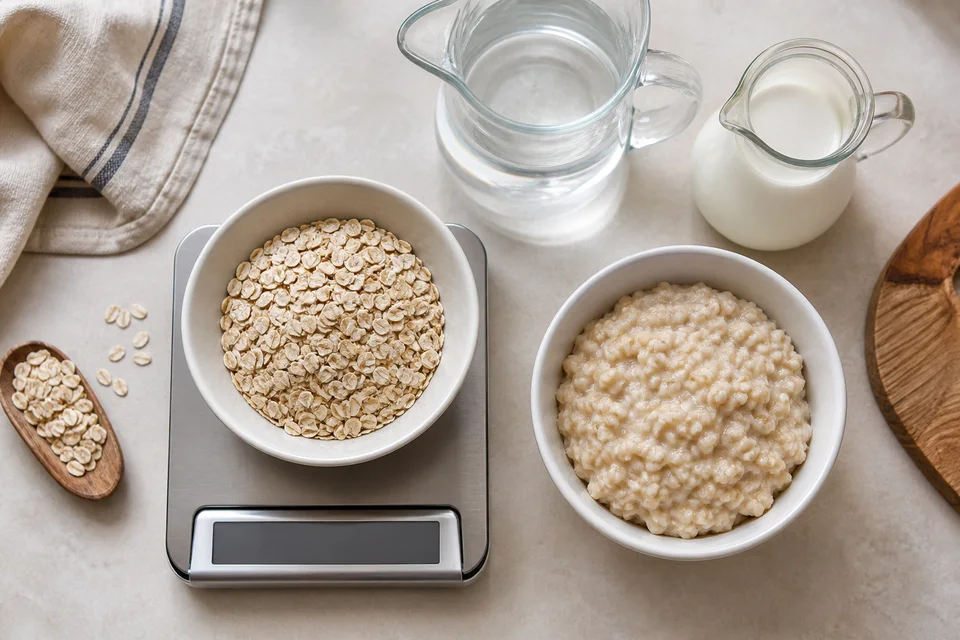
Cooking oats in water changes texture, volume, and weight. Water dilutes the nutrients per 100 g of finished porridge because much of that finished weight is water. The original dry portion still sets the grain contribution unless oats or cooking liquid are discarded.
A thicker bowl made with less water can appear more nutrient-dense by spoonful than a thin bowl made from the same dry oats, yet both began with the same grain portion. This is why “per 100 g cooked” and “per dry serving” are not interchangeable.
What nutrients do oats contribute?
Carbohydrate: Starch supplies most of the energy in plain oats. Total carbohydrate on a label includes fibre and sugars according to the labelling system.
Fibre: Oats contain dietary fibre, including soluble and insoluble fractions. The amount on a product label belongs to the stated serving. Do not convert a fibre claim into a guaranteed health outcome for an individual.
Protein: Oats contribute some protein, but a bowl is not automatically a high-protein meal. Milk, yogurt, eggs, nuts, seeds, or a separate savoury side can change the complete meal.
Fat: Plain oats naturally contain some fat. Butter, cream, nut butter, coconut products, and frying fat can add much more, so read the whole recipe.
Micronutrients: Oat labels and food-composition records may list iron, magnesium, phosphorus, zinc, thiamin, or other nutrients. Fortified instant products can differ from plain rolled oats. Use the current label rather than a generic internet number when accuracy matters.
Rolled, quick, instant, and steel-cut oats
These names describe processing and particle form, not a guaranteed nutrition ranking. Steel-cut oats are groats cut into pieces. Rolled oats are steamed and flattened. Quick oats are rolled more thinly or cut smaller, and instant products may be pre-cooked or formulated with additional ingredients.
When equal amounts of plain oats are compared, processing often changes cooking behaviour more visibly than the ingredient list. Smaller particles hydrate faster and produce a smoother porridge. Product fortification, flavour sachets, sweeteners, and serving sizes can still make labels differ, so compare the actual packages.
For pancake batter, oat form matters substantially. Steel-cut oats are not a direct replacement for rolled oats because hard pieces may remain firm. Oat flour absorbs and structures batter differently from intact flakes. The easy oatmeal pancake recipe uses a controlled combination rather than treating every oat form as interchangeable.
Read the Nutrition Facts label in order
- Serving size: Note grams, household measure, and servings per container.
- Prepared or dry: Check whether the values assume water, milk, or another addition.
- Calories or energy: Match the serving before comparing.
- Total carbohydrate and fibre: Keep the units and serving basis together.
- Added sugars: Plain oats and sweetened oatmeal are different products.
- Sodium: Flavoured savoury or sweet packets may include salt.
- Protein and fat: Read the actual value rather than inferring from marketing words.
- Vitamins and minerals: Fortification and national labelling requirements vary.
- Ingredient list: Identify sweeteners, flavours, milk ingredients, nuts, or other additions.
- Allergen statement: Follow the label and your own dietary requirements.
Daily Value percentages are reference tools defined for nutrition labelling. They are not personalised targets for every age, condition, or activity level. The FDA’s label guidance explains how the percentages relate to a reference daily diet.
What cooking liquid changes
Water adds no energy or macronutrients, but it changes the bowl’s weight and concentration. Dairy milk contributes its product-specific protein, carbohydrate, fat, vitamins, and minerals. Plant beverages vary widely: some are fortified, some are sweetened, and some contain very little protein. Canned coconut milk is not equivalent to a thin drinking beverage.
If a recipe or label says “as prepared,” confirm which liquid and amount were assumed. Recording a bowl as plain oatmeal when it contains milk and sweetener understates the complete dish; recording milk nutrients as if they came from oats overstates the grain.
Toppings change the complete bowl
Fruit adds its own nutrients, water, and natural sugars. Nuts and seeds add fat, protein, fibre, and energy in product-specific amounts. Yogurt can add protein and dairy or plant ingredients. Syrup, honey, brown sugar, chocolate, granola, and sweetened nut butter can substantially change sugars and energy.
None of those additions is automatically “good” or “bad” in isolation. Choose a portion and combination that fits the meal and the person eating it. The oatmeal pancake toppings guide groups options by fruit, creaminess, crunch, and savoury direction without pretending one topping creates a universal result.
Oatmeal versus oatmeal pancakes
Porridge cooks oats in liquid. Oatmeal pancakes distribute oats through a batter that may also include wheat flour, egg, milk, yogurt, banana, sugar, leavener, salt, and cooking fat. A pancake’s nutrition therefore depends on the formula, yield, portion, and toppings.
Do not copy the label values for 40 g of oats onto a two-pancake serving unless the recipe truly places that amount in the portion. Add every ingredient’s contribution across the full batch, then divide by the actual yield. Variable scoop size makes calculated servings drift.
The oat, banana, and yogurt pancake recipe shows how several ingredients combine. Its title does not make every portion or topping nutritionally identical.
A practical portion example
Suppose two people each start with the same weighed amount of plain rolled oats. One cooks the oats with water and makes a thick bowl; the other adds more water and makes a larger, thinner bowl. The second bowl occupies more volume, but both contain the same dry oat amount. If the second person also adds milk, banana, and nut butter, those additions belong in the complete meal even though the oatmeal base began identically.
Apply the same logic to pancakes. If a batch contains 160 g of oats and produces eight equal pancakes, the oat share is calculated across eight pieces. If four pancakes are much larger, an even “two pancake” serving assumption no longer works. Count or weigh portions consistently, include batter left in the bowl, and do not ignore the cooking fat. This simple batch accounting is more defensible than assigning a generic oatmeal number to any oat-coloured pancake.
Gluten and allergen boundary
Oats do not make a finished product automatically gluten-free. Product standards, agricultural handling, processing, ingredient labels, and kitchen cross-contact all matter. Oatmeal pancakes may include wheat flour directly. Milk, nuts, seeds, soy, and egg can enter through liquids and toppings.
Anyone managing a diagnosed allergy, coeliac disease, or medical nutrition need should use products and professional guidance appropriate to that situation. A general oat page cannot certify a kitchen or product.
Current-batch fixes
The bowl is much larger than expected: Check the dry oat weight and water amount. Volume expansion reflects absorbed liquid; it does not prove the serving contains more grain.
The oatmeal is too thick: Stir in a measured amount of hot water or the chosen liquid, then recheck. Record the adjustment so the nutrition estimate includes any nutrient-containing liquid.
The oatmeal is too thin: Continue gentle cooking if the product method allows, or let it stand briefly. Adding more dry oats changes the serving and requires additional cooking.
The sweetness is excessive: Stop adding sweetener. Plain yogurt, extra unsweetened oats cooked separately, or fruit may rebalance the plate, but they also change the portion.
Oat pancakes are gummy: The batter may be too thick, over-ground, oversized, or undercooked. Use the Pancake Troubleshooting hub and evaluate one variable at a time.
Prevent the next batch from drifting
Weigh the dry oats, measure the cooking liquid, and note the exact product. Add toppings after measuring if you want a repeatable record. For pancakes, weigh the full cooked yield or count equal portions and record the scoop. Recalculate when an ingredient, brand, or yield changes.
Keep “recipe nutrition estimate” separate from “package label.” A calculator based on generic database entries can be useful, but the actual packaged ingredients and serving remain the better basis for a specific home batch. Avoid copying rounded values from unrelated preparations.
FAQ
Is cooked oatmeal lower in calories than dry oats?
Water lowers the concentration per 100 g of cooked food, but the energy from the original dry oats remains in the bowl. Compare equal dry oat portions.
Are steel-cut oats more nutritious than rolled oats?
Do not assume so from the name. Compare equal weights and current labels; processing, fortification, and added ingredients can differ.
Does milk count as part of oatmeal nutrition?
Yes for the complete prepared bowl. The nutrients belong to the selected milk or plant beverage, not to the oats themselves.
Are oatmeal pancakes the same as a bowl of oatmeal?
No. Pancakes contain a complete batter and cooking fat, with a yield and toppings that must be included.
Can oatmeal be called gluten-free?
Only when the specific product, ingredients, preparation environment, and applicable standards support that claim. Ordinary oat wording alone is insufficient.
Related Pancake World guides
Cook the easy oatmeal pancake recipe, choose balanced additions through toppings for oatmeal pancakes, or compare a fuller oat batter in oat, banana, and yogurt pancakes.
Sources and editorial references
- Utah State University Extension: Oats —
https://extension.usu.edu/fscreate/ou-files/handout_oats.pdf - U.S. Food and Drug Administration: Daily Value on the Nutrition and Supplement Facts Labels —
https://www.fda.gov/food/new-nutrition-facts-label/daily-value-new-nutrition-and-supplement-facts-labels - USDA MyPlate: MyPlate Food Guidance —
https://www.myplate.gov/
For more practical food and breakfast guides, visit Pancakes World.
For the wider topic, start with Guides/healthy Pancakes.
For a closely related guide, see Oatmeal Pancake Ingredients: Oats, Ratios, and Swaps.
A useful next comparison is How to Make Balanced Pumpkin Pancakes.
You can also continue with Baked Oatmeal: A Flexible Breakfast Formula and Four Ideas.
