
Quick answer
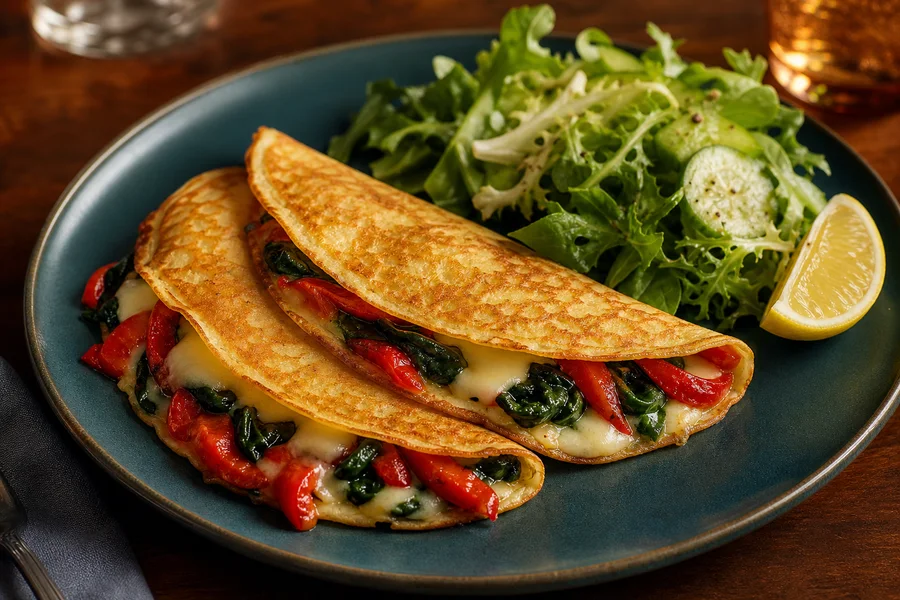
One complete savoury dinner recipe with a coordinated filling and serving workflow. The practical target is thin, flexible pancakes wrapped around a hot but moisture-controlled filling. The goal is one coordinated filled dinner rather than a broad roundup of savory pancake styles.
Begin the test for savoury pancakes for dinner with pepper, spinach, and cheese with “Make the thin batter.” Watch how 160 g all-purpose flour behaves as the edge sets and the underside releases, then inspect the thickest center for thin, flexible pancakes wrapped around a hot but moisture-controlled filling. That first result tells you more than borrowing a pan setting or cooking time from a different batter.
What success looks like
The finished result should show thin, flexible pancakes wrapped around a hot but moisture-controlled filling. It should also fit the promised serving format: a stack must remain stable, a fold must stay flexible, and a delicate foam or alternative-flour pancake must be supported during turning. Flavor, texture, and safety are separate judgments; a browned surface is useful culinary information but not proof that a raw egg center is safe.
The build plan runs from 160 g all-purpose flour to 120 g melting cheese, and the first method decision is “Make the thin batter.” Keep those controls stable while calibrating portion and heat; otherwise a change in the formula can be mistaken for a pan problem.
Ingredients or build plan
- 160 g all-purpose flour
- 2 large eggs
- 360 g milk
- 30 g melted butter or neutral oil
- 1/2 teaspoon salt
- 2 roasted red peppers, drained and sliced
- 250 g mushrooms, sliced
- 150 g spinach
- 120 g melting cheese
Treat 160 g all-purpose flour as the opening control and 120 g melting cheese as the final recipe-specific addition, not as parts of a universal pancake ratio. Make a measured adjustment only when the test pancake fails to approach thin, flexible pancakes wrapped around a hot but moisture-controlled filling.
Prepare before cooking
Drain the peppers thoroughly. Cook mushrooms in a wide skillet until their released liquid has evaporated, then wilt the spinach and squeeze out excess moisture. Keep the filling warm while mixing the batter.
Because 160 g all-purpose flour is handled before cooking, do not taste the raw batter or dough. Clean hands, bowls, tools, and work surfaces after raw flour or egg contact. For this formula, the preparation control is specific: Drain the peppers thoroughly. Cook mushrooms in a wide skillet until their released liquid has evaporated, then wilt the spinach and squeeze out excess moisture. Keep the filling warm while mixing the batter.
Method
Make the thin batter
Whisk flour and salt, then add eggs and milk gradually to avoid flour pockets. Stir in melted fat and rest while the filling cooks. The batter should coat the pan in a thin, continuous layer.
Cook flexible pancakes
Wipe a medium-hot skillet with fat, pour a small ladle of batter, and rotate immediately. Cook until the top loses its wet sheen and the edges lift, then turn briefly. Stack under a clean towel so the pancakes remain pliable.
Season the filling as a unit
Combine peppers, mushrooms, and spinach, then taste before adding cheese. Pepper and cheese may already carry salt. Keep the mixture warm but avoid simmering it into a wet sauce.
Fill without overloading
Place filling across one half of each pancake, add cheese, and fold. Return folded pancakes to the skillet seam-side down until the cheese melts and the exterior regains a little color.
Serve in batches
Move finished pancakes to warm plates and add a crisp salad. If cooking for a group, hold filled pancakes on a rack in a low oven rather than stacking them in a covered dish.
Fix the current batch
Start current-batch triage with “Filling leaks,” because it is the first likely failure for this formula. Preserve any pancake already showing thin, flexible pancakes wrapped around a hot but moisture-controlled filling, and change only the part of the process connected to that observed defect.
Filling leaks
Remove some filling, simmer off moisture, and fold the next pancake with a smaller portion. Record what changed so the correction can be repeated or rejected on the next pancake.
Pancakes crack
They may be too thick or too dry. Brush the current one with a little melted butter and warm it; thin the remaining batter with a spoonful of milk. Record what changed so the correction can be repeated or rejected on the next pancake.
Dinner goes cold
Finish the filling before starting pancakes and warm the plates. Fold and melt cheese in a short final sequence. Record what changed so the correction can be repeated or rejected on the next pancake.
Bottom scorches during the final melt
Lower the heat and cover briefly. The filling is already cooked; the aim is melted cheese and a hot center, not more browning. Record what changed so the correction can be repeated or rejected on the next pancake.
Variations and serving
Swap spinach and mushroom for sautéed leeks and peas, or use roasted squash with a sharp cheese. Keep the same moisture rule. A spoonful of thick yogurt or mustard-dressed greens can add acidity without turning the filling into a loose sauce.
Plate savoury pancakes for dinner with pepper, spinach, and cheese so thin, flexible pancakes wrapped around a hot but moisture-controlled filling remains visible. The serving direction begins “Swap spinach and mushroom for sautéed leeks and peas, or use roasted squash with a sharp cheese”; keep that addition restrained enough to show whether the pancake itself reached the intended texture.
Prevent problems in the next batch
Write down the pan, burner setting, portion size, and the one adjustment that improved the current batch. For savoury pancakes for dinner with pepper, spinach, and cheese, the most useful record is whether the result moved closer to thin, flexible pancakes wrapped around a hot but moisture-controlled filling. A note such as “lower heat” is incomplete without the pancake size and observed center.
After “Filling leaks,” alter only the correction named in that diagnostic before repeating “Make the thin batter.” Changing portion, heat, and 160 g all-purpose flour together would hide which action moved the result toward thin, flexible pancakes wrapped around a hot but moisture-controlled filling.
Use the first pancake to test the relationship between 160 g all-purpose flour and 120 g melting cheese. Its spread shows whether the build plan is coherent, its release tests the pan, and its center reveals whether “Make the thin batter” produced thin, flexible pancakes wrapped around a hot but moisture-controlled filling.
Food safety
For savoury pancakes for dinner with pepper, spinach, and cheese, 160 g all-purpose flour remains raw until cooked, so do not taste the batter. Handle raw eggs and flour with clean hands, bowls, tools, and surfaces. Cook the thickest sample until no liquid egg or raw batter remains; the target thin, flexible pancakes wrapped around a hot but moisture-controlled filling is a quality cue, while surface browning alone is not a safety conclusion.
A practical batch notebook
Before cooking, record the starting formula and the intended serving format. During cooking, note the first pancake’s diameter, visible edge behavior, underside color, and center texture. After cooking, record only the correction that genuinely improved thin, flexible pancakes wrapped around a hot but moisture-controlled filling. This creates evidence for the next batch without turning one kitchen result into a universal claim.
When changing 160 g all-purpose flour or 120 g melting cheese, restart with the same pan and portion used for “Make the thin batter.” Compare the new result with thin, flexible pancakes wrapped around a hot but moisture-controlled filling, then apply the smallest correction suggested by “Filling leaks” instead of forcing the variation to behave like a different formula.
Evaluate texture after cooling briefly
Cut one representative pancake after a short rest and compare the center, edge, and surface. For this recipe, the central question is whether the sample shows thin, flexible pancakes wrapped around a hot but moisture-controlled filling. A hot pancake can feel softer from steam, while a long uncovered wait can dry it, so make the comparison at a consistent point. Record the result in plain observable language instead of calling it perfect or failed.
Frequently asked questions
Can I cook the pancakes earlier?
Yes. Cool them, separate with parchment, cover, and rewarm briefly before filling. The filling should be prepared close to service.
Can I use crepes?
These pancakes are deliberately thin and crepe-like. The key is a flexible, unsweetened wrapper sturdy enough for the filling.
What if I do not eat cheese?
Omit it and add a thick bean spread or a spoonful of seasoned yogurt at service. Avoid watery substitutes inside the fold.
How many pancakes does this make?
Yield depends on pan diameter and ladle size. Record the first pancake’s batter amount so the remaining portions are consistent.
Related Pancake World pages
Sources and editorial references
- U.S. Food and Drug Administration, Flour Is a Raw Food and Other Safety Facts —
https://www.fda.gov/consumers/consumer-updates/flour-raw-food-and-other-safety-facts - USDA Food Safety and Inspection Service, Shell Eggs from Farm to Table —
https://www.fsis.usda.gov/food-safety/safe-food-handling-and-preparation/eggs/shell-eggs-farm-table
For more practical food and breakfast guides, visit Pancakes World.
For the wider topic, start with Guides/pancake Ingredients.
For a closely related guide, see A Savoury Pancake Recipe for a Family Table.
A useful next comparison is Savoury Pancake Recipes: Six Dinner-Ready Ideas.
You can also continue with Grilled Cheese Pancakes.
For another practical angle, read Dutch Baby Versus Pancakes: Heat, Release and Batch Method.
