
Quick answer
A useful savoury pancake recipe collection with six clearly differentiated ideas and one adaptable base. The practical target is savory pancakes whose additions stay distinct and whose centers cook without wet vegetable pockets. These six ideas are a discovery set; use the related savory method guide when you need a single batter explained step by step.
Begin the test for savoury pancake recipes: six dinner-ready ideas with “1. Zucchini, corn, and dill.” Watch how 180 g all-purpose flour behaves as the edge sets and the underside releases, then inspect the thickest center for savory pancakes whose additions stay distinct and whose centers cook without wet vegetable pockets. That first result tells you more than borrowing a pan setting or cooking time from a different batter.
What success looks like
The finished result should show savory pancakes whose additions stay distinct and whose centers cook without wet vegetable pockets. It should also fit the promised serving format: a stack must remain stable, a fold must stay flexible, and a delicate foam or alternative-flour pancake must be supported during turning. Flavor, texture, and safety are separate judgments; a browned surface is useful culinary information but not proof that a raw egg center is safe.
The build plan runs from 180 g all-purpose flour to one controlled recipe addition from the list below, and the first method decision is “1. Zucchini, corn, and dill.” Keep those controls stable while calibrating portion and heat; otherwise a change in the formula can be mistaken for a pan problem.
Ingredients or build plan
- 180 g all-purpose flour
- 1 teaspoon baking powder
- 1/2 teaspoon salt
- 2 large eggs
- 300 g milk
- 30 g oil
- one controlled recipe addition from the list below
Treat 180 g all-purpose flour as the opening control and one controlled recipe addition from the list below as the final recipe-specific addition, not as parts of a universal pancake ratio. Make a measured adjustment only when the test pancake fails to approach savory pancakes whose additions stay distinct and whose centers cook without wet vegetable pockets.
Prepare before cooking
Whisk the base dry ingredients and wet ingredients separately. Prepare only one variation per bowl unless dividing before additions. Cook watery vegetables first and cool them, because raw moisture is the most common reason a loaded savory pancake stays gummy.
Because 180 g all-purpose flour is handled before cooking, do not taste the raw batter or dough. Clean hands, bowls, tools, and work surfaces after raw flour or egg contact. For this formula, the preparation control is specific: Whisk the base dry ingredients and wet ingredients separately. Prepare only one variation per bowl unless dividing before additions. Cook watery vegetables first and cool them, because raw moisture is the most common reason a loaded savory pancake stays gummy.
Method
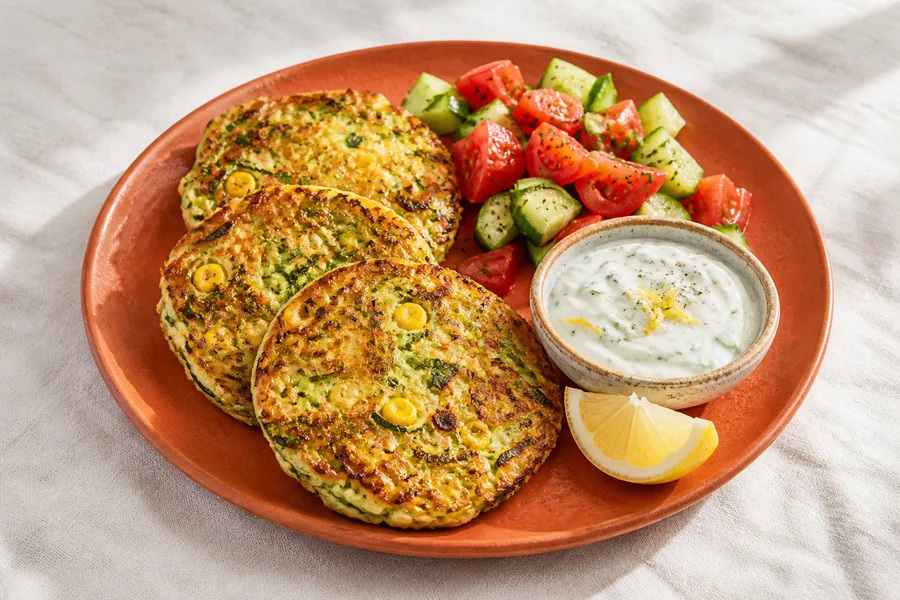
1. Zucchini, corn, and dill
Squeeze grated zucchini, pat corn dry, and fold both into batter with dill. Keep the pancakes small and serve with lemon yogurt.
2. Mushroom, spinach, and thyme
Sauté mushrooms until dry, wilt spinach, and chop both. Fold in a restrained quantity or use them as a topping over plain herb pancakes.
3. Chickpea, cumin, and tomato
Use a tested chickpea-flour formula rather than swapping it blindly into the wheat base. Serve with chopped seasoned tomato after cooking.
4. Potato and spring onion
Use cooked grated potato or a dedicated raw-potato recipe; the two need different moisture and cooking controls. Spring onion and black pepper keep the flavor clear.
5. Roasted pepper and feta
Drain peppers well and crumble feta finely. Reduce added salt until the complete cooked pancake is tasted.
6. Leftover roast vegetables
Chop suitable cooked vegetables small and use only enough for batter to surround each piece. Saucy or very wet leftovers belong on top instead.
Fix the current batch
Start current-batch triage with “Pancakes fall apart,” because it is the first likely failure for this formula. Preserve any pancake already showing savory pancakes whose additions stay distinct and whose centers cook without wet vegetable pockets, and change only the part of the process connected to that observed defect.
Pancakes fall apart
Reduce the solid load, make smaller rounds, and wait until the first side has structure before turning. Record what changed so the correction can be repeated or rejected on the next pancake.
Vegetables create wet pockets
Cook or drain the remaining vegetables and fold them into a fresh portion of batter. Record what changed so the correction can be repeated or rejected on the next pancake.
Cheese scorches
Use less cheese in the batter, wipe the pan between rounds, and move some cheese to a topping. Record what changed so the correction can be repeated or rejected on the next pancake.
Recipe tastes bland
Season the additions and finish with acid or herbs instead of relying only on batter salt. Record what changed so the correction can be repeated or rejected on the next pancake.
Variations and serving
The six ideas cover different structures, so they are not direct one-for-one swaps. Zucchini and mushrooms demand moisture control; chickpea flour needs its own hydration; potato needs a dedicated doneness plan; feta changes salt; leftovers depend on their original handling and sauce.
Plate savoury pancake recipes: six dinner-ready ideas so savory pancakes whose additions stay distinct and whose centers cook without wet vegetable pockets remains visible. The serving direction begins “The six ideas cover different structures, so they are not direct one-for-one swaps”; keep that addition restrained enough to show whether the pancake itself reached the intended texture.
Prevent problems in the next batch
Write down the pan, burner setting, portion size, and the one adjustment that improved the current batch. For savoury pancake recipes: six dinner-ready ideas, the most useful record is whether the result moved closer to savory pancakes whose additions stay distinct and whose centers cook without wet vegetable pockets. A note such as “lower heat” is incomplete without the pancake size and observed center.
After “Pancakes fall apart,” alter only the correction named in that diagnostic before repeating “1. Zucchini, corn, and dill.” Changing portion, heat, and 180 g all-purpose flour together would hide which action moved the result toward savory pancakes whose additions stay distinct and whose centers cook without wet vegetable pockets.
Use the first pancake to test the relationship between 180 g all-purpose flour and one controlled recipe addition from the list below. Its spread shows whether the build plan is coherent, its release tests the pan, and its center reveals whether “1. Zucchini, corn, and dill” produced savory pancakes whose additions stay distinct and whose centers cook without wet vegetable pockets.
Food safety
For savoury pancake recipes: six dinner-ready ideas, 180 g all-purpose flour remains raw until cooked, so do not taste the batter. Handle raw eggs and flour with clean hands, bowls, tools, and surfaces. Cook the thickest sample until no liquid egg or raw batter remains; the target savory pancakes whose additions stay distinct and whose centers cook without wet vegetable pockets is a quality cue, while surface browning alone is not a safety conclusion.
A practical batch notebook
Before cooking, record the starting formula and the intended serving format. During cooking, note the first pancake’s diameter, visible edge behavior, underside color, and center texture. After cooking, record only the correction that genuinely improved savory pancakes whose additions stay distinct and whose centers cook without wet vegetable pockets. This creates evidence for the next batch without turning one kitchen result into a universal claim.
When changing 180 g all-purpose flour or one controlled recipe addition from the list below, restart with the same pan and portion used for “1. Zucchini, corn, and dill.” Compare the new result with savory pancakes whose additions stay distinct and whose centers cook without wet vegetable pockets, then apply the smallest correction suggested by “Pancakes fall apart” instead of forcing the variation to behave like a different formula.
Frequently asked questions
Which recipe is easiest for beginners?
Roasted pepper and feta is straightforward when the peppers are well drained. Zucchini is also approachable if it is squeezed thoroughly.
Can I make a mixed platter?
Yes, but cook one batter variation at a time and label it for guests. Keep portions small so different pancakes finish at similar rates.
Are all savory pancakes vegetarian?
No. These six ideas are vegetable-led, but toppings and substitutions determine the final plate. Check ingredients rather than relying on the category name.
Can I freeze them?
Many cooked savory pancakes freeze reasonably, but fillings with high moisture may soften. Cool promptly, pack carefully, and reheat until fully hot.
Related Pancake World pages
Sources and editorial references
- U.S. Food and Drug Administration, Flour Is a Raw Food and Other Safety Facts —
https://www.fda.gov/consumers/consumer-updates/flour-raw-food-and-other-safety-facts - USDA Food Safety and Inspection Service, Shell Eggs from Farm to Table —
https://www.fsis.usda.gov/food-safety/safe-food-handling-and-preparation/eggs/shell-eggs-farm-table
For more practical food and breakfast guides, visit Pancakes World.
For the wider topic, start with Guides/pancake Ingredients.
For a closely related guide, see Scrambled Egg and Crêpe Breakfast Casserole.
A useful next comparison is 22 Savoury Chickpea Crepe Cake Ideas.
You can also continue with Savoury Pancakes for Dinner with Pepper, Spinach, and Cheese.
