
Quick answer
A dependable homemade pancake is less about a secret ingredient than about controlling a few ordinary variables. Measure the flour without packing it, distribute the baking powder through the dry ingredients, mix only until no dry pockets remain, and cook one tester before committing the whole bowl. The tester tells you more than a rigid timer: it reveals whether the batter spreads correctly, whether the pan is too hot, and whether the centre cooks before the surface becomes too dark.
This recipe makes about 12 medium pancakes. It is designed as a flexible American-style base with a tender crumb and enough structure for berries, sliced banana, or a small amount of chocolate. The quantities belong to this recipe; if you change the flour, liquid, egg, or leavener substantially, treat the result as a new formula and adjust from a small test pancake.
Reliable homemade pancake recipe
Ingredients
- 240 g all-purpose flour, about 2 cups when spooned and levelled
- 25 g sugar, about 2 tablespoons
- 2 teaspoons baking powder
- 1/2 teaspoon fine salt
- 2 large eggs
- 360 ml milk, about 1 1/2 cups
- 45 g melted butter or 3 tablespoons neutral oil, plus a little for the pan
- 1 teaspoon vanilla extract, optional
Whisk the flour, sugar, baking powder, and salt in a wide bowl. In a second bowl, beat the eggs, milk, melted butter or oil, and vanilla until the egg white is no longer visible in strands. Pour the wet mixture into the dry mixture. Fold with a flexible spatula, scraping the bottom and sides, just until the flour is moistened. Small soft lumps are acceptable; streaks of dry flour are not.
Leave the batter for five minutes while the cooking surface heats. During that pause, the flour hydrates and the batter may become slightly thicker. It should fall from a spoon in a broad ribbon and settle gradually rather than pour like water or stand like bread dough. If it is genuinely too stiff to spread, fold in milk one tablespoon at a time. If it races across the pan, wait until after the tester before adding any flour; a cool pan can make a workable batter appear thin.
Heat a large nonstick skillet or well-seasoned griddle over medium heat. Brush on a thin film of fat, then add about 60 ml or 1/4 cup batter for a tester. Watch the surface and edge together. Turn when bubbles have formed and some have opened, the edge looks matte rather than wet, and the underside lifts as one piece. Cook the second side until golden and the centre springs back gently. Cut the tester open: the crumb should look set and tender, without a glossy stripe of uncooked batter.
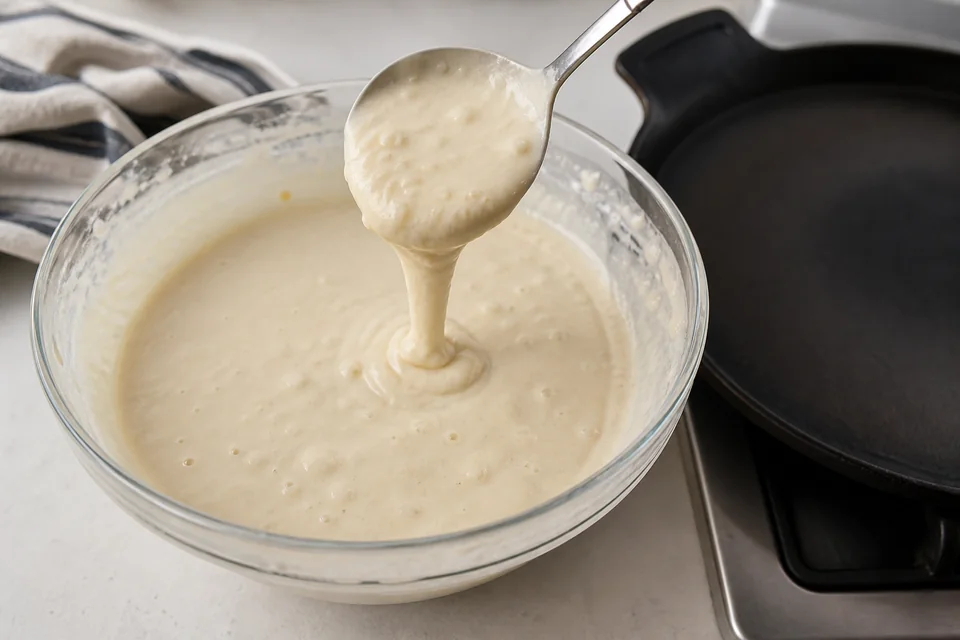
Cook the remaining pancakes without crowding the pan. Reapply only a light film of fat as needed; pools of butter can create patchy, almost fried rings. Transfer each batch to a rack rather than stacking it immediately, because trapped steam softens the surfaces. If everyone is not eating at once, hold the rack briefly in a low oven and serve as soon as practical.
What each ingredient contributes
Flour provides the main structure. All-purpose flour keeps this base straightforward, but the way it is measured matters. Scooping directly with the cup can compact flour and move the batter toward a dry, dense result. A scale avoids that variation. If cups are your only option, loosen the flour, spoon it into the cup, and level the top without pressing.
Baking powder supplies leavening for this milk-based formula. It must be evenly dispersed, which is why the dry mixture is whisked before liquid arrives. Old baking powder may not perform like a fresh container, but replacing it with an arbitrary extra spoonful is not a sound correction; too much can create an unpleasant flavor and a coarse rise. Check the package date and test a small batch when its performance is uncertain.
Eggs help the batter hold together and contribute richness. Milk hydrates the flour and makes the batter fluid enough to portion. Butter brings a familiar flavor, while neutral oil remains liquid as the pancakes cool and is useful when a clean, uncomplicated result is preferred. Sugar is modest here: it supports browning and sweetness, but a heavily sweetened batter can darken before a thick centre has set.
Diagnose the tester before cooking the batch
The pancake is dark outside but wet in the middle
The pan is probably delivering heat to the surface faster than the centre can set, especially if the pancake is large or thick. Lower the heat, give the pan a moment to settle, and make the next tester slightly smaller. Do not press it with the spatula; pressing changes the thickness after the structure has begun to form. Browning is a culinary cue, not proof that the interior is fully cooked, so confirm with the set edge, resilient centre, and a cut tester.
The batter spreads into a thin, ragged puddle
First verify that the skillet is properly preheated and that the batter had its short rest. If the second tester still runs quickly, fold in one tablespoon of flour and rest for another minute. Large corrections made directly in the main bowl are difficult to reverse. A single measured addition keeps the experiment legible.
The pancake is tall but heavy
A batter can look thick and still contain too much flour for its liquid. Review the measurement before adding more milk blindly. Dense pancakes can also follow vigorous mixing, which develops more structure in a conventional wheat batter and removes some of the bubbles you were trying to preserve. For a fuller diagnosis, see why pancakes turn dense.
The first side is pale and greasy
The surface may be too cool, or there may be more fat than the pancake needs. Let the pan recover between batches and wipe away excess fat before the next pour. A thin coating helps release; a visible pool changes the cooking method and produces uneven color.
The pancakes tear during the turn
They may simply be early. Wait for the upper surface to show open bubbles and for the edge to lose its wet shine. Slide a broad spatula under most of the pancake, lift decisively, and turn once. Our guide to when to flip pancakes separates useful visual cues from unreliable timer-only advice.
Flavor variations that keep the base stable
For blueberry pancakes, pour the batter first and scatter a small spoonful of berries over each round. This gives every pancake a similar fruit load and avoids crushing berries throughout the bowl. Frozen berries can cool the local batter and release juice, so use a restrained amount and allow the cooking cues, not the plain-batch time, to lead.
For lemon pancakes, rub finely grated lemon zest into the measured sugar before it joins the dry mixture. Zest adds aroma without materially changing hydration. A spoonful of lemon juice is not equivalent: it adds liquid and acidity, so it should be part of a separately tested formula rather than an improvised last-second addition.
For banana pancakes, place thin slices on the poured surface instead of mixing a large amount of mashed banana into this base. Mashed banana changes moisture, sweetness, and weight at once. If that is the texture you want, use a banana-specific recipe and expect different browning and turning behavior.
For a whole-grain direction, begin by replacing only part of the all-purpose flour and watch the batter after resting. Whole-grain flours can absorb liquid differently and bring a more pronounced flavor. Make a half batch, record the weight of the substitution, and change one variable at a time.
Better results on the next batch
Keep a short note of flour weight, liquid amount, pan setting, and tester result. “Medium heat” describes a dial position, not the temperature delivered by every burner and pan. A note such as “first tester browned before the edge set; reduced one notch” is far more reusable than “cook two minutes.” It captures what happened in your kitchen.
Portion consistently. A spring scoop, small ladle, or 1/4-cup measure makes thickness more predictable, which means the visual turning cues appear in a comparable sequence. If the last pancake is much thicker because the bowl has settled, fold the batter once or twice gently before portioning it; do not whisk it aggressively back to smoothness.
Separate the jobs of the pan and the batter. Batter controls spread, tenderness, and gas retention; the pan controls how quickly the surfaces set and brown. When a pancake fails, ask which system produced the symptom before changing both. This simple habit prevents a thin batter from being “fixed” with high heat or an overheated pan from being “fixed” with extra flour.
Food safety
Raw flour and raw egg batter should not be tasted. The U.S. Food and Drug Administration advises treating flour as a raw food and cooking foods made with it; the U.S. Department of Agriculture advises thorough cooking and safe handling for foods containing eggs. Wash bowls, utensils, hands, and work surfaces after contact with raw batter. Use the recipe’s visual and cut-test cues to judge culinary doneness, while remembering that surface color by itself is not a safety test.
Frequently asked questions
Can I make this batter the night before?
This quick-leavened formula was tested for mixing and cooking in one session. Holding it overnight changes hydration and gives the leavener a different timeline, so the next-morning result may not match. For faster breakfast preparation, combine the dry ingredients in advance and refrigerate the measured wet ingredients separately, then mix them shortly before cooking.
Why does the first pancake look different?
The first pour often acts as a calibration round: the pan and fat film may not yet be evenly settled. Use it deliberately. If its underside is patchy, adjust the fat; if it darkens before bubbles open, reduce the heat; if it runs, reassess the rested batter. The first pancake is useful evidence, not a batch failure.
Should pancake batter be perfectly smooth?
Not for this conventional wheat-flour recipe. It should contain no dry pockets, but a few small soft lumps are acceptable. Chasing a polished, lump-free batter with repeated whisking can make the texture less tender. Different styles, such as thin crêpes, follow different mixing rules.
How do I keep pancakes warm without making them soggy?
Place them in a single layer on a wire rack set over a sheet pan in a low oven for a short interval. A plate covered tightly with foil traps steam against the surfaces. For a larger gathering, serve in smaller waves so the first batch is not held for an extended period.
Related pancake help
This is a general homemade formula in the family of American pancakes. If the tester exposes a repeatable problem, use Pancake Troubleshooting to follow the symptom rather than adding several ingredients at once.
More practical guides
Sources and editorial references
- University of Tennessee Extension, “Flat As A Pancake” —
https://www.healthyfamilies.tennessee.edu/recipes/flat-as-a-pancake/ - King Arthur Baking, “Don’t make this pancake mistake” —
https://www.kingarthurbaking.com/blog/2017/04/20/dont-make-this-pancake-mistake - U.S. Food and Drug Administration, “Handling Flour Safely” —
https://www.fda.gov/consumers/consumer-updates/handling-flour-safely-what-you-need-know - U.S. Department of Agriculture Food Safety and Inspection Service, “Shell Eggs from Farm to Table” —
https://www.fsis.usda.gov/food-safety/safe-food-handling-and-preparation/eggs/shell-eggs-farm-table
For more practical food and breakfast guides, visit Pancakes World.
For the wider topic, start with Guides/pancake Ingredients.
For a closely related guide, see Sourdough Pancakes: One Reliable Base, Three Directions.
A useful next comparison is Waffle and Pancake Recipes for Breakfast.
You can also continue with Tomato and Herb Mini Frittatas.
For another practical angle, read Can I Use Oat Flour Instead of Old-Fashioned Oats?.
