
Quick answer
A sourdough pancake recipe and small variation set that uses maintained discard without promising fermentation or health benefits. The practical target is tender pancakes with lightly crisp edges and a gentle tang that does not overpower the toppings. The three variations begin from one controlled discard batter; the foundational discard guide explains starter and base-formula decisions in more depth.
Begin the test for sourdough pancakes: one reliable base, three directions with “Combine the main batter.” Watch how 200 g maintained sourdough discard behaves as the edge sets and the underside releases, then inspect the thickest center for tender pancakes with lightly crisp edges and a gentle tang that does not overpower the toppings. That first result tells you more than borrowing a pan setting or cooking time from a different batter.
What success looks like
The finished result should show tender pancakes with lightly crisp edges and a gentle tang that does not overpower the toppings. It should also fit the promised serving format: a stack must remain stable, a fold must stay flexible, and a delicate foam or alternative-flour pancake must be supported during turning. Flavor, texture, and safety are separate judgments; a browned surface is useful culinary information but not proof that a raw egg center is safe.
The build plan runs from 200 g maintained sourdough discard to 1/2 teaspoon salt, and the first method decision is “Combine the main batter.” Keep those controls stable while calibrating portion and heat; otherwise a change in the formula can be mistaken for a pan problem.
Ingredients or build plan
- 200 g maintained sourdough discard
- 160 g all-purpose flour
- 240 g milk
- 2 large eggs
- 30 g sugar for a sweet batch, or omit for savory
- 45 g melted butter or neutral oil
- 1 teaspoon baking soda
- 1/2 teaspoon salt
Treat 200 g maintained sourdough discard as the opening control and 1/2 teaspoon salt as the final recipe-specific addition, not as parts of a universal pancake ratio. Make a measured adjustment only when the test pancake fails to approach tender pancakes with lightly crisp edges and a gentle tang that does not overpower the toppings.
Prepare before cooking
Use discard from a starter that has been maintained with clean equipment and normal aroma. If the starter shows mold, unusual color, or a truly foul odor, discard it according to reliable starter-care guidance rather than cooking with it.
Because 200 g maintained sourdough discard is handled before cooking, do not taste the raw batter or dough. Clean hands, bowls, tools, and work surfaces after raw flour or egg contact. For this formula, the preparation control is specific: Use discard from a starter that has been maintained with clean equipment and normal aroma. If the starter shows mold, unusual color, or a truly foul odor, discard it according to reliable starter-care guidance rather than cooking with it.
Method
Combine the main batter
Whisk discard, milk, eggs, sugar if using, and melted fat. Add flour and salt and stir only until hydrated. The batter can rest briefly while the skillet heats, but the final baking soda is held back.
Add baking soda last
Stir in baking soda just before cooking. The batter may loosen or foam as it meets the acidic mixture. Cook promptly rather than holding the activated bowl for an extended time.
Calibrate one pancake
Use a medium-hot, lightly greased skillet and a modest portion. Watch spread, edge set, and browning. Discard hydration varies, so the first pancake determines whether a spoonful of milk or flour is useful.
Cook from observable cues
Turn when the rim is set and the underside releases. Finish until the center is resilient and a cut test shows no raw batter. Tang and color do not determine safety.
Choose one variation
Divide the base only after its thickness is correct. Fold berries into one portion, replace a small share of flour with whole grain in another planned batch, or omit sugar and add chives for savory pancakes.
Fix the current batch
Start current-batch triage with “Batter is very thin,” because it is the first likely failure for this formula. Preserve any pancake already showing tender pancakes with lightly crisp edges and a gentle tang that does not overpower the toppings, and change only the part of the process connected to that observed defect.
Batter is very thin
Your discard may be more hydrated. Add flour one tablespoon at a time and reassess after a short stand. Record what changed so the correction can be repeated or rejected on the next pancake.
Flavor is sharply sour
Use fresher discard, keep the rest shorter, and pair with fruit or dairy. Do not claim that longer fermentation automatically improves the pancake. Record what changed so the correction can be repeated or rejected on the next pancake.
Pancakes are flat
Confirm the baking soda was added at the end and cook the rest promptly. Also check whether the batter is too thin. Record what changed so the correction can be repeated or rejected on the next pancake.
Edges burn
Reduce heat and wipe away dark butter solids. Sourdough batter can brown before a thick center has set. Record what changed so the correction can be repeated or rejected on the next pancake.
Variations and serving
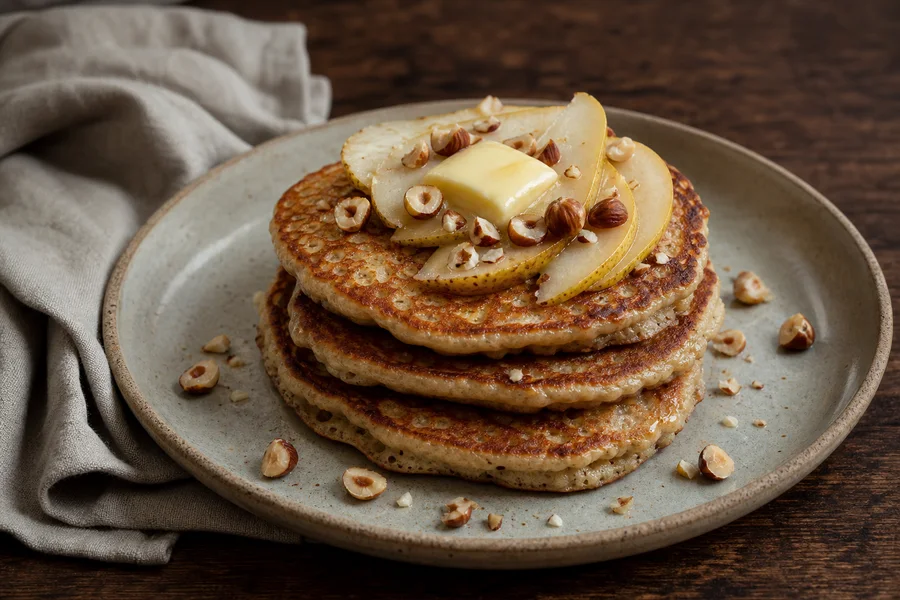
Pear and hazelnut: fold diced pear into small pancakes and serve with toasted hazelnuts. Blueberry-oat: replace 30 g flour with oat flour and adjust milk after resting. Savory herb: omit sugar, add chives and black pepper, and serve with sautéed mushrooms.
Plate sourdough pancakes: one reliable base, three directions so tender pancakes with lightly crisp edges and a gentle tang that does not overpower the toppings remains visible. The serving direction begins “Pear and hazelnut: fold diced pear into small pancakes and serve with toasted hazelnuts”; keep that addition restrained enough to show whether the pancake itself reached the intended texture.
Prevent problems in the next batch
Write down the pan, burner setting, portion size, and the one adjustment that improved the current batch. For sourdough pancakes: one reliable base, three directions, the most useful record is whether the result moved closer to tender pancakes with lightly crisp edges and a gentle tang that does not overpower the toppings. A note such as “lower heat” is incomplete without the pancake size and observed center.
After “Batter is very thin,” alter only the correction named in that diagnostic before repeating “Combine the main batter.” Changing portion, heat, and 200 g maintained sourdough discard together would hide which action moved the result toward tender pancakes with lightly crisp edges and a gentle tang that does not overpower the toppings.
Use the first pancake to test the relationship between 200 g maintained sourdough discard and 1/2 teaspoon salt. Its spread shows whether the build plan is coherent, its release tests the pan, and its center reveals whether “Combine the main batter” produced tender pancakes with lightly crisp edges and a gentle tang that does not overpower the toppings.
Food safety
For sourdough pancakes: one reliable base, three directions, 200 g maintained sourdough discard remains raw until cooked, so do not taste the batter. Handle raw eggs and flour with clean hands, bowls, tools, and surfaces. Cook the thickest sample until no liquid egg or raw batter remains; the target tender pancakes with lightly crisp edges and a gentle tang that does not overpower the toppings is a quality cue, while surface browning alone is not a safety conclusion.
A practical batch notebook
Before cooking, record the starting formula and the intended serving format. During cooking, note the first pancake’s diameter, visible edge behavior, underside color, and center texture. After cooking, record only the correction that genuinely improved tender pancakes with lightly crisp edges and a gentle tang that does not overpower the toppings. This creates evidence for the next batch without turning one kitchen result into a universal claim.
When changing 200 g maintained sourdough discard or 1/2 teaspoon salt, restart with the same pan and portion used for “Combine the main batter.” Compare the new result with tender pancakes with lightly crisp edges and a gentle tang that does not overpower the toppings, then apply the smallest correction suggested by “Batter is very thin” instead of forcing the variation to behave like a different formula.
Frequently asked questions
What is sourdough discard?
It is the portion removed during starter maintenance. Its exact hydration and acidity depend on how that starter is fed, so recipes may need small adjustments.
Does the recipe need an overnight ferment?
No. This version is a same-session discard pancake. It makes no claim that a longer hold is necessary or nutritionally superior.
Can I use active starter?
Yes, but its hydration and gas activity may differ. Judge the batter after mixing and avoid assuming the same spread.
Why add baking soda last?
It begins reacting in the acidic batter. Holding it back preserves more of that activity for the pan.
Related Pancake World pages
Sources and editorial references
- University of Illinois Extension, Sourdough 101 —
https://extension.illinois.edu/media/8391/download?inline= - U.S. Food and Drug Administration, Flour Is a Raw Food and Other Safety Facts —
https://www.fda.gov/consumers/consumer-updates/flour-raw-food-and-other-safety-facts - USDA Food Safety and Inspection Service, Shell Eggs from Farm to Table —
https://www.fsis.usda.gov/food-safety/safe-food-handling-and-preparation/eggs/shell-eggs-farm-table
For more practical food and breakfast guides, visit Pancakes World.
For the wider topic, start with Guides/pancake Ingredients.
A useful next comparison is Almond-Flour Pancakes: A Tender, Easy-to-Turn Recipe.
You can also continue with Cottage Cheese Pancake Variations: Sweet, Savory, and Flour Changes.
For another practical angle, read How to Compare Protein Pancake Mixes.
Related reading
Image note: Editorial images were created and refined with AI.
