
Quick answer
Green savory pancakes get their colour and flavour from spinach, parsley, dill, and spring onion—not food colouring. The vegetables must be dry enough that the batter still holds a small round, and the pancakes must cook gently enough for the centre to set before the green surface becomes dark.
This recipe blends spinach with egg and milk for even colour, then folds in chopped herbs and spring onion for visible texture. It reconstructs the exact legacy page’s spinach-and-herb focus without claiming line-by-line recovery of an unavailable formula. The result is a tender, naturally green pancake suitable for breakfast, lunch, or a light supper.
Ingredients
- 120 g baby spinach, washed and dried
- 20 g flat-leaf parsley, leaves and tender stems
- 10 g dill
- 3 spring onions, finely sliced
- 2 large eggs
- 240 ml milk, with 30 ml held back
- 30 g melted butter, cooled, or 2 tablespoons olive oil
- 180 g plain all-purpose flour
- 1 1/2 teaspoons baking powder
- 1/2 teaspoon fine salt
- 1/4 teaspoon black pepper
- A little suitable fat for the pan
- Plain yogurt, lemon, herbs, or salad for serving, optional
The batch makes about ten small pancakes. Weigh greens after trimming and drying. A wet bunch can add a surprising amount of uncontrolled liquid.
Prepare the greens
Dry spinach thoroughly. If the leaves are mature or tough, wilt them briefly, cool, and squeeze dry before weighing. Tender baby spinach can be blended raw in this formula. Do not use frozen spinach without thawing and squeezing it; the water balance would be different.
Separate delicate dill and parsley from coarse stems. Keep spring onion out of the blender so it remains in small visible pieces. This makes the finished crumb taste of both fresh herbs and cooked greens instead of one uniform purée.
Blend the green base
Place spinach, parsley, dill, eggs, 210 ml milk, and melted cooled butter or oil in a blender. Blend until the spinach is finely dispersed and the mixture is bright green. Stop and scrape once if necessary. Do not continue blending until the liquid becomes hot or foamy.
The purée should pour freely but still show tiny flecks. If the blender cannot move it, add a spoonful from the reserved milk rather than a large splash.
Mix the batter
Whisk flour, baking powder, salt, and pepper in a large bowl. Pour in the green mixture and fold just until no dry flour remains. Stir in sliced spring onion. Let the batter rest for five minutes.
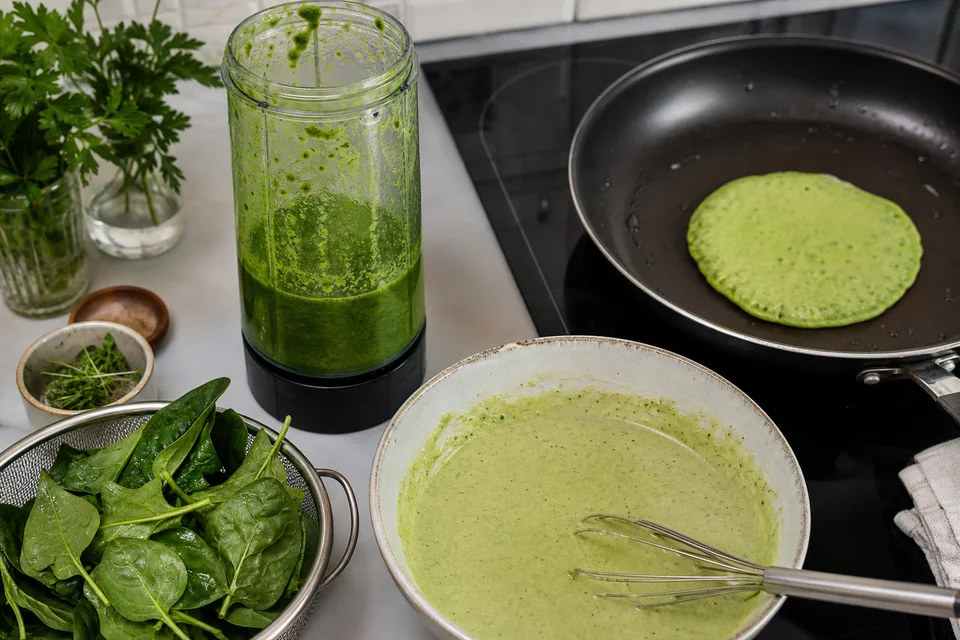
The rested batter should fall in a thick ribbon. Add reserved milk one tablespoon at a time if it remains rigid. If it is thin, cook a small test before adding flour; hydrated flour and egg may still provide enough structure.
Cook one test pancake
Warm a skillet gradually over medium-low to moderate heat. Apply a thin film of fat and spoon in a small portion. Let it spread naturally to a round about 9 to 10 cm wide. Green batter hides some browning, so watch the edge and surface rather than waiting for a familiar golden colour.
Turn when the edge is set, the underside releases, and bubbles or small openings remain visible. Cook the second side until the centre is set. Cut the test piece. It should be tender and green with no glossy flour line.
Taste the cooked pancake. Add a measured pinch of salt, pepper, or chopped herbs only if needed. Do not taste the raw bowl.
Cook the batch
Stir gently before each panful because spring onion can settle. Keep pancakes small and leave room to turn. Remove dark residue between rounds; browned herb particles can make later pancakes taste bitter.
Transfer cooked pancakes to a rack or loose platter. A covered stack traps steam and dulls both colour and surface texture. Serve promptly while the edges remain lightly crisp.
Keep the colour naturally green
Heat inevitably deepens spinach colour. The goal is not a neon pancake but a natural green interior with browned cooking surfaces. Excessive pan heat, prolonged holding, or repeated reheating turns the outside olive or dark brown.
Lemon juice can brighten flavour at service, but adding a large amount to the batter changes acidity and leavening. Do not use baking soda as a colour trick; it changes taste and structure. Use fresh greens, controlled heat, and prompt service.
Serving ideas
Serve with plain yogurt, lemon zest, cucumber, tomato salad, roasted mushrooms, poached or firmly cooked egg, smoked fish, or a chickpea salad. Keep one creamy element and one crisp or acidic element rather than covering the green crumb with several sauces.
The savory pancake toppings guide helps match moisture and texture. For a neutral batter with mix-ins rather than a green purée, use how to make savory pancakes.
Useful variations
Spinach and chive: Replace dill with chives for a milder allium direction.
Spinach and feta: Crumble a small amount of feta onto the cooked pancakes or fold in a measured amount after reducing salt. Wet cheese can loosen the bowl.
Pea and mint: Replace part of the spinach with cooked cooled peas and use mint, but choose a recipe-tested amount because peas thicken the purée.
Dairy-free: Use an unsweetened plant beverage whose label and behaviour suit cooking. Products vary in sugar, protein, fat, and thickness.
Gluten-free adaptation: Use a complete tested gluten-free formula. Replacing wheat flour cup for cup changes binding and spread, and the complete kitchen must support any dietary claim.
Browse 22 savoury pancake recipes when the desired change becomes a different pancake rather than a minor variation.
Current-batch fixes
Batter is too thin: Stir and rest. If the test spreads without holding, add flour one measured tablespoon at a time and let it hydrate.
Batter is too thick: Add reserved milk gradually. Avoid a large pour that erases the controlled texture.
Pancakes are brown outside and wet inside: Lower heat and reduce the scoop. Do not press after turning.
Pancakes tear: Make them smaller, wait for a set underside, and use a broad turner. Long spring-onion pieces should be cut shorter.
Colour looks dull: Stop prolonged cooking and serve with fresh herbs or lemon at the table. Do not add artificial colour or excess baking soda.
Flavour is bitter: Dark herb residue or excessive mature greens may be responsible. Clean the pan and reduce coarse stems next time.
Use the Pancake Troubleshooting hub for general burning, sticking, or raw-centre symptoms.
Prevent the next batch from drifting
Record the exact greens, dried weight, whether spinach was raw or wilted, milk adjustment, blender time, scoop, and pan. Photograph the test pancake’s cut centre. Green bunches vary in water and strength, so weights and observations matter more than “one handful.”
Keep the successful base unchanged before testing cheese, peas, or plant milk. Prepare greens shortly before mixing and keep raw batter appropriately chilled only when the recipe permits. Do not hold it overnight by default; hydration and leavening continue changing.
Storage and reheating
Cool leftovers promptly in one layer, then refrigerate or freeze them under current official guidance. Store yogurt and salad separately. Reheat only until hot throughout; a skillet or oven preserves the surface better than prolonged microwaving.
Colour will be less bright after storage, and frozen greens may release some moisture. That is a quality change, not a reason to underheat the centre.
FAQ
Why are the pancakes green?
Spinach, parsley, and dill are blended into the wet ingredients. No artificial colour is needed.
Can I use frozen spinach?
Yes only after thawing and squeezing it very dry, with a measured amount. It may produce a darker colour and different moisture.
Can I taste the batter for seasoning?
No. It contains raw flour and egg. Taste one fully cooked test pancake.
Why do my green pancakes taste bitter?
Over-browned herb residue, coarse mature greens, excessive dill, or scorched pan fat can contribute. Clean the pan and use tender, balanced herbs.
Are green pancakes automatically healthy?
No. The name describes ingredients and colour. Nutrition depends on the complete recipe, portion, cooking fat, and toppings.
Related Pancake World guides
Learn the neutral method in how to make savory pancakes, choose another format from 22 savoury pancake recipes, and finish the plate with savory pancake toppings.
Sources and editorial references
- U.S. Food and Drug Administration: Handling Flour Safely —
https://www.fda.gov/consumers/consumer-updates/handling-flour-safely-what-you-need-know - U.S. Food and Drug Administration: What You Need to Know About Egg Safety —
https://www.fda.gov/food/buy-store-serve-safe-food/what-you-need-know-about-egg-safety
For more practical food and breakfast guides, visit Pancakes World.
For the wider topic, start with Guides/healthy Pancakes.
For a closely related guide, see Easy Oatmeal Pancakes with a Tender, Oat-Flecked Crumb.
A useful next comparison is How to Make Cottage Cheese Pancakes.
You can also continue with Healthy Pumpkin Pancakes: A Balanced, Reliable Recipe.
