
Quick answer
Sourdough discard is the portion removed when a maintained starter is refreshed. It can flavor pancakes and contribute flour and water, but it is not a complete pancake batter by itself. For a reliable quick batch, combine a known amount of discard with measured flour, milk, egg, fat, salt, and chemical leavening, then use one test pancake to adjust consistency and pan heat.
The result should be tender, lightly tangy, and fully cooked, with more flavor than an otherwise similar plain pancake. How tangy it tastes depends on the starter, flour, feeding schedule, storage, and recipe. “Discard” does not mean spoiled starter. Use discard only from a starter with a known, healthy maintenance history; unusual colored growth, fuzzy mold, a putrid smell, or unknown handling history is a reason to discard the culture rather than cook with it.
This is a same-day quick-pancake method, not a fermented overnight protocol. Chemical leavening supplies prompt lift. If you want an overnight sponge, follow a complete recipe written for that timing and refrigeration plan.
What sourdough discard contributes
Most discard contains flour and water that have been inhabited by a sourdough culture. When it enters pancake batter, that flour and water must be counted in the formula. Treating 200 g of discard as if it were merely a flavoring can produce an unexpectedly thin, sour, or gummy batter.
Discard may add acidity and fermentation aromas. Its exact hydration—the relative amounts of water and flour—matters. A 100% hydration starter contains equal weights of flour and water; a stiffer or more liquid starter does not. This article’s framework assumes a 100% hydration wheat starter. If yours differs, use a recipe developed for it or calculate the flour and water change.
Discard age is not a precise flavor dial. Refrigerated discard can become sharper, but flour choice and starter ecology also matter. Do not promise a specific sourness from a number of days alone.
A measured same-day formula
For about 10–12 medium pancakes, gather:
- 200 g sourdough discard at 100% hydration;
- 120 g plain flour;
- 180 g milk, plus up to 20 g for adjustment;
- 1 large egg;
- 30 g melted butter or neutral oil, cooled slightly;
- 20 g sugar, optional or adjustable;
- 2 teaspoons baking powder;
- 1/2 teaspoon baking soda;
- 1/2 teaspoon fine salt;
- optional vanilla, cinnamon, or finely grated citrus zest.
The baking soda is appropriate only in balance with this acidic discard-based formula. Do not increase it to chase height; excess can produce an alkaline or soapy taste. Starter acidity varies, which is another reason to cook one test pancake.
If the discard already contains whole-grain flour, expect a different flavor and water demand. If it is very liquid, hold back some milk. If it is stiff, the reserved milk may be needed. Record what you add.
Step-by-step method
1. Verify the discard
Use discard from your own maintained starter or another source whose history you trust. A gray liquid layer or sharp fermented aroma may occur in a hungry starter, but this page cannot diagnose every culture from appearance. Mold, pink or orange discoloration, a rotten odor, or an unknown long warm hold is not a pancake opportunity.
2. Mix wet ingredients
Whisk discard, most of the milk, egg, cooled melted fat, and optional flavoring until the discard is evenly dispersed. Small starter strands are less important than eliminating dense unmixed lumps.
3. Combine dry ingredients
In a separate bowl, whisk flour, sugar, baking powder, baking soda, and salt thoroughly. Even distribution prevents a pocket of soda from tasting unpleasant.
4. Make the batter
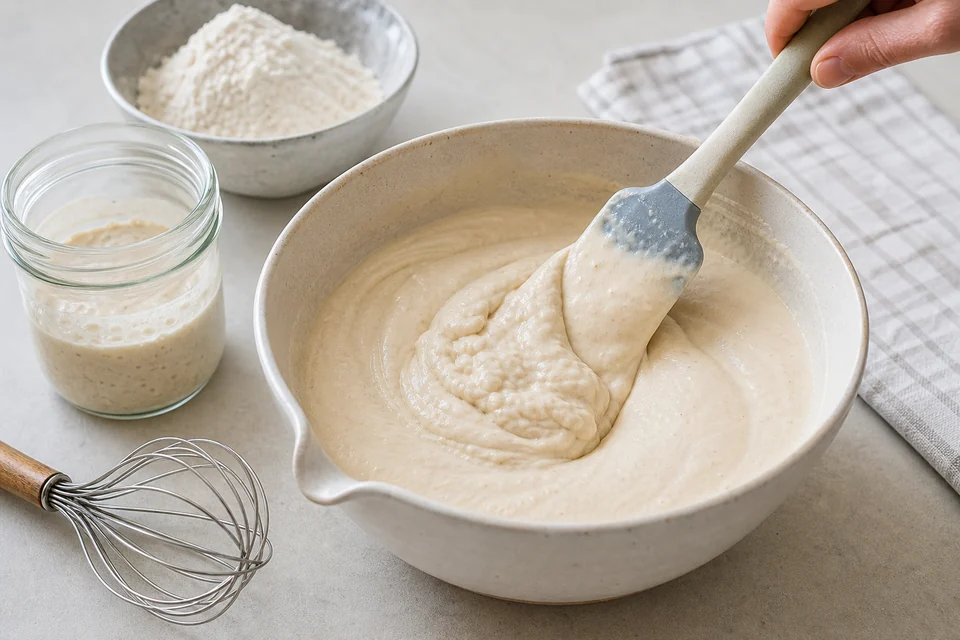
Pour wet into dry and fold until no dry flour pockets remain. A few small lumps are preferable to prolonged beating. The batter should fall from a spoon in a thick ribbon and spread slowly on the pan. Rest five to ten minutes while the pan warms; do not treat that short rest as extended fermentation.
5. Cook a test pancake
Warm a heavy skillet or griddle over medium-low heat and apply a thin film of fat. Portion one small pancake. Watch the edge become matte and the underside develop even gold. Bubbles are one clue, not an automatic command to flip; the base must support the turn.
6. Adjust once
If the test pancake barely spreads and stays raw in a mound, add reserved milk one tablespoon at a time. If it runs thin, verify the measurements before adding flour; then use one tablespoon only if needed. If the exterior darkens before the center sets, lower the heat and make a smaller round.
7. Finish in batches
Cook with space between portions. Turn once when practical and cook until the center is set. Hold finished pancakes briefly in a single layer or loose stack, not under a tight cover that traps enough steam to make them wet.
Quick versus overnight discard pancakes
| Method | Lift | Timing | Flavor development | Main control |
|---|---|---|---|---|
| same-day quick batter | baking powder and soda | mix and cook promptly | discard brings existing flavor | batter consistency and pan heat |
| overnight sponge | recipe-specific fermentation plus later leavening | planned rest, often with a morning finish | more time for recipe-defined fermentation | time, temperature, ingredient sequence |
| active-starter pancake | may use vigorous starter plus recipe leavening | tied to starter readiness | depends on ripe starter | activity and complete formula |
Do not convert a quick recipe to overnight storage by simply leaving the mixed batter on the counter. Raw flour, egg, and dairy require safe handling, and chemical leavening can lose useful action. The pancake-batter storage guide explains why a cooked-first plan is often simpler.
Troubleshooting the current batch
Batter is too thick: starter hydration or flour absorption differs. Add milk in small measured amounts and retest. Do not pour in a large splash.
Batter is too thin: confirm that discard and milk were weighed. Let the batter stand for the specified short rest, then add flour only one tablespoon at a time if still necessary.
Pancakes taste soapy or bitter: too much baking soda or poor distribution is a likely suspect. Return to the measured formula; extra acid added blindly can create another imbalance.
Pancakes are gummy: the portion may be too thick, pan too hot, or total water too high. Make smaller rounds and lower heat. Use the pancake troubleshooting hub if the center remains wet.
Pancakes are dense: check leavener freshness, batter overmixing, thickness, and cooking temperature before blaming the starter. The pancake troubleshooting hub gives a broader path.
Flavor is too sour: use fresher discard next time, blend with a milder flour choice, and keep toppings balanced. Do not hide an unpleasant or suspect starter behind sugar.
Surface burns quickly: sugar, acidity, residual pan film, and high heat can all accelerate darkening. Wipe the pan and lower the burner.
Savory and sweet directions
For a sweet plate, use vanilla and serve with berries, fruit compote, or a restrained syrup. Taste the plain pancake before adding sugar to the topping; sourdough tang can make sweetness seem more pronounced.
For savory pancakes, omit vanilla and most or all sugar, then add finely sliced scallion or herbs. Keep wet vegetables and large cheese pieces out of the batter until you know the base cooks reliably. A savory direction does not change the need to cook flour and egg fully.
Avoid overloading the first batch. The purpose of the base test is to understand discard, leavening, and heat. Once it works, add one flavor direction at a time.
Discard management and storage boundaries
King Arthur Baking defines discard as the portion removed during routine starter maintenance and notes that it may be used immediately or stored for later baking. Storage advice still depends on a trustworthy starter, clean container, refrigeration, and the selected recipe.
Label a discard jar with the date and starter type. Do not keep topping up an unwashed communal jar indefinitely. Do not use a “discard recipe” as a disposal guide for a culture that may be contaminated. If the starter’s history is uncertain, begin with a reliable starter rather than relying on heat to correct unknown conditions.
Cooked pancakes should be cooled and stored separately from wet toppings. For longer storage, freeze cooked pancakes in separated portions and reheat them using a method suited to their thickness. The label and record are more useful than guessing by smell later.
Food-safety and allergy notes
FDA guidance states that flour is a raw food and advises against tasting uncooked dough or batter. Sourdough fermentation is not permission to eat raw pancake batter. Cook the pancakes through, wash hands and tools after raw flour and egg contact, and keep batter away from ready-to-eat toppings.
Sourdough is not automatically gluten-free. A wheat or rye starter contains gluten, and even a starter made from another grain may face cross-contact. Milk, egg, wheat, and toppings may also be allergens. Verify the complete ingredient and kitchen situation.
Mistakes and limitations
Do not confuse discard with waste of any condition. Do not combine a quick recipe’s final leavener with an unplanned overnight counter rest. Do not assume every starter is 100% hydration. Do not add soda until the sour flavor disappears; flavor and acid-base balance are related but not interchangeable measurements at the stove.
This home formula is not a starter-maintenance manual, microbial test, or commercial shelf-life plan. It produces pancakes from known maintained discard. When the culture itself is the question, use an experienced sourdough resource.
Frequently asked questions
What exactly is sourdough discard?
It is the portion removed when a sourdough starter is refreshed. It contains flour, water, and the starter culture, and can be used in recipes designed to account for it.
Does discard need to be active and bubbly?
Not for this chemically leavened quick method. The discard contributes flour, water, acidity, and flavor; baking powder and soda provide prompt lift.
Can I use cold discard from the refrigerator?
Yes if the selected recipe permits it and the discard has a known safe history. Cold ingredients may thicken the batter or affect melted butter, so mix carefully.
Why add both baking powder and baking soda?
The measured combination supports lift in this specific acidic batter. Soda also affects flavor and browning. Do not generalize the amounts to another formula.
Can I leave the batter overnight?
Not this batter. Use a complete overnight sourdough pancake recipe with its own ingredient sequence, time, and temperature controls.
Are discard pancakes very sour?
Not necessarily. Tang depends on the starter and formula. The test pancake tells you more than the word “discard.”
Can I freeze them?
Yes. Cool cooked pancakes, separate portions, package airtight, label, freeze, and reheat only what you plan to eat.
Related Pancake World pages
Start with the American pancakes hub, use the Pancake World troubleshooting hub for symptoms, and read how to store pancake batter before turning a same-day formula into an unplanned make-ahead experiment.
Sources and editorial references
- King Arthur Baking, What is sourdough discard and what should I do with it? —
https://www.kingarthurbaking.com/blog/2024/04/18/sourdough-discard - King Arthur Baking, Classic sourdough pancakes —
https://www.kingarthurbaking.com/recipes/classic-sourdough-pancakes-recipe - U.S. Food and Drug Administration, Flour is a raw food and other safety facts —
https://www.fda.gov/consumers/consumer-updates/flour-raw-food-and-other-safety-facts
For more practical food and breakfast guides, visit Pancakes World.
For the wider topic, start with Guides/pancake Ingredients.
For a closely related guide, see Vegan Overnight Oats: Control Thickness and Cold Storage.
A useful next comparison is Delicious Hotcakes: A Reliable Fluffy Breakfast Method.
You can also continue with Sourdough Pancakes: One Reliable Base, Three Directions.
Related reading
- Oatmeal Pancakes: A Tender Rolled-Oat Recipe
- Baked Oatmeal: A Flexible Breakfast Formula and Four Ideas
Image note: Editorial images were created and refined with AI.
