Traditional Easter brunch menu
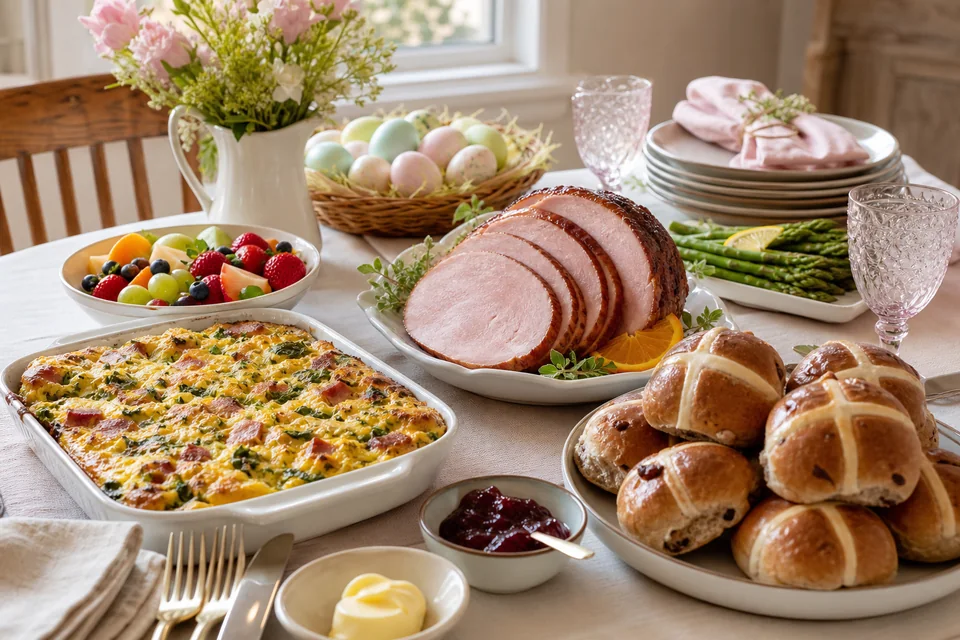
The careful answer: tradition is plural and evidence must be named
There is no single traditional Easter brunch menu. The National Museum of Ireland documents eggs as the main food of Easter Sunday breakfast after a Lenten surplus, followed by a family meal that could include meat and dairy. The Royal Danish Library documents Danish Easter-lunch contexts including eggs, mustard sauce, cabbage dishes and lamb. CzechTourism documents Czech Jidáše buns, mazanec, lamb-shaped cake and Easter stuffing in named days of Holy Week. These are different contexts, not interchangeable proof for a generic plate. This page compares them, then labels one Irish-referenced home menu as an adaptation. The broader Pancake World collection provides the platform context without turning one regional reference into a universal claim.
Terminology boundaries
| Term or role | Useful meaning in this guide | Boundary |
|---|---|---|
| Easter meal | Food associated with the celebration in a particular community | Not identical across regions or families |
| Brunch | A modern service window combining breakfast and lunch patterns | May be a contemporary adaptation |
| Egg | Food, decoration or symbolic object depending on the source | Do not assume one symbolism for every culture |
| Festive bread | Enriched, braided, sweet or regional bread served for an occasion | Name the specific bread when making a cultural claim |
| Fresh greens | Seasonal contrast or side dish | Availability and local practice vary |
| Shared table | A service pattern that supports family or community eating | Do not infer household structure |
Named-context comparison
| Named context | What the named source documents | What this page does not infer |
|---|---|---|
| Ireland — National Museum of Ireland | Eggs at Easter Sunday breakfast; decorated eggs; a welcome family meal with meat and dairy after Lent | That every Irish household serves one fixed modern brunch |
| Denmark — Royal Danish Library | Modern Easter lunch; cabbage traditions; hard-boiled “dirty eggs” with mustard sauce; eggs and lamb on Easter tables | That Danish lunch dishes prove Irish or Czech practice |
| Czech Republic — CzechTourism | Jidáše buns, mazanec, lamb-shaped cake, Easter stuffing and day-specific meal references | That a tourism overview defines every Czech regional household |
| England — English Heritage | The history of the Easter egg hunt as an activity and custom | That an egg hunt is evidence for a particular brunch dish |
One coherent regional menu
Documented reference: the National Museum of Ireland identifies eggs as the main food of traditional Easter Sunday breakfast and describes a welcome family meal with meat and dairy after Lenten abstention. Bounded home adaptation for six: twelve fully cooked eggs, one 750 g loaf cut into twelve slices, 600 g cooked meat or a clearly labelled dairy-based alternative, 900 g fresh fruit, and tea or coffee. Eggs and the meat/dairy return are evidence-linked; the bread quantity, fruit and beverage service are this page’s practical adaptation, not claims about a universal Irish table.
Documented tradition versus adaptation
Irish evidence: Easter Sunday breakfast eggs and a later family meal with meat and dairy are described by the National Museum of Ireland. Danish evidence: the Royal Danish Library names cabbage traditions, hard-boiled eggs with mustard sauce and lamb in Easter-lunch history. Czech evidence: CzechTourism names Jidáše buns, mazanec, lamb-shaped cake and bread-egg-smoked-meat stuffing. A modern brunch may adapt portion size, add fruit or change service time, but the adaptation must be labelled and cannot be used to rewrite the named source.
Preparation order
- Write the regional reference and the adaptation note on the menu card.
- Prepare bread, table labels and stable decorations first.
- Wash and prepare greens while keeping their final cooking stage visible.
- Prepare the meat element according to its complete method and current handling guidance.
- Mix and bake the egg anchor close enough to service to protect texture.
- Finish greens and fruit after the hot anchor is under control.
- Place the vegetarian or accessibility path on a separate labelled plate.
- Explain one source-backed tradition and one modern adaptation when guests ask.
The order separates historical reference from kitchen logistics: the sequence is a host plan, not a claim that the documented tradition used this exact modern workflow.
Route ownership versus /easter-brunch-meal/
This page owns documented regional terminology, comparisons among named Easter contexts and one clearly labelled Irish-referenced menu. The separate Easter brunch meal guide owns a generic execution-first meal plan. A modern home adaptation may use the planning method here, but it must not be presented as the universal or only traditional Easter menu.
Cultural summary and conclusion
- Name the region, community or documented source.
- Separate a documented tradition from the host’s modern adaptation.
- Use one coherent menu instead of a collage of unconnected Easter foods.
- Record which dish carries the reference and which items are practical supports.
- Give guests ingredient and access information without inventing universal history.
- Use current food-safety and product guidance for the actual kitchen.
Related Reading
Sources and editorial references
- National Museum of Ireland, Easter Traditions —
https://www.museum.ie/en-IE/Collections-Research/Folklife-Collections/Folklife-Collections-List-(1)/Religion-and-Calendar-Customs/Easter-traditions - Royal Danish Library, Easter Lunch —
https://www.kb.dk/en/inspiration/easter/easter-lunch - VisitCzechia, Easter Feasting —
https://www.visitczechia.com/en-us/news/2026/03/n-czech-easter-feasting - English Heritage, History of the Easter Egg Hunt —
https://www.english-heritage.org.uk/easter/history-of-the-easter-egg-hunt/ - Encyclopaedia Britannica, Easter —
https://www.britannica.com/topic/Easter-holiday - FDA, Food Safety at Home —
https://www.fda.gov/consumers/consumer-updates/food-safety-home