
Quick answer
A low-carbohydrate pancake method for readers who already choose a ketogenic eating pattern, without claiming medical outcomes or a universal carb total. The practical target is small, tender pancakes that hold together while remaining more delicate than wheat pancakes. This is a cooking and label-reading guide, not medical nutrition advice or a promise that one serving fits every ketogenic plan.
Begin the test for keto pancakes: a practical almond-flour breakfast with “Build a spoonable batter.” Watch how 110 g fine almond flour behaves as the edge sets and the underside releases, then inspect the thickest center for small, tender pancakes that hold together while remaining more delicate than wheat pancakes. That first result tells you more than borrowing a pan setting or cooking time from a different batter.
What success looks like
The finished result should show small, tender pancakes that hold together while remaining more delicate than wheat pancakes. It should also fit the promised serving format: a stack must remain stable, a fold must stay flexible, and a delicate foam or alternative-flour pancake must be supported during turning. Flavor, texture, and safety are separate judgments; a browned surface is useful culinary information but not proof that a raw egg center is safe.
The build plan runs from 110 g fine almond flour to water as needed, one tablespoon at a time, and the first method decision is “Build a spoonable batter.” Keep those controls stable while calibrating portion and heat; otherwise a change in the formula can be mistaken for a pan problem.
Ingredients or build plan
- 110 g fine almond flour
- 15 g coconut flour
- 1 teaspoon baking powder
- a pinch of salt
- 3 large eggs
- 120 g unsweetened full-fat yogurt or unsweetened plant yogurt
- 30 g melted butter or neutral oil
- water as needed, one tablespoon at a time
Treat 110 g fine almond flour as the opening control and water as needed, one tablespoon at a time as the final recipe-specific addition, not as parts of a universal pancake ratio. Make a measured adjustment only when the test pancake fails to approach small, tender pancakes that hold together while remaining more delicate than wheat pancakes.
Prepare before cooking
Read every package label before calculating a serving: almond flour, yogurt, sweetener, and toppings vary. Whisk the dry ingredients thoroughly so the absorbent coconut flour is dispersed, then combine eggs, yogurt, and fat separately.
The mixture uses 110 g fine almond flour and water as needed, one tablespoon at a time. Handle raw egg batter with clean hands, bowls, utensils, and work surfaces, then cook until no liquid egg or raw batter remains. The relevant setup is: Read every package label before calculating a serving: almond flour, yogurt, sweetener, and toppings vary. Whisk the dry ingredients thoroughly so the absorbent coconut flour is dispersed, then combine eggs, yogurt, and fat separately.
Method
Build a spoonable batter
Stir wet into dry and let the mixture stand for five minutes. Coconut flour continues absorbing liquid. The batter should fall slowly from a spoon; add water gradually if it remains stiff enough to mound without spreading.
Use small portions
Heat a nonstick or well-seasoned skillet over medium-low heat and add a thin film of fat. Spoon compact pancakes rather than large diner rounds. Small diameter reduces the distance the fragile center must support during turning.
Wait for a stable edge
Cook until the rim looks matte and the pancake slides when nudged. Surface bubbles may be less dramatic than in wheat batter. Turn with a broad spatula and support the full pancake instead of lifting one edge.
Finish gently
Cook the second side until the center feels set. If the surface darkens before the middle firms, lower the heat and use smaller portions. Check the first pancake by cutting it rather than relying on color.
Count the whole plate
Choose toppings after reviewing their labels and portion sizes. Berries, nuts, yogurt, and sweeteners can all change the total. The word keto describes the larger dietary pattern, not an automatic property of any pancake title.
Fix the current batch
Start current-batch triage with “Pancake breaks on the turn,” because it is the first likely failure for this formula. Preserve any pancake already showing small, tender pancakes that hold together while remaining more delicate than wheat pancakes, and change only the part of the process connected to that observed defect.
Pancake breaks on the turn
Let the next one cook longer on the first side, reduce its diameter, and use a wider spatula. A teaspoon more almond flour can help only if the batter is visibly runny. Record what changed so the correction can be repeated or rejected on the next pancake.
Center feels wet
Lower the burner and cover briefly. Make the remaining pancakes smaller; do not simply darken the exterior. Record what changed so the correction can be repeated or rejected on the next pancake.
Batter becomes paste-like
Add water one tablespoon at a time after the rest. Record the final amount because coconut flour brands absorb differently. Record what changed so the correction can be repeated or rejected on the next pancake.
Pancakes taste eggy
Use vanilla, cinnamon, or lemon zest and keep the pancakes well browned without scorching. Do not add more sweetener before checking its label and your serving plan. Record what changed so the correction can be repeated or rejected on the next pancake.
Variations and serving
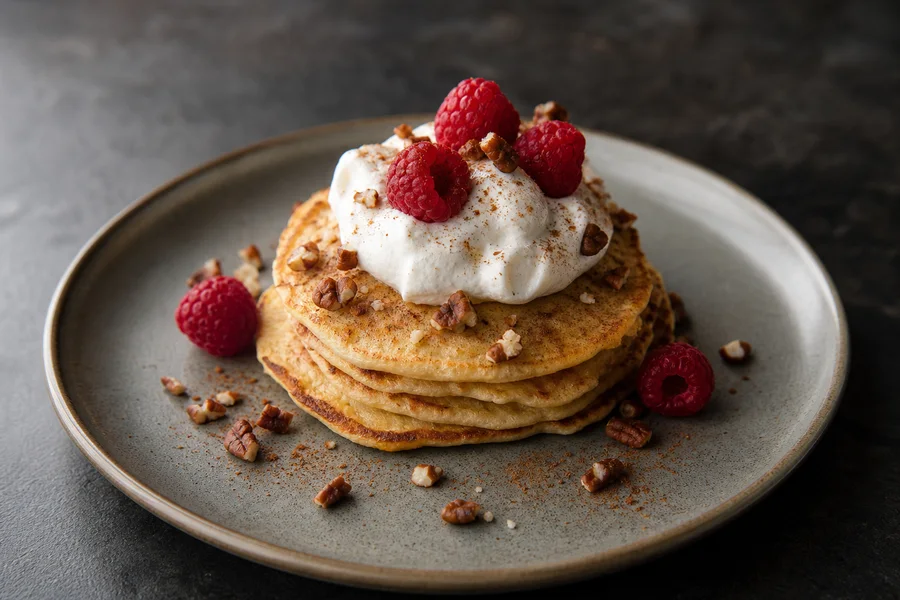
For a savory plate, omit vanilla and add chopped chives plus black pepper. For cinnamon-pecan pancakes, fold finely chopped nuts into the rested batter. For berry pancakes, press two or three small berries into each portion in the pan rather than flooding the bowl with fruit moisture.
Plate keto pancakes: a practical almond-flour breakfast so small, tender pancakes that hold together while remaining more delicate than wheat pancakes remains visible. The serving direction begins “For a savory plate, omit vanilla and add chopped chives plus black pepper”; keep that addition restrained enough to show whether the pancake itself reached the intended texture.
Prevent problems in the next batch
Write down the pan, burner setting, portion size, and the one adjustment that improved the current batch. For keto pancakes: a practical almond-flour breakfast, the most useful record is whether the result moved closer to small, tender pancakes that hold together while remaining more delicate than wheat pancakes. A note such as “lower heat” is incomplete without the pancake size and observed center.
After “Pancake breaks on the turn,” alter only the correction named in that diagnostic before repeating “Build a spoonable batter.” Changing portion, heat, and 110 g fine almond flour together would hide which action moved the result toward small, tender pancakes that hold together while remaining more delicate than wheat pancakes.
Use the first pancake to test the relationship between 110 g fine almond flour and water as needed, one tablespoon at a time. Its spread shows whether the build plan is coherent, its release tests the pan, and its center reveals whether “Build a spoonable batter” produced small, tender pancakes that hold together while remaining more delicate than wheat pancakes.
Food safety
For keto pancakes: a practical almond-flour breakfast, the raw mixture includes 110 g fine almond flour. Keep raw egg batter away from ready-to-eat toppings, clean contacted bowls and tools, and cook the thickest sample until no liquid egg or raw batter remains. The target small, tender pancakes that hold together while remaining more delicate than wheat pancakes describes texture, not a guarantee based on surface color.
A practical batch notebook
Before cooking, record the starting formula and the intended serving format. During cooking, note the first pancake’s diameter, visible edge behavior, underside color, and center texture. After cooking, record only the correction that genuinely improved small, tender pancakes that hold together while remaining more delicate than wheat pancakes. This creates evidence for the next batch without turning one kitchen result into a universal claim.
When changing 110 g fine almond flour or water as needed, one tablespoon at a time, restart with the same pan and portion used for “Build a spoonable batter.” Compare the new result with small, tender pancakes that hold together while remaining more delicate than wheat pancakes, then apply the smallest correction suggested by “Pancake breaks on the turn” instead of forcing the variation to behave like a different formula.
Frequently asked questions
Are these pancakes automatically keto for everyone?
No. Ketogenic plans differ, and labels and portions matter. Calculate the complete serving with the exact products you use.
Can I use only almond flour?
You can experiment, but this formula uses a small amount of coconut flour to manage moisture. Removing it changes absorption and may require a different liquid amount.
Why cook them smaller?
Almond-flour pancakes are usually more fragile than wheat pancakes. A smaller round is easier to set, support, and turn without tearing.
Can I make them dairy-free?
Use a labeled unsweetened plant yogurt and neutral oil, then reassess batter thickness. The substitution changes flavor and possibly carbohydrate content.
Related Pancake World pages
Sources and editorial references
- Harvard T.H. Chan School of Public Health, Diet Review: Ketogenic Diet —
https://nutritionsource.hsph.harvard.edu/healthy-weight/diet-reviews/ketogenic-diet/ - USDA Food Safety and Inspection Service, Shell Eggs from Farm to Table —
https://www.fsis.usda.gov/food-safety/safe-food-handling-and-preparation/eggs/shell-eggs-farm-table
For more practical food and breakfast guides, visit Pancakes World.
For the wider topic, start with Guides/healthy Pancakes.
For a closely related guide, see Egg and Banana Pancakes: A Two-Ingredient Method.
A useful next comparison is 17 Keto Pancake Ideas: Ingredients, Texture, and Toppings.
You can also continue with How to Make Keto-Style Pancakes in the Microwave.
